
Autonomous transport solution
Free ride in the Smart Factory
In the Smart Factory of pump manufacturer Wilo, driverless transport systems from IBG transport pumps or assemblies between manual and automated workstations. The AGVs can navigate freely and communicate with robots, while the management system organizes loading processes and vehicle scheduling.
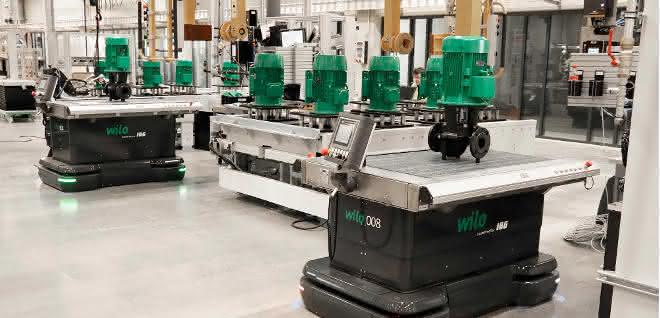
With the AGV, IBG has developed a driverless transport system that can be flexibly adapted to spatial conditions and requirements in terms of size or weight to be transported. The transport system moves autonomously and communicates with robots and automation systems. Track-guided solutions and free navigation, including obstacle avoidance, as well as hybrid variants of the navigation forms are available. The AGV consists of various basic modules. This modular design enables individual adaptation to all requirements. It is equipped with a lift table, a roller conveyor, as a tug or stacker.
New smart factory built
Wilo in Dortmund produces pumps and pump systems for heating, cooling and air-conditioning technology, water supply and wastewater disposal and treatment. The company's newly built Smart Factory relies on automated intralogistics. The AGV solution from IBG is used here.
The vehicle handles transportation between manual and automatic workstations. AGVs transport pumps or assemblies weighing between ten and 1,000 kilograms between the assembly stations within an assembly line. At the work stations, employees carry out assembly processes on the pump. For this purpose, the workpiece is positioned at an ergonomic height using an integrated lifting table to ensure better accessibility. At the end, the employee "releases" the AGV, which then independently follows its travel order to the next station.
The transport system moves autonomously, communicates and transports assemblies weighing up to 1,000 kilograms safely between the assembly stations.
There are also assembly stations where the pump is pushed off with the workpiece carrier via an integrated roller conveyor and automated transfer and picked up again later. This ensures that the pumps are transported safely during the production process - especially during transfers.
Freely navigating AGVs
The AGV fleet used is freely navigating. This means that no tracks are laid and no further markings are necessary. Navigation is based on the characteristics of the existing hall infrastructure. The fleet manager is used to differentiate between various areas on the generated map, such as preferred routes, prohibited areas, fixed and variable objects, workstations and charging stations. The selected navigation method enables the successive connection of adjacent departments and areas.
The vehicles communicate with each other via the fleet manager. In addition, charging processes, the return of unoccupied vehicles, queue control, collision avoidance, routing, automated handover/takeover at corresponding interfaces and vehicle scheduling for transfer from the test benches and e-assembly stations are managed via the higher-level management system. as


You might also be interested in
Atlas Copco takes over long-standing sales partner
Atlas Copco has taken over Heide-Pumpen. The specialist for mobile pumps has been working closely with Atlas Copco in sales and service for a long time, especially for surface pumps for construction site dewatering and wastewater detour or in the...
 read more...
Lutz Pumpen at the Achema 2024
New mobile drum pump with battery drive
The new B3 Battery from Lutz Pumpen promises mobile and safe working with aggressive liquids without having to compromise on pumping performance compared to wired versions. The battery-powered drum pump will be on display at Achema, the world's...
read more...Maintenance and Pumps&Valves in February
Final preparations are underway in Dortmund: On February 21, 2024, maintenance will start as the leading trade fair for industrial maintenance and with it Pumps&Valves as the trade fair for industrial pumps, fittings and valves.
read more...Liquid separator keeps pumps dry
Vacuum clamping minimizes distortion and enables five sides to be machined in one clamping operation. The use of cooling lubricants poses a challenge: If they get into the vacuum generator, they can cause serious damage.
read more...Spring clutches for construction machinery
Spring clutches from Torsion Control Products (TCP) are ideal for use in construction machinery where modern diesel engines are used.
read more...Protection against cooling lubricant
Liquid separator from Schmalz keeps pumps dry
Anyone clamping with a vacuum during CNC machining must protect the pump from cooling lubricant. The NLS liquid separator from Schmalz separates the cooling lubricant and returns it to the running process - without interrupting the vacuum.
read more...Which clutch for what?
Mechanical engineering and its applications are multifaceted. Every application is special and requires a perfect machine design. Individual components in the system must also be optimally designed.
read more...Energy efficiency needs electrical engineering and IT
The energy crisis makes one thing clear: it is not enough to simply screw a photovoltaic system onto your roof or purchase green electricity. Industry is faced with the challenge of reducing consumption in order to counter the rise in energy prices,...
read more...Solutions for a networked and climate-neutral industry
At the world's leading trade fair for industry, around 4,000 companies from the mechanical engineering, electrical and digital industries as well as the energy sector will be showcasing solutions for the production and energy supply of the future.
read more...