
Tox Pressotechnology
Sheet metal round point method for clinching
Even the largest mountains of laundry find room in the large-volume drums of Miele washing machines. To manufacture the drums, a machine manufacturer was commissioned to integrate a subsystem from Tox Pressotechnik into its rotary transfer system. The stainless steel components are now joined using the round-point sheet metal joining process - a secure hold for dirty laundry.

Whether it's analyzer-prepared labware, freshly washed towels and bed linen or gleaming dishes: With its Professional series for industrial customers, Miele offers high performance and durability in its machine designs. What is special about the Professional series is that the company's service begins even before the appliance is delivered to the customer. Thanks to a careful needs analysis and well-founded capacity calculations - combined with individual 2D and 3D room and process planning as well as detailed profitability calculations - the specialist develops specific problem solutions in dialog with the customer. The result is a needs-based system solution that guarantees reliable, smooth processes.
Even the largest mountains of laundry can therefore be accommodated in the large-capacity drums of Miele Professional washing machines. A capacity of 110 liters requires a secure drum design. Miele ordered a rotary transfer machine from a manufacturer of special machines and production equipment in order to reliably and safely join the two components, the drum base and drum shell, made of stainless steel sheets. The sheet metal processing and joining technology specialists from Tox Pressotechnik were brought on board for the task of joining the stainless steel sheets. After analyzing the requirements and the general conditions, they proposed the use of the company's patented round-point sheet metal joining process and designed a complete solution that could be integrated into the rotary transfer system as a ready-to-connect subsystem by the special machine manufacturer.
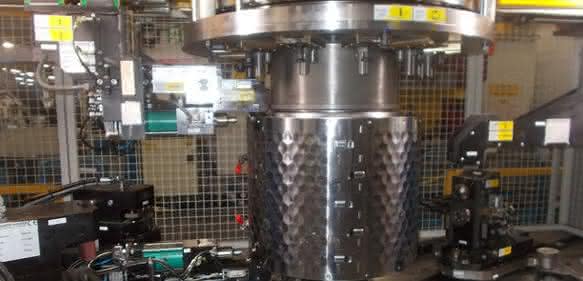
Connected with 97 round points
The subsystem comes in the form of a ready-to-use clinching device and is based on the modular Tox construction kit. The modular system consists of two CRH machine tongs with HZO hydraulic drive cylinder, the round-point tool set (punch and die) for clinching, an SP spraying device for oiling the clinching tool and the CEP process monitoring system for quality assurance. All components are made by Tox Pressotechnik. The machine tongs have a notch depth of 35 millimetres and an opening of 49 millimetres and are designed for press forces of up to 100 kilonewtons. The two components, drum base and drum shell, are joined by clocked setting of 97 Tox round points with a diameter of 8 millimeters. Clinching is carried out with a press force (including hold-down force) of 75 kilonewtons. The die depth is 1.2 millimetres and the control dimension X, the residual base thickness in the clinching point after joining is 0.85 millimetres. Each clinch point results in enormous head tensile/shear tensile strengths of 2,300 newtons and 2,700 newtons respectively, with process monitoring ensuring absolutely reproducible and documented joint quality.
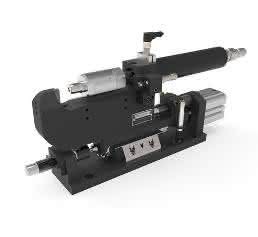
The Tox-Clinch system as a ready-to-connect and ready-to-operate subsystem resulted in economic and time benefits for both Miele and the special machine manufacturer. The end customer benefited from the process know-how for sheet metal connections and received a complete solution that was tailored to their needs and worked reliably. And the special machine manufacturer was able to concentrate on the design and construction of the rotary transfer system and only had to integrate the subsystem. Thanks to the consistent use of standardized mechanical engineering, drive, peripheral, control and process monitoring components from the Tox modular system, special machine construction could also be carried out cost-effectively. ee


You might also be interested in
Conrad continues to grow
Conrad Electronic now generates 80% of its sales with business customers and has successfully developed from a traditional technology retailer into a B2B procurement platform. The company aims to become Europe's leading procurement platform for...
 read more...
AI finds its way into automotive customer service
In addition to computer solutions for vehicle diagnostics, Getac now also offers AI-based digital tools that support customer contact in service operations.
read more...SMC: "Preferred Supplier" from Bosch
The technology and service company Bosch has recognized SMC for the performance of its automation technology in factory and process automation and awarded it the status of "Preferred Supplier" in the material group "Standardized Pneumatic Devices".
read more...Combined ERP forces
The medium-sized ERP providers Step Ahead Software, Godesys and Informing merge to form the Step Ahead Group.
read more...Cybersecurity for asset-intensive companies
Forge Cybersecurity Platform, the new software platform from Honeywell, has been developed for the cybersecurity of asset-intensive companies and critical infrastructures. The platform is available in three versions.
read more...Automated machine tool as a success factor
Industry 4.0 is the hot topic of the moment. For small and medium-sized companies and contract manufacturers, it holds great potential for increasing production efficiency step by step. The focus here is on efficient and user-specific automation...
read more...Nemo hand vacuum lifts all materials
A new addition to the Eurotech portfolio is the battery-operated Nemo vacuum cleaner, which is suitable for handling almost all surfaces.
read more...Future-oriented cobot projects
Three pillars of successful cobot initiatives
What is important if cobot projects are to be future-oriented? Automation and robotics expert Omron has identified three aspects for human-machine collaboration.
read more...Short-stroke linear actuator instead of pneumatic cylinders
The new short-stroke linear actuator from Ketterer Antriebe and halstrup-walcher is characterized by high dynamics and a large stroke in a compact size. Thanks to the integrated electronics, the drive is easy to control compared to pneumatic...
read more...