
Maintenance of cable carrier systems
Predictive maintenance reduces downtimes
If damage occurs in a system, this often leads to unforeseen downtimes and financial losses. Predictive maintenance can prevent breakdowns. This applies not only to machines, but also to energy supply chains.
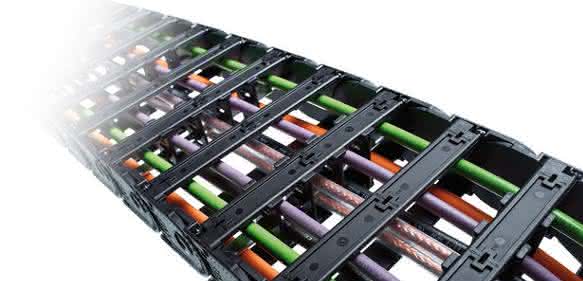
Parts weighing up to 9.5 tons float fully automatically on overhead cranes through the 22,000 m² hall of WOB-Wessling Oberflächenveredlung (WOB). The company operates Europe's largest specialist facility for contract coating and is primarily responsible for the cathodic dip coating (CDC) of commercial vehicles, large automotive parts and mechanical engineering components. The technology ensures high-quality corrosion protection, durability and visual refinement of the end product.
However, the coating process is lengthy and involves several stages: Pre-treatment and coating takes place in several huge dip tanks for maximum component dimensions of up to 16 m long, 2.60 m wide and 3.60 m high, before being transported on to the drying oven. This is followed, if necessary, by powder coating, which involves a further firing process. The above-mentioned overhead crane system, which is equipped with a total of six large energy guiding chains from Tsubaki Kabelschlepp, is responsible for transporting the large and heavy components from station to station.
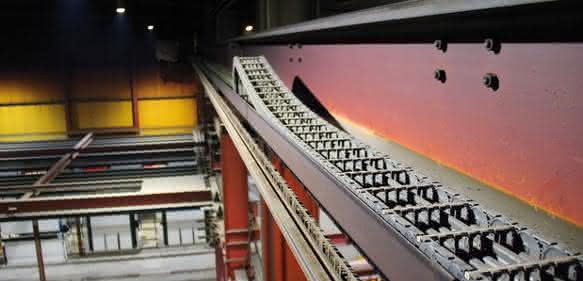
"The energy supply systems are a very important part of the system," explains Sebastian Hüer, Head of Maintenance and Repair at WOB. Just how essential becomes particularly clear in the event of damage: "If a chain is defective, in the worst-case scenario our production comes to a standstill for several days." For this reason, the contract coater has opted for Tsubaki Kabelschlepp's maintenance service, as part of which the manufacturer inspects and maintains the cable drag chains on an annual basis. The advantage for WOB: failure risks are reduced, damage is prevented and downtimes are avoided.
Regular inspections increase system safety
"Two cable carriers from our M series are used in the two buffer converters and a chain from the Master series in the area of the dip tanks. They are all just under 32 m long," says Patrick Kleusberg, service technician at Tsubaki Kabelschlepp. "Three more cable carriers from the Uniflex Advanced series with a length of 23 m are then installed in the moving bridge." The cable drag chains used at WOB were selected for the application in question; the M series, for example, is particularly suitable for use in indoor process cranes. Although the systems are robust and fail-safe according to the manufacturer, regular inspection is still advisable.
"The cable drag chains are of a high quality. But even the best product is not immune to signs of wear," emphasizes Hüer. "To be on the safe side, we have been using Tsubaki Kabelschlepp's MRO service for some time now." WOB currently carries out an annual inspection of the system. The technician checks all cable carrier systems - he runs the entire length of the chains and inspects cables and wearing parts. Any defects, risks or potential need for optimization are identified and recorded for the user. The technical condition of all cable carrier systems is also assessed. "This appointment is about determining the need for repairs and maintenance, whereby we can also carry out minor repairs directly thanks to the spare parts we have with us," explains Patrick Kleusberg. "This minimizes downtime and prevents major damage from occurring in the first place." If required, the work carried out can be documented in the form of maintenance logs, which the user can then use as part of the company's own quality management or for certification purposes.
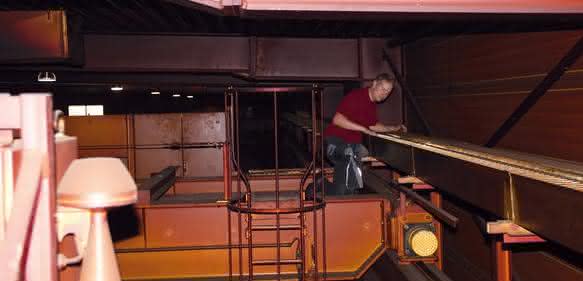
The inspection is adapted to the user's schedule and wishes: the technicians work at any time of the day or night and also at weekends and on public holidays - ideally adapted to the planned downtime of the system.
Detect damage early with predictive maintenance
Detecting damage before it occurs is the aim of Tsubaki Kabelschlepp's MRO service. Hüer can name a few examples where predictive maintenance has paid off for WOB: for example, an energy guiding chain grinded unnoticed on the permanently installed cables of a crane system, so that the cable insulation in the area was already severely damaged. This was detected during the inspection before any major damage could occur.
The Head of Maintenance and Repair is generally satisfied with the MRO service from Tsubaki Kabelschlepp: "We are very pleased that the manufacturer offers this from a single source. With the annual inspections, we can ensure that the system is always safe - that's not only a good feeling, but also a monetary benefit thanks to the avoidance of downtime."
The MRO service is also available in the event of acute damage, as it is inevitable that not all problems can be prevented in advance. Furthermore, the competent technicians provide fast and uncomplicated support even if no regular inspections are carried out on the system in question. However, it is of course helpful if the system, including its energy supply systems, is already known. This is why Tsubaki Kabelschlepp also carries out an inventory of systems if required: "Many plant manufacturers rely on Tsubaki Kabelschlepp's cable drag chains," explains Patrick Kleusberg. "However, the end customer may be overwhelmed by the maintenance of solutions that are unfamiliar to them. In this case, we determine and record the installed cable carrier systems and can therefore react all the more quickly in the event of a problem and put the customer's systems back into operation." The bottom line: better safe than sorry - this is especially true for energy supply systems. ag


You might also be interested in
Helu makes its first trade fair appearance under a new brand name
Helu Kabel will be presenting itself as Helu for the first time at Hannover Messe 2026, showcasing system solutions, Heluchain cables and new industrial luminaires.
 read more...
Strategic realignment with brand relaunch
In future, Helukabel will trade as Helu
The Helukabel Group is parting with part of its name: in future, the company will only operate under the Helu brand. With this step, the specialist for electrical connection technology is underlining its strategic development from a classic cable...
read more...Modular plant construction for corrugated board
Insight into the production of corrugators at BHS Corrugated: Automated, modular and equipped with Helukabel components.
read more...Best quality for the steel
Conditions in the steel industry are harsh and inhospitable. The machines used must be able to withstand the demanding environmental conditions in order to deliver the best quality at all times.
read more...If the standard cable is not sufficient
Lapp offers cables for countless applications - but not for all of them. From time to time, the developers have to modify a standard cable or develop a special cable.
read more...Slight decline in sales, strong investments
The Lapp Group has not been spared from the weakening global economy. However, the company only recorded a slight loss in the past 2024 financial year.
read more...Electrical connection technology
Cables and wires for industrial automation
Heukabel offers system solutions for cable routing from a single source. The subsidiary EKD Systems specializes in tailor-made cable drag chains made of steel, stainless steel and plastic, which are used in moving machines and systems as well as in...
read more...Lapp relies on Ultramid from BASF
Mobile charging of electric vehicles
The automotive industry is currently undergoing the biggest transformation in its history. The boom in battery electric vehicles in particular is presenting the industry with major challenges. Lapp, as a supplier of cables and connection...
read more...Cable handling application
At this year's Motek, ArtiMinds Robotics is showcasing a robot-based automation solution for the sensor-assisted assembly of flexible cables in connector housings.
read more...