

Interview
Castor combines quiet and efficient rolling
In order to combine the factors of energy efficiency and noise reduction in a track roller, a fundamental contradiction between the two must be overcome. Chiara Steiner, Head of Sales & Business Unit Development Intralogistics at Faigle, explains how the manufacturer has solved this problem.

Why did you decide to further develop the tried-and-tested Faigle castor?
The new roller has been specially developed for high-performance parcel and baggage sorting systems. In order to protect employees, noise levels must be kept under control. However, the energy balance of a system is the main deciding factor when awarding a contract.
Achieving both goals at the same time proved to be a challenge, as they are contradictory: reducing roller resistance leads to lower energy costs. Energy-efficient castors therefore have to be rather hard, which comes at the expense of noise damping, while quiet-running castors tend to be soft, which increases resistance.
We solved the problem by decoupling the "rolling" and "damping" functions. The damping now takes place directly on the non-rotating roller axle. It therefore has no influence on the rolling resistance. The new castor has a reduced resistance of up to 60 percent. At the same time, the new castor concept makes it possible to create an appropriate working atmosphere.

Are there other advantages for the user?
Systems often stand still over the weekend - loaded or unloaded. The standstill can lead to the rollers becoming flat. In extreme cases, the sorting system will no longer start the next working day. The PAS-PU TCS material we have developed for the roller drum minimizes the compression set. During longer stops under load, the new intralogistics rollers flatten significantly less. This means that less force is required to start up the system. Individual customization to the customer's corporate design is also possible as an option.
What specifically tipped the scales for the development of the new castor concept?
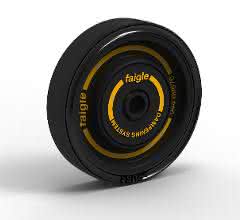
This was based on discussions with our customers and feedback from the sales department. The requirements were defined and specified in the form of a specification sheet. We then carried out rolling resistance measurements on our newly developed rolling resistance test bench with various materials, hardnesses and geometries. The aim of this phase was to better understand the influence of these factors on rolling resistance. Based on the knowledge gained, we developed a concept for an optimal roller design and optimized it in terms of strength using FEM analysis.
What other benefits can you draw from this for the future?
The data and results are also important for developments in other application areas, for example for products in the escalator, moving walkway, elevator and overhead conveyor categories.


You might also be interested in
When heat slows down production
Cooling concept for industrial halls with significantly reduced energy requirements
Infranorm is developing a cooling concept for industrial halls based on two-stage adiabatic cooling. According to the company, energy consumption can be reduced by up to 95 percent.
 read more...
Networked energy and automation solutions
Schneider Electric presents solutions for Industry 4.0 at Hannover Messe 2026: networked energy and automation technologies, AI-supported processes, modern control systems and strategies to combat skills shortages, safety risks and energy...
read more...Peak load management in forklift trucks
Intelligent energy management prevents expensive power peaks
Targeted and efficient energy management is becoming increasingly important for customers in the logistics sector: a large number of devices, different charging cycles and high electricity volumes mean that electricity is a critical cost factor for...
read more...AI is shaping logistics worldwide, supply chains are being restructured
The Agility Emerging Markets Logistics Index 2026 shows that artificial intelligence is being used almost everywhere in the logistics industry. At the same time, geopolitical uncertainties, tariffs and production relocations continue to drive the...
read more...New life for old machines
"When we talk about retrofitting, for us it's about giving a machine tool a second life that lasts just as long as the first," emphasizes Ralf Glatzeder, Head of the Reman department at Liebherr-Verzahntechnik in Kempten.
read more...Sustainability along the robot life cycle
Automation through the use of robots offers numerous advantages. One is often overlooked: Robots can make a valuable contribution to sustainability, for example by helping to reduce emissions. However, this requires the entire robot life cycle to be...
read more...Encoders increase the efficiency of servo...
Same performance with less energy
Electric motors in industrial applications are responsible for more than 40 percent of global electricity consumption. With encoders from Hengstler, the efficiency of drives can be significantly increased, resulting in a significant reduction in...
read more...Sustainable industry starts with efficiency
Electrification and digitalization are key levers for improving efficiency in industry. Optimizing efficiency requires an intelligent and flexible approach that makes full use of the available technical possibilities.
read more...Energy-efficient use of extraction and filter systems
How manufacturing companies can sustainably reduce their energy costs through clever and forward-looking system design.
read more...