

Platform library for co-simulation
Putting factories into virtual operation
For mechanical and plant engineering, a simulation platform is a powerful tool for using digital twins to cost-effectively configure entire plants, including the control system, and to test and commission them virtually.
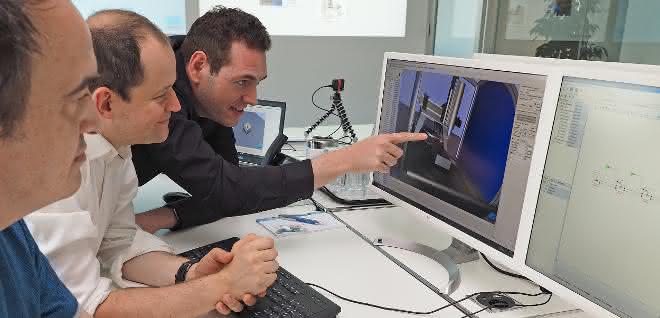
In recent years, the increasing complexity of machines and systems has increasingly led to the control software only being finally programmed on the actual system. With the development of digital twins and virtual commissioning, it has been possible to shift this process back to the engineering phase. The virtual components, assemblies and control units of a mechatronic system are a one-to-one replica of their real-life counterparts, from the parameters to the interfaces to the behavior. High-resolution simulation models in a model or software-in-the-loop simulation for individual processes are particularly advantageous at the start of engineering in order to run through various designs or control processes in a cost-effective and uncomplicated manner. The hardware-in-the-loop simulation (HILS) is then used to test the real control hardware. In HILS, the digital twin is connected to the control system via the industrial real-time fieldbus. The behavior of the fieldbus components is simulated in such a way that there is no difference to the behavior of real fieldbus components. Practical experience confirms that these digital test simulations significantly accelerate development processes and commissioning, contribute to quality improvement and reduce costs. However, if the aim is either to commission the entire factory virtually or to take a closer look at the production process in a machine analysis, it is not enough to use idealized simulation models; the model complexity must be massively increased.
The aim is to map all interactions and interdependencies between the mechatronic processes, the control system and the operating behavior while significantly increasing the model depth. This involves combining highly developed simulation models from mechanical, electrical and software engineering into an overall model. This is referred to as a coupled or multi-domain simulation. The challenge lies not only in the fact that this has to take place in real time, but also that a greater model depth of the digital twins is required to map physical effects than before. It is therefore necessary to increase the computing power that can be used for HILS. The solution is a platform for real-time co-simulation whose characteristic features are partitioning, parallelization, synchronization, data exchange and integration interfaces.
Multicore simulation in real time
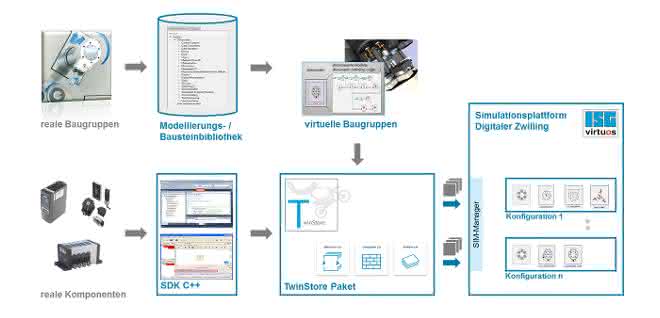
The real-time calculation of complex simulation models is made possible by parallelization. The module-based system model is broken down into various sub-models - automated by the system or manually by the user. Parallel computing cores make it possible to significantly accelerate the overall model calculation. Even the most complex systems can be mapped. This includes the description of the respective process, the simulation of the machine behavior, for example with regard to logic, kinematics and dynamics, as well as the behavior simulation of industrial control components including their sensors and actuators. The modeling environment shows how the overall model is distributed across the individual computing cores and allows adjustments and reconfigurations to be made. The platform is therefore the basis for functional solutions that allow different models to be combined with each other, regardless of whether they are SILS or HILS models.
Open library concept for the integration of models
A simulation platform offers the greatest added value for the user if it has standardized integration interfaces for incorporating third-party simulation models. Specific libraries can be seamlessly integrated into simulation solutions via these integration interfaces. This gives machine builders the opportunity to simulate the hardware and software components of a system end-to-end without system discontinuity, right through to the virtual commissioning of entire factories. The modular library is growing continuously and provides ready-made partial models for direct integration into a wide range of application scenarios. This not only reduces the necessary modeling times, but also increases the informative value of virtual commissioning, as ready-made models from simulation and component experts ideally depict reality. The open library concept also offers plant and machine manufacturers new opportunities if they provide the plant operator with the simulation model of their production plant. Four business opportunities are outlined below.
1. training of the operating personnel
It is already common practice for machine manufacturers to provide plant operators with the digital twin so that they can use it to train their staff. The advantages are obvious: critical situations can be simulated on the computer that cannot be caused in reality, even for training purposes, for safety reasons or because production has to continue. With training in the virtual world, however, operators can prepare themselves well for an emergency so that they can react correctly and restart the system as quickly as possible. The training also increases the productivity of the system - after all, the system operator can get started immediately after the real commissioning of the machine without first having to complete an "operator crash course" and block the system in the process.
2. predictive maintenance service
Systems require regular maintenance. This is usually carried out by the machine manufacturer or a specialized service provider. With a digital twin of the system and the additional use of a predictive maintenance tool, maintenance companies can offer customers predictive maintenance as an additional service. This involves recognizing when a problem is just beginning to develop. The virtual system serves as a "golden reference" - if the parameters of the real system deviate from this, intervention may be necessary. The underlying predictive analytics model takes into account the current operating data as well as process engineering correlations and relevant influencing factors of the plant periphery. By comparing this with historical data, e.g. using an integrated AI solution, it is possible to determine how the data is most likely to develop, allowing countermeasures to be taken before damage occurs. Another business model based on predictive maintenance is that the service provider is not remunerated for the maintenance measures, but for guaranteed system availability. It is then up to the service provider to keep the machine in good working order.
3. compass for the best technical solution
Today, there are hardly any off-the-shelf machines. The rule is rather customized individual production. This is where the difficulty often lies for the customer - what is the optimum solution for them? The plant manufacturer can carry out a pre-project with the customer before the quotation phase, in which they run through various configurations on the simulation platform. The more digital components are already available in the libraries, the less effort is required. It is also to be expected that the buyer will then also commission this machine manufacturer to implement the system.
4. digital retrofitting
Instead of building from scratch, in many cases it is worth modernizing existing systems by replacing obsolete components or retrofitting them for a new product. Similar to the engineering of a new development, the effort involved can be significantly reduced if the operator first carries out the retrofitting virtually on the simulation platform. The prerequisite for this is that the plant manufacturer provides him with the digital twins and simulation models for a fee.
Location-independent access, redundancy and knowledge transfer
An open and multicore-capable simulation platform enables co-simulations in real time. On the one hand, designers can carry out extensive test runs with different virtual control systems in order to find the optimum control system for the respective system with relatively little effort and in a short time. On the other hand, an entire system can now be simulated end-to-end and thus put into virtual operation. The platform should contain expandable simulation libraries that also allow highly specialized, technology-specific third-party simulation solutions to be integrated via appropriate interfaces. It has also been shown that a shared online platform that grows with the company is very crisis-proof. The keywords here are location-independent access, redundancy and knowledge transfer. Plant manufacturers are also offered new sources of revenue - through the provision of digital twins, simulation models and services such as predictive maintenance.
Dr. Christian Daniel, Business Manager Simulation Technology and Dr. Christian Scheifele, Head of R&D Simulation Technology, both ISG Industrial Control Technology


You might also be interested in
Predictive maintenance in retrofit
Predictive maintenance pays off. This is because early detection of impending failures means that systems can be serviced in a targeted manner before production downtime occurs. But how complex is it to integrate such a maintenance concept into an...
 read more...
Maintenance instead of replacement
The circular economy starts with the machinery
Sustainability in industry starts with machines, says our guest author from Deguma: How maintenance, modernization and the 5R strategy save resources, energy and CO₂.
read more...3D printing for unplanned requirements
The material fails and the machine suddenly stops? Then you need to take the right measures to be able to resume production quickly. Material failure in the form of faulty components or material wear in the frame are a risk for any production.
read more...High demands in terms of safety, application and robustness
Demanding work in the electrical trade and energy supply as well as smooth processes in production require innovative and customized measurement technology that scores points for safety, ease of use and resilience.
read more...Car meets e-bike: riding with lubrication-free polymer bearings
Studies show that the proportion of pedestrian and bicycle traffic is increasing in urban areas. With the JetBike, JetBike GmbH from Braunschweig presents a mixture of e-bike and car and relies on lubrication-free polymer bearings from Igus.
read more...Hydraulic hub for more efficient servicing
Bosch Rexroth presents a digital toolbox for service and maintenance. With a comprehensive range of digital services, the Hydraulic Hub simplifies and accelerates the service and maintenance of hydraulic products and increases machine availability.
read more...Arnold Umformtechnik expands after-sales...
Faster help with VR glasses
Arnold Umformtechnik is expanding the after-sales service for its machines to include digital remote services. The focus is on data security, simple operation and clear processes.
read more...147,000 euros per hour: high costs for German companies due to unplanned downtime
According to the "Value of Reliability" study, 67% of industrial companies in Germany experience unplanned downtime at least once a month. This costs the German economy 147,000 euros per hour. Nevertheless, reactive maintenance concepts are not...
read more...Maintenance starts with a maintenance planner
Legal requirements stipulate that machines and systems must be serviced regularly. The maintenance work serves to ensure occupational safety and economic efficiency.
read more...