
Virtual commissioning
The helpful twin
A digital twin is versatile. It can do more than simply map a complete plant. It can also reduce stress levels for plant engineers. Thanks to integrated virtual commissioning, it ensures improved working conditions.
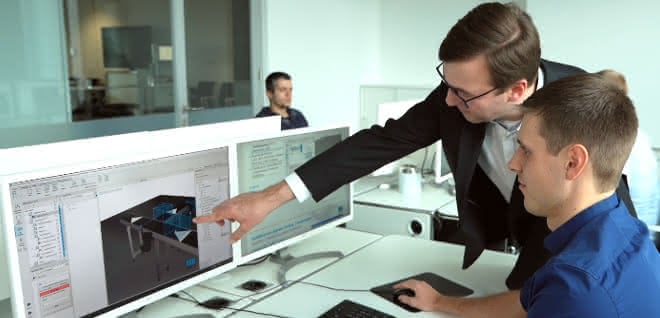
Virtual commissioning (VIBN) is the classic use case for the digital twin in mechanical and plant engineering. However, it not only enables significant increases in efficiency and shorter project times to be achieved. Shifting tasks from the execution phase to the engineering phase significantly eases the work situation during the construction and start-up of a plant. The technicians have much more time to test and optimize the plant without jeopardizing the handover date. In addition, the engineering data is still available for research and development or for similar orders even when the system is already running at the customer's site. Not to forget: Thanks to VIBN, the entire value chain can be digitally mapped and optimized both technologically and organizationally - for example with regard to supply chains.
Taking the pressure out of the boiler
Things are usually very hectic at the end of a plant construction project. Commissioning engineers are under immense pressure, which can lead to acute or long-term health problems. Stressed employees also make more mistakes. However, if they can bring forward some of their work tasks by virtually commissioning and testing the production system to be delivered, this eases the situation considerably later on the construction site.
This also gives those responsible the opportunity to test the (virtual) system much more extensively and intensively - with a correspondingly positive impact on quality. In addition, employees do not have to be on site in the early project phase, but can work in the office or from home. Noise pollution is much lower there than on the construction site. They can concentrate on their tasks without being disturbed.
Teamwork made easy
Thanks to the earlier exchange of information between the various disciplines - mechanical, electrical and software - coordination is more structured and inaccuracies of fit or misunderstandings can be identified and rectified more quickly. However, a simulation model is also a very effective means of communication for collaboration with the customer: plant engineers and the subsequent operator can iteratively test their ideas and suggestions on the model and inspire each other. An exchange of knowledge takes place en passant, which is beneficial for everyone involved.
Thanks to the VIBN, the safety assessment takes place at a very early stage and countermeasures can be taken if necessary. As a rule of thumb, the cost of errors increases tenfold in each subsequent project phase. Conversely, these costs can be significantly reduced the earlier a defect is rectified. This makes in-house production more efficient in terms of costs and throughput time, while the customer benefits from increased process quality.
A VIBN also offers enormous advantages beyond the actual construction of a system - from conception to go-live.
For sales: The sales engineer does not have to use material from an existing system, which very likely does not correspond to what the current customer wants. Instead, he shows him a moving, already customized 3D model and can even run through various designs with him.
In service and in research & development: VIBN is also used to test alternative scenarios for existing systems in terms of their feasibility, cost effects and process optimization. The time-to-market for new developments is significantly reduced.
In training and further education: New employees can be trained in a very practical way - on digital systems whose counterparts exist in real life. The digital twin can also be used to train operating personnel and in education.
The component library that grows with you
Many standard components are used in mechanical and plant engineering. As a rule, 80 to 90 percent of even special systems can be built from available modules. Once the digital twin is available, it can be used again and again. Future users also have the security of knowing that these are tried and tested units. The savings potential in terms of both time and money is even greater if several plant manufacturers and component suppliers share their virtual components.
The easiest way to do this is via the platform-based, modular TwinStore online component library, which can be continuously expanded. It grows with each new digital twin and provides ready-made partial models for direct integration into a wide range of application scenarios. This reduces modeling times. The informative value of virtual commissioning is also increased, as the models of existing components and systems ideally reflect reality. As an online platform, access is possible from any location and at any time. At the same time, plant manufacturers are offered new sources of revenue - through the provision of digital twins or simulation models and services such as predictive maintenance.
Simulation technology as part of value creation
The VIBN incurs one-off financial expenses for the hardware and software equipment. In addition, there are project-related expenses for in-house personnel or service providers who create the simulation models and configure the individual tests of the virtual IBN. However, the expenses for carrying out the VIBN itself are not additional costs, as they compensate for later expenses during real commissioning. Ideally, the VIBN-specific costs have already been amortized after the first system is started up. However, maximum efficiency gains are achieved by reusing the digital components and the simulation models, which also have a modular structure. However, the virtual control system should not be part of the simulation, but connected via an interface. The consistency of the simulation methods used is crucial - from model-in-the-loop to software-in-the-loop and hardware-in-the-loop. It is often the case, for example, that the designers are not yet able to assess which drive technology is best suited at the start of the project. This is why they initially work with various simulation models, which they later replace with the digital twin.
A VIBN integrated into the digital value chain pays off for everyone involved: In addition to time savings and immense cost savings, the benefits include improved quality of the production systems, their rapid adaptability and new possibilities for plant and process optimization. Other benefits include practical training and reduced time-to-market.


You might also be interested in
Predictive maintenance in retrofit
Predictive maintenance pays off. This is because early detection of impending failures means that systems can be serviced in a targeted manner before production downtime occurs. But how complex is it to integrate such a maintenance concept into an...
 read more...
Maintenance instead of replacement
The circular economy starts with the machinery
Sustainability in industry starts with machines, says our guest author from Deguma: How maintenance, modernization and the 5R strategy save resources, energy and CO₂.
read more...3D printing for unplanned requirements
The material fails and the machine suddenly stops? Then you need to take the right measures to be able to resume production quickly. Material failure in the form of faulty components or material wear in the frame are a risk for any production.
read more...High demands in terms of safety, application and robustness
Demanding work in the electrical trade and energy supply as well as smooth processes in production require innovative and customized measurement technology that scores points for safety, ease of use and resilience.
read more...Car meets e-bike: riding with lubrication-free polymer bearings
Studies show that the proportion of pedestrian and bicycle traffic is increasing in urban areas. With the JetBike, JetBike GmbH from Braunschweig presents a mixture of e-bike and car and relies on lubrication-free polymer bearings from Igus.
read more...Hydraulic hub for more efficient servicing
Bosch Rexroth presents a digital toolbox for service and maintenance. With a comprehensive range of digital services, the Hydraulic Hub simplifies and accelerates the service and maintenance of hydraulic products and increases machine availability.
read more...Arnold Umformtechnik expands after-sales...
Faster help with VR glasses
Arnold Umformtechnik is expanding the after-sales service for its machines to include digital remote services. The focus is on data security, simple operation and clear processes.
read more...147,000 euros per hour: high costs for German companies due to unplanned downtime
According to the "Value of Reliability" study, 67% of industrial companies in Germany experience unplanned downtime at least once a month. This costs the German economy 147,000 euros per hour. Nevertheless, reactive maintenance concepts are not...
read more...Maintenance starts with a maintenance planner
Legal requirements stipulate that machines and systems must be serviced regularly. The maintenance work serves to ensure occupational safety and economic efficiency.
read more...