
Subscription models
Industrial machines by subscription
Subscription models are catching on. Major digital players such as Microsoft, streaming services such as Netflix and video conferencing providers such as Zoom have been working with them for a long time. And many manufacturing companies, above all the automotive industry, are expanding their portfolios with digital services and developing new business models - often with flexible, customer-centric subscription models.
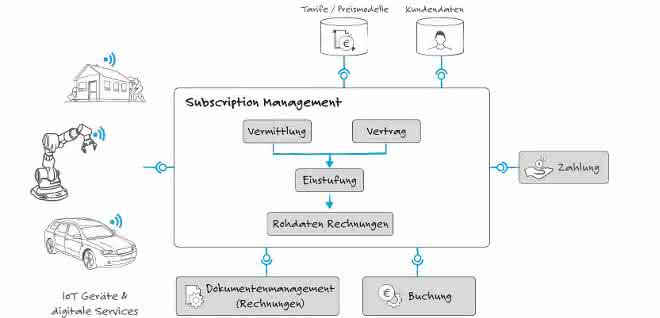
However, as Matthias Sekinger, IoT Consultant and Associated Partner at software company DoubleSlash, observes, the monetization and software-side mapping of a subscription-enabled business model is often introduced far too late in the project.
The video conferencing service "Zoom" is just one example of many: In December 2019, around ten million people were using the service, a figure that climbed to more than 300 million in April. Zoom owes its rapid growth to the outbreak of Covid-19 and the resulting increase in demand for video conferencing services. The crucial point: Zoom had the right software product and flexible pricing model at the right time. The user starts with a free basic model. If they want to use individual settings and functions such as encryption types, storage capacity, branding or support, they can purchase these via paid add-ons.
The key to success is the individual subscription model, which makes it very easy for users to book and bill for services. But above all: Zoom was prepared for the extremely rapid scaling. The company was able to cushion the change and offer the rapidly growing number of users new services, a very satisfying user experience and individual variants that were easy to customize.
New value creation models
Such digital subscription models are not only attractive for customers: this applies to both the B2C and B2B segments. They also offer providers the opportunity to retain their customers and introduce new value creation models to the market. This is all the more so as the flexibility of subscriptions accommodates the increasingly fast-moving market.
Manufacturers of industrial machinery are also developing more and more "pay-per-use" business models based on subscription - and their customers are happy to take advantage of the benefits. They no longer have to buy expensive equipment, but can rent it instead. Only the usage is billed. At the same time, the manufacturer assumes responsibility for the smooth functioning of its technology and monetizes its IT-based service and maintenance services via full-service contracts.
The advantage of this is that the user always works with the latest generation of machines. They only pay when the machine is running and do not have to make high investments that tie up their capital in the long term. Instead, his costs correlate directly with the order situation or capacity utilization of his machinery.
Subscription reflects new framework conditions
The rapidly changing market conditions can be managed in a value-creating way using subscription models. This is because the market is characterized by high volatility, uncertainty, complexity and ambiguity. The abbreviation VUCA (Volatility, Uncertainty, Complexity, Ambiguity) stands for this phenomenon of the digitalization age. It follows from this: Customers give preference to the provider that adapts its products and services most precisely to their respective, possibly rapidly changing needs. Those who do this convincingly will be among the winners of this development.
It is no coincidence that the term "subscription economy" has long been making the rounds among experts. A key feature of the "subscription economy" is the focus not on the product, but on the customer. Whereas in the past it was technical feasibility and other manufacturer-oriented parameters that determined development, today it is the wishes and needs of the customer. Suddenly, the focus is on the customer and the use of services. In addition, more and more customers are placing less emphasis on owning things and more on results and individualized offers. This means that the change in customer behavior is becoming massively important for every product developer.
It's a classic win-win situation: the user can get started easily, quickly and without a large investment. They use what they want, when they want and for how long they want. And that's exactly what they pay for.
But the providers also benefit:
- They bring new machines and newly developed digital services to the market more easily.
- They get to know their customers and their needs much faster than through a one-off transaction. A digitalized and networked product offers a direct line to the customer. But if you know their usage behavior and evaluate it in real time, you can respond better to their needs and make your product more attractive. Usability, for example, can be improved precisely on the basis of analysis data, and additional digital services and functions can be offered. Newly acquired machine data and insights make it easier to implement and optimize predictive maintenance scenarios. All of this reduces costs and boosts innovative strength.
- You bill monthly and thus create a constant, easily calculable source of income. With a purchased product, the customer relationship usually ends when the customer pays at the checkout. If the customer no longer purchases the product, there is no income. Subscription providers, on the other hand, can generate recurring revenue through long-term customer relationships and additional services offered for more individuality. Not to forget: The subscription principle strengthens customer loyalty.
- Scalability: It is very easy to use a digital service via an app, for example. The number of users can double virtually overnight - see Zoom at the start of 2020. The 100% automation approach of subscription models makes it easy to cope with even extreme growth.
- Better use of resources: A provider of storage space in the cloud, for example, does not have to double the storage space when its customer base doubles because not all users access the full storage capacity at the same time. As a result, the services scale better. In principle, this also applies to all other subscription-based business models, albeit to varying degrees.
- Flexibility as a business model: Subscription models are flexible because they are digital. If customers' needs and requirements change, prices or offers can be changed within a very short space of time and introduced as a new subscription offer. Customers notice that their needs are being taken into account. Among other things, this creates the basis for a long-term customer relationship.
The customer as a driver of innovation

The transformation from a traditional product provider to a service provider with a subscription business model has an impact on all areas of the company. The mindset changes almost automatically because the customer provides the key information. Development impulses from market research, brainstorming meetings and technological feasibility are now being replaced by the customer as the driver of innovation. On the other hand, new processes are being created and existing processes are being adapted. The focus here is primarily on automation in order to be able to provide services in real time and keep process costs low. This applies in particular to the IT landscape.
The decisive factor here is that the systems involved must work together. Billing components such as invoices and bookings, the product catalog, service activation and customer account management must be integrated into a functional subscription management system. In most cases, traditional ERP and CRM systems are unable to automatically process the high number of transactions required. And the appropriate interfaces and processes are usually missing. On the other hand, it is generally not cheaper to develop a subscription management system from scratch. In this case, it makes sense to implement the various components with established, largely standardized products.
In demand: a good system integrator
These products need to be integrated into the existing IT landscape in such a way that they mesh well and the system as a whole functions smoothly. This requires foresight and experience. Skills that a good system integrator brings to the table, even if not all the details of the business case have been planned down to the last detail. A professional system integrator is particularly useful when integrating a system for the management and billing of subscriptions. He not only holds all the relevant threads in his hand, but also deliberately gives the client company the opportunity to further develop the core of its product and services.
A study by management consultants Oliver Wyman for the automotive sector shows that subscription models are targeting a growing market: according to the study, 38% of consumers in Germany are interested in a car subscription and around 12% have already had experience with one. Just one year earlier, only one in four respondents were interested in a subscription model.
There is no doubt that digitalization can make a meaningful contribution to shaping our future and overcoming crises. Subscription models play a key role in this. Companies that work with such models are more adaptable than others and prove to be comparatively crisis-proof. And the market for them is growing.
Matthias Neher, Associated Partner and IoT Consultant at doubleSlash / mho


You might also be interested in
ESTIA aims to strengthen Europe's cloud
New tech alliance for EU sovereignty
Twelve companies, including Dassault Systèmes, are founding the European Sovereign Tech Industry Alliance (ESTIA). The initiative aims to strengthen Europe's technological independence and define requirements for sovereign cloud services. The start...
 read more...
Deutsche Telekom and Nvidia launch one of Europe's largest AI factories
With the Industrial AI Cloud in Munich, Deutsche Telekom and NVIDIA are creating one of the largest AI factories in Europe. Companies can train AI models, carry out simulations and access 10,000 GPUs.
read more...Leveraging data potential with AI and streaming
Huge data treasures are still lying dormant in many manufacturing companies. And yet it is high time that these treasures were unlocked. There is often a lack of resources and capacity to make data usable in real time. Streaming production data can...
read more...More awareness of noise
Dematic offers solutions that are tailored to different cloud environments and reduce environmental impact through reduced material consumption and improved energy efficiency.
read more...Generative AI in the automation environment
The mechanical engineering and automation industry is undergoing profound change. This transformation is being driven by more volatile global trade, geopolitical crises and increasing market pressure, which demands greater agility, technological...
read more...Rigid data structures have had their day
The traditional data center is no longer the center of data. A hybrid cloud storage approach enables manufacturing companies to both meet the current requirements of data-intensive processes and future-proof their infrastructure.
read more...Software as a service in three stages
CIM Database Cloud is a new out-of-the-box solution from Contact for end-to-end digital product development.
read more...How production can benefit from AI
Together with AI technology, IIoT networking makes it possible to better control machine parameters and optimize quality with predictive quality. Downtimes and set-up times can also be further minimized. Cloud platforms also make these technologies...
read more...More expertise for digital engineering
Altair, a computational science and artificial intelligence (AI) company, has acquired OmniV, a technology from Michigan, USA-based software company XLDyn.
read more...