
Process Information Management System
Cool calculated and hot fired
RHI Magnesita uses a process information management system to optimize its production processes. The PI system from OSIsoft was chosen. After its initial use in a single plant, the system was gradually expanded into a global Industry 4.0 infrastructure with predictive maintenance and manufacturing analytics.
Anyone who drinks their coffee in the morning, reads the first news on their smartphone and then drives to work is hardly aware that the raw materials for these now indispensable foundations of our modern life are produced at temperatures higher than in a volcano: Steel, copper, aluminum, glass and plastic, without which our world would not be what it is today.
Highly specialized equipment that can withstand temperatures of up to 2,000 °C is required before the raw materials can be turned into usable materials. RHI Magnesita, headquartered in Vienna and with 35 main production sites worldwide, specializes in refractory products. 14,000 employees ensure that around 120,000 different products are manufactured and delivered to over 10,000 customers worldwide. "The manufacture of our products is a highly complex process in which, among other things, precisely consistent firing temperatures and constant pressing pressure are essential for quality," says Thomas Reiterer, Head of Department and Project Manager R&D Process Technology.
From a stand-alone solution to central digitalization
The company records thousands of signals in real time in around 400 production machines of various types worldwide. Common questions can be: Has the gas consumption in the furnace per tonne of refractory material decreased since the optimization? Are the control parameters for the burners in the furnace correct? How many press cycles have been run through?
"Before central digitization, there were isolated solutions for machines or production lines in the factories, whose data was stored locally, queried manually and processed. It was impossible back then to get an overview of exactly what was happening where and how to improve efficiency or quality at individual points," Reiterer recalls.
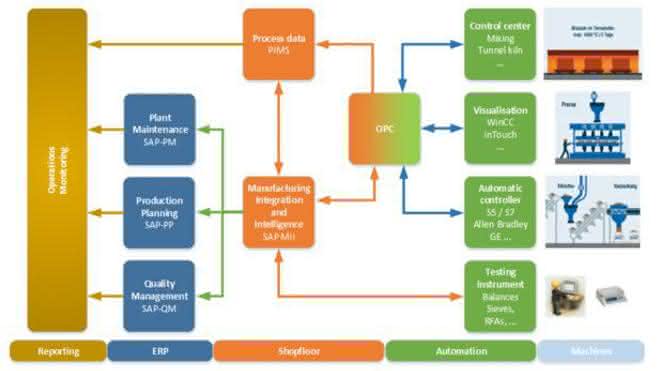
In 2006, RHI decided to use a Process Information Management System, or PIMS in technical jargon, to evaluate and utilize its process data. The specific reason for this was the construction of a new plant in the Chinese city of Dalian, the commissioning of which was to be optimized from Austria in order to avoid having to send several teams of experts there for long periods of time. Following the successful initial deployment at the plant in Hochfilzen, the solution was to be implemented in Dalian and later rolled out globally.
Production parameters tracked and understood
The most important task of the PIMS was defined as tracking, analyzing and understanding production parameters such as electricity and gas consumption or pressing pressures in the very heterogeneous machine landscape live and historically. The system was to support production as well as commercial decision-makers. It also needed to archive process data fully automatically and provide both real-time and historical data. Ease of use and the option of graphical processing, calculations and evaluations were further criteria. Access via RHI Magnesita's global WAN (Wide Area Network) based on MPLS with a prioritized network connection was important for data exchange.
With its PI system, OSIsoft fulfilled the tender criteria perfectly. It is able to connect the control data via the OPC standard used in automation technology with the SAP modules, production data acquisition and evaluation databases as well as office systems. The system structures the data in such a way that engineers and managers on site can use the insights gained to increase productivity or use them in applications such as predictive maintenance to accelerate deep learning and the analysis of machines.
The central elements are the PI server in Vienna and the respective PI interface, which is installed at each production site and transmits the process data to the PI server in Vienna via TCP/IP.
Ready for operation in a week
After the solution had proven its performance in initial tests in Vienna and Hochfilzen, the development partner and RHI's information management team also installed it in Dalian within just one week. Simple, redundant miniservers are used as PI interfaces. The hot standby technology guarantees that if one system fails, the system immediately switches over to the parallel computer. The company relies on a virtual server landscape that has been adapted to its growing requirements over the years - the server has grown along with the global rollout.
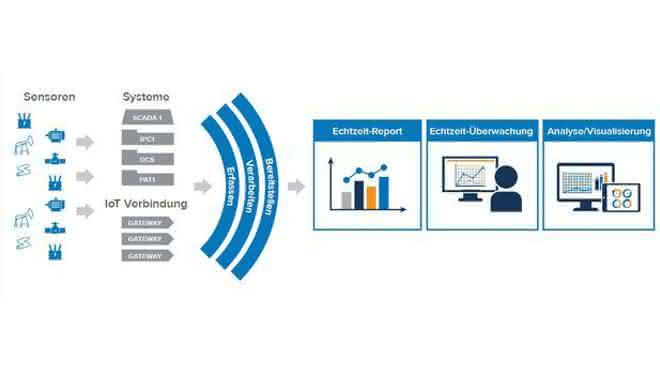
In order to be able to read out all control data correctly, all machine controls had to be connected to the PI interface with their IP addresses and the so-called tags for all conceivable signal data had to be configured on the PI server.
Around 430 machines in 26 production plants are currently integrated into the PIMS, sending around 70,000 data signals. "Our experts can view the evaluations from anywhere. They can see firing and mixing temperatures, the mixer speed, the pressing pressure or the pressing time in real time and over time. In addition to improving energy efficiency, this saves travel time and immense costs," says Daniel Neubauer, Team Manager Business Applications R&D/Quality Management and PIMS application manager in the Information Management team. "A special feature of the OSIsoft solution is the intelligent storage technology, thanks to which not even a terabyte of data volume has been created even after more than ten years of use," adds Neubauer.
The stored history forms the basis for analyses of how the individual production parameters influence product quality and how they can be optimized. "Another issue is preventive maintenance. Previously, we serviced the machines at fixed intervals. Based on the counter readings available in PIMS, we can use performance-oriented maintenance by transferring the data to SAP on a daily basis and now carrying out maintenance every 100,000 press strokes, for example. This means that the machines are never serviced too early or - even worse - too late," says Neubauer. RHI Magnesita goes one step further with predictive maintenance, which uses process data to anticipate and report faults before a machine breaks down. By replacing a simple spare part in good time, operations can continue without interruption.
The recorded and evaluated information has also become an indispensable part of the continuous global optimization process in quality assurance and in the R&D area. For example, the system uses the raw data to calculate peak and hourly averages for gas and electricity consumption or deviations from specifications and makes them available to users on visualization monitors in production, from machine operators to group and plant managers. In an emergency, the process data also triggers alarm e-mails.
"Based on this data, we can not only quickly identify problems such as deviations in the process, but also subsequently eliminate them through simulations and tests. New developments are now also easier to implement across all areas of the company, because the data quality and availability gained enables knowledge to be exchanged virtually at the touch of a button," says Reiterer.


You might also be interested in
Predictive maintenance in retrofit
Predictive maintenance pays off. This is because early detection of impending failures means that systems can be serviced in a targeted manner before production downtime occurs. But how complex is it to integrate such a maintenance concept into an...
 read more...
Maintenance instead of replacement
The circular economy starts with the machinery
Sustainability in industry starts with machines, says our guest author from Deguma: How maintenance, modernization and the 5R strategy save resources, energy and CO₂.
read more...3D printing for unplanned requirements
The material fails and the machine suddenly stops? Then you need to take the right measures to be able to resume production quickly. Material failure in the form of faulty components or material wear in the frame are a risk for any production.
read more...High demands in terms of safety, application and robustness
Demanding work in the electrical trade and energy supply as well as smooth processes in production require innovative and customized measurement technology that scores points for safety, ease of use and resilience.
read more...Car meets e-bike: riding with lubrication-free polymer bearings
Studies show that the proportion of pedestrian and bicycle traffic is increasing in urban areas. With the JetBike, JetBike GmbH from Braunschweig presents a mixture of e-bike and car and relies on lubrication-free polymer bearings from Igus.
read more...Hydraulic hub for more efficient servicing
Bosch Rexroth presents a digital toolbox for service and maintenance. With a comprehensive range of digital services, the Hydraulic Hub simplifies and accelerates the service and maintenance of hydraulic products and increases machine availability.
read more...Arnold Umformtechnik expands after-sales...
Faster help with VR glasses
Arnold Umformtechnik is expanding the after-sales service for its machines to include digital remote services. The focus is on data security, simple operation and clear processes.
read more...147,000 euros per hour: high costs for German companies due to unplanned downtime
According to the "Value of Reliability" study, 67% of industrial companies in Germany experience unplanned downtime at least once a month. This costs the German economy 147,000 euros per hour. Nevertheless, reactive maintenance concepts are not...
read more...Maintenance starts with a maintenance planner
Legal requirements stipulate that machines and systems must be serviced regularly. The maintenance work serves to ensure occupational safety and economic efficiency.
read more...