
DevOps
DevOps - adapting IT culture for production
Traditionally, the development and operation of software solutions were strictly separated. It is unthinkable that developers would intervene in software that is already in operation. It would be possible for them to omit necessary tests or use software that is up-to-date but does not meet the operator's specifications. However, new functions could be made available immediately via software. By Andreas Müller

You can imagine it like this: A production-critical application for monitoring orders is running in production. Now the production process changes and the software has to be adapted accordingly. A developer could implement all the necessary changes within a few hours. However, the new version can only go live once all tests have been passed and all security and compatibility requirements have been met. The employees from Operations are responsible for the latter. For the most part, they are currently manually ensuring that the application is stable. It can take days for the processes in production to be converted.
The DevOps principle
DevOps has been around for a good decade to prevent such time-consuming processes and continuously improve the coordination of people and processes. There is a lot of confusion surrounding this term, mainly due to the fact that there is no set of rules, no manifesto as we know it from agile methods.
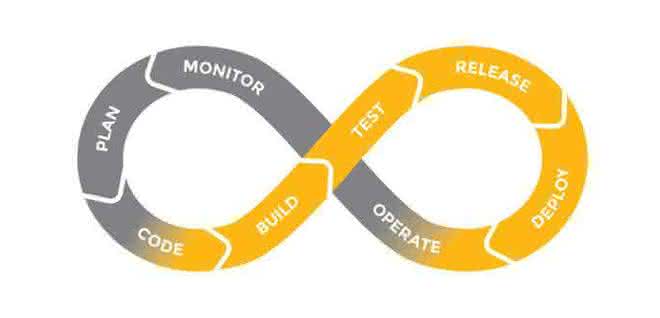
At its simplest, DevOps is a blending of the areas of development and operations. But it is also a new way of working together, a philosophy that is based on continuous training, creating transparency, strengthening communication with one another and jointly assuming end-to-end responsibility. This starts with the selection of the tools used, continues with the composition of interdisciplinary teams and extends to the way in which we work together effectively. The aim of everyone involved is always to provide the customer with individual, high-quality solutions and to be able to react quickly and seamlessly to changes. Prime examples of DevOps in action are Netflix and Amazon, which are constantly revising and improving their software without users having to do without services or even noticing an interruption in the application.
An important step in this direction is the automation of processes. Tests, for example, ensure that changes do not affect the stability of the solution. With the help of automated processes, these tests can be carried out as often as possible, thereby increasing stability. This is the only way for companies to be able to react flexibly to adjustments.
Production also benefits from DevOps
So what does all this have to do with production? In the context of digitalization, the influence of IT will continue to grow rapidly. Whether it's solutions for managing production orders or planning tools, production needs high-quality solutions that don't take months to update. This is because software is often already outdated by then and the competition has moved on. DevOps is also a corporate culture that focuses on the employee. Away from the IT departments, production and intralogistics in particular could work together more efficiently in many cases if the exchange is intensified and the common goal - customer satisfaction - is the focus. One possible positive side effect that the DevOps culture has on a company is growing employee satisfaction. Taking responsibility and being actively involved increases motivation to achieve the best possible end result.
However, DevOps requires a central rethink: an error and feedback culture must be created that enables communication in all directions, not only across hierarchical levels, but also across departmental boundaries.
Continuous improvement
Modern software applications need to be continuously improved and revised. DevOps offers the right environment for this, as automated processes and more efficient collaboration between disciplines result in rapid and continuous improvements. Manufacturing companies can also take this as an example for their products. As a result, they benefit from faster development cycles, higher product quality and more satisfied employees and customers.
How companies can benefit from DevOps
- Faster time-to-market
- More stable applications
- Optimized cross-departmental collaboration and communication
- Transparent working
- Faster problem solving
- Happier, more productive employees and teams
Andreas Müller, Senior DevOps Engineer at Salt Solutions


You might also be interested in
"We are clearly different from the competition"
The IT company 21unity offers a range of hardware and software services, as well as traditional services. Andreas Mühlbauer spoke to Managing Director Anja I. Gondolf about the company's appearance at the Hannover Messe, its services and future...
 read more...
Think digital, act local
When it comes to industrial damping technology, on-site advice is often very valuable for engineers and designers.
read more...Plagiarius 2024 negative prize
On January 26, 2024, the Plagiarius campaign awarded its dreaded "Plagiarius" negative prize for the 48th time to manufacturers and retailers of particularly brazen counterfeits and fakes.
read more...Spindel Full Service records second-best...
Maintenance as an economic success factor
Spindel Full Service, the spindle repair specialist from Baden-Württemberg, can look back on its second-best financial year in its history - with 15% growth compared to the previous year. And the further forecast also looks good.
read more...Thyssenkrupp and Novelis cooperate
Platform for the circular economy
With a platform for the circular economy in the automotive industry, the two companies Thyssenkrupp Materials Services and Novelis want to set new standards for the recycling of used materials. The open platform will enable access to larger...
read more...How production can benefit from AI
Together with AI technology, IIoT networking makes it possible to better control machine parameters and optimize quality with predictive quality. Downtimes and set-up times can also be further minimized. Cloud platforms also make these technologies...
read more...Marco Ghirardello takes the lead
Fanuc has appointed Marco Ghirardello (48) as the new President and CEO of Fanuc Europe. Ghirardello succeeds Shinichi Tanzawa, who has led the company since 2016 and will take on a new role at Fanuc's headquarters in Japan.
read more...Efficient robot monitoring
Microchips are installed almost everywhere - whether in smartphones, washing machines or cars. With increasing digitalization, the demand for semiconductors has been growing rapidly in all areas of the economy for years.
read more...Everything on one platform
Functional and powerful tools are essential for professional work on the construction site, in the workshop or when carrying out repairs.
read more...