
Homogenization of machine data
Democratization of machine data
Since the medium-sized injection molding company Peiler & Klein embarked on the path to the smart factory with the help of Siemens MindSphere, Industry 4.0 ideas have been bubbling up. The basis for this is the homogenization of machine data using the Elastic Gear architecture from Nuremberg-based system house Data Ahead.

With around 100 employees, Peiler & Klein Kunststofftechnik in Höchstadt an der Aisch, Franconia, has been manufacturing technical injection-molded parts for the automotive, electrical engineering, building services, cosmetics and aviation industries - including for Siemens- since 1994. Every year, around 17 million plastic parts are supplied to the Amberg electronics plant and the company's neighboring appliance plant.
In order to secure its role as a top supplier in the future, Managing Director Christian Werner set out on the path towards a smart factory back in 2015. The necessary foundation was already in place at the medium-sized company thanks to its state-of-the-art machinery. The raw data from the approximately 70 injection molding machines "only" had to be provided and evaluated.
However, in order to ensure secure cross-company data exchange and offer customers a high level of transparency at all times through real-time access to important quality and production data, two things are needed above all: a reliable connection to the Industrial Internet of Things (IIoT) and targeted utilization of the data provided by the machines. "According to a study, less than five percent of plants and machines in companies are currently able to provide data in such a way that it can be used in a meaningful way," says Jürgen Kramer, Head of Sales in the Siemens Digital Factory Division, pointing out the challenge.
Analysis tools from the cloud
The Siemens MindSphere platform, for example, transforms big data into smart data by analyzing machine data using a wide range of apps in the cloud. This information then helps to increase availability and improve the productivity and efficiency of individual machines, entire plants, systems and distributed machine parks. "But these new functions and services usually lack direct access to the raw data on the store floor," says Ulrich Grauvogel from Nuremberg-based system house Data Ahead.
The problem is that companies' existing enterprise resource planning (ERP) or manufacturing execution systems (MES) often fail to keep pace with the volatility of digital change. This is also because proprietary middleware and dedicated interfaces and gateways make it difficult to provide and evaluate production data transparently. "Before companies dive into Industry 4.0, they should therefore first do their Industry 2.0 homework and homogenize all participating data sources," recommends Grauvogel.
He places particular emphasis on the fact that "homogenization" is not the same as "formatting" or "standardization". Elastic Gear, the Nuremberg-based architecture for finding and using data quickly, closes the gap and homogenizes all data formats and sources without losing raw data.
And with the Hifive app from Elastic Gear, all of MindSphere's requirements for processing mass data can be met. Christian Werner, Managing Director of Peiler & Klein, also came across the Nuremberg-based system house, which is involved in the MindSphere ecosystem as a "hybrid IIoT partner" of Siemens, in his search for help. Like the Franconian supplier, the service provider also relies on the consistent democratization of all data.
"Making machine data visible without first defining how and by whom it should ultimately be evaluated was and is the guiding principle and an important success factor in all our projects," emphasizes Grauvogel.
More ideas for optimization
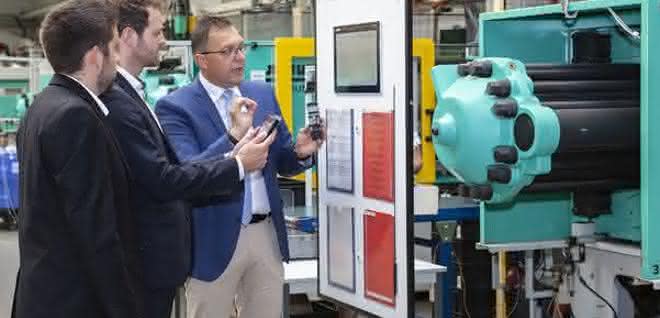
Elastic Gear now homogenizes all distributed data sources at Peiler & Klein, for example at drying ovens and granulate scales or the sensors on the injection moulding machines themselves. With the help of Simatic Panel PCs, which integrate an industrial computer with an operating front, visualization is possible directly on the system. This means that the production processes can be analyzed directly at store floor level, even as a team and in real time. At the same time, the installation effort is kept to a minimum: The hardware components are simply docked onto the respective production machine as a "piggyback device" without having to intervene in the respective process control system.

The visualization of data directly at the machine sparked ideas, and applications such as the display of Overall Equipment Effectiveness (OEE), load balancing between individual machines, comprehensive tool monitoring, traceability and the use of digital twins were driven forward by the production employees themselves.
With the connection to MindSphere, the powerful analysis tools there are now finally accessible. There is no shortage of other exciting applications for tapping into new optimization potential. "Almost every day, solutions are found that were not even actively sought," reports Werner. The appetite comes with eating.
The 5 V in industrial big data use

There are five factors to consider when providing machine data via the Industrial Internet of Things (IIoT). These are the following 5 Vs: Variety, Velocity, Visibility, Volatility and Volume. Ulrich Grauvogel, CMO of Data Ahead, describes them in detail here.
1) The variety of formats and sources for storing data in the industrial environment is immense: In addition to structured information such as master data, semi-structured (e.g. emails) and unstructured data - such as posts from the social web - are increasingly being incorporated into data processing. At the same time, it is important to harmonize company and external data as well as machine-generated and human-generated information without forcing them into specific formats and losing information.
2) Speed is a key factor in the IIoT with its enormous growth in the number of devices involved. This is because response times increase exponentially with the number of instances involved in interlinked dependencies. The "magic second" is used as a guideline for an upper time limit. This is the amount of time a human is prepared to wait for a machine to respond.
3) Visibility of raw machine data is not a matter of course: half of the company data stored worldwide is "dark data", the content and business value of which are still unknown. This makes it all the more important to make both visible, corrigible and usable without having to rely on proprietary viewers or dashboard developments.
4. customer and business process data differ significantly from raw machine data due to their volatility. This often expires shortly after processing and is no longer available for future services. Good architectures, on the other hand, keep historical data available ad hoc in unrestricted raw quality even years later.
5 The amount of available data continues to increase exponentially in the age of digitalization. Conventional database systems quickly reach their limits as a result. Multi-node technologies and cloud platforms that are freely scalable are therefore in demand.
Bernhard Müller-Hildebrand, freelance journalist from Düsseldorf /ag


You might also be interested in
ESTIA aims to strengthen Europe's cloud
New tech alliance for EU sovereignty
Twelve companies, including Dassault Systèmes, are founding the European Sovereign Tech Industry Alliance (ESTIA). The initiative aims to strengthen Europe's technological independence and define requirements for sovereign cloud services. The start...
 read more...
Deutsche Telekom and Nvidia launch one of Europe's largest AI factories
With the Industrial AI Cloud in Munich, Deutsche Telekom and NVIDIA are creating one of the largest AI factories in Europe. Companies can train AI models, carry out simulations and access 10,000 GPUs.
read more...Leveraging data potential with AI and streaming
Huge data treasures are still lying dormant in many manufacturing companies. And yet it is high time that these treasures were unlocked. There is often a lack of resources and capacity to make data usable in real time. Streaming production data can...
read more...More awareness of noise
Dematic offers solutions that are tailored to different cloud environments and reduce environmental impact through reduced material consumption and improved energy efficiency.
read more...Generative AI in the automation environment
The mechanical engineering and automation industry is undergoing profound change. This transformation is being driven by more volatile global trade, geopolitical crises and increasing market pressure, which demands greater agility, technological...
read more...Rigid data structures have had their day
The traditional data center is no longer the center of data. A hybrid cloud storage approach enables manufacturing companies to both meet the current requirements of data-intensive processes and future-proof their infrastructure.
read more...Software as a service in three stages
CIM Database Cloud is a new out-of-the-box solution from Contact for end-to-end digital product development.
read more...How production can benefit from AI
Together with AI technology, IIoT networking makes it possible to better control machine parameters and optimize quality with predictive quality. Downtimes and set-up times can also be further minimized. Cloud platforms also make these technologies...
read more...More expertise for digital engineering
Altair, a computational science and artificial intelligence (AI) company, has acquired OmniV, a technology from Michigan, USA-based software company XLDyn.
read more...