
White light interferometry
Measurement results with maximum accuracy in material testing
Reliable test data on the hardness, tensile strength and flow curves of metals enable statements to be made about the quality of the material, prevent mix-ups and form the basis for further quality testing and assurance.
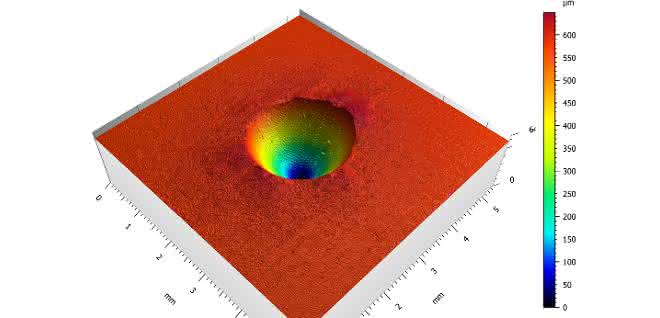
Imprintec Material Testing Solutions is an expert in the field of mechanical materials testing. The company uses white light interferometers from Isra Vision for its testing devices, offering its customers maximum accuracy and fast measurement results.
The i3D series testing machines from Imprintec are used, among other things, to carry out strength tests for the unambiguous identification and quality control of materials. They are also used for component testing and for local inspection of heat treatments, hot forming or weld seams, for example. Another area of application is the investigation of strength curves of partially press-hardened sheet metal components, which are used in the automotive industry, among others. Imprintec uses the indentation method in accordance with DIN SPEC 4846, in which a minimal, punctual test indentation is generated under force control and then the indentation and the surrounding impact are measured optically in three dimensions. Thanks to sophisticated algorithms and FEM simulations, material properties such as yield curve and yield strength, tensile strength and hardness value can be determined quickly and precisely from the data obtained.
"Optical measurement is a sub-step of the test procedure at Imprintec. High demands are placed on measurement and repeat accuracy. Lateral resolution also plays a decisive role," says Peter Zok, Application Consultant at Imprintec. To achieve this, NetGage3D white light interferometers from Isra Vision are used in the devices. They deliver reliable and fast 3D measurement results and thus ensure short inspection times. Another decisive factor for the use of the sensors was the possibility of individual customization, according to Peter Zok: "As part of the cooperative collaboration with Isra Vision, the optical sensors could be configured to suit our inspection devices. This simplified integration enormously. The sensors used measure three-dimensional surfaces of up to 200 mm² in a short space of time. This is a considerable technological advantage over conventional point or line sensors."
The NetGage3D sensors are based on the principle of white light interferometry, in which a measurement object and a reference mirror are evenly illuminated by white light. The reference mirror and measurement object reflect the rays back into the camera. Depending on the height structure and object surface, different path lengths are created for the reference and sample light. These superimposition patterns are evaluated by software and a distance is calculated for each object point. This results in a topographical image of the sample in the form of a height map. The coaxial arrangement of the measuring light and camera lens means that depths such as boreholes, trenches and etched structures can be measured with high precision. The repeatability of the measurements with standard systems at a step height of 50 µm is typically around 100 nm, with an absolute accuracy of ±200 nm. Variants with increased accuracy are also available.
In addition to the technical properties and the customer-specific configuration of the sensors, Imprintec also opted for the NetGage3D sensors because of the simple connection to the overall system, says Peter Zok: "The easy-to-integrate interface allowed us to program the sensor ourselves. This was a great advantage for integration into our inspection systems."
As a result, Imprintec was able to launch a compact device for mechanical quality assurance of components and materials in accordance with DIN SPEC 4846 in a very short development time, which customers can use to reliably and precisely determine the mechanical properties of their products - and thus increase quality, improve process reliability and minimize rejects or complaints.


You might also be interested in
From ERP System to AI Platform
RNA, based in Aachen, manufactures up to 2,000 custom-designed feeding systems annually and handles all order processing through a central ERP platform.
 read more...
Cybus Brings in Siemens Executive Stefan Schwab to Lead the Company
The Hamburg-based software provider Cybus will have a dual leadership structure going forward: Stefan Schwab will join co-founder Peter Sorowka as co-CEO.
read more...Artificial Intelligence for the Physical Space
Alibaba Expands Qwen Model Family with a Robotics Suite for Physical AI
Alibaba is expanding its Qwen model family with a robotics suite for Physical AI. The three models—for manipulation, navigation, and simulation—are designed to assist autonomous robots with complex tasks in real-world environments.
read more...5 Challenges for AI Projects in Manufacturing
Manufacturing companies have high hopes for AI. IFS highlights the five most common reasons why AI projects fail.
read more...Implementing Manufacturing Software: 5 Practical Tips
To remain competitive in the market in the future, more and more companies are considering digitizing their CNC manufacturing processes. The right software solutions can make process knowledge transparently accessible and significantly reduce the...
read more...AI automation specialist reorganizes...
Generation change at Insiders Technologies
After almost 30 years at the helm, Werner Weiss is handing over the management of Insiders Technologies. Andree Albrecht takes over the management after a transition phase.
read more...Intelligent brownfield networking
Many industrial companies are struggling with established plant structures and proprietary interfaces. Stefan Klaus' presentation will show in a practical way how brownfield environments can be efficiently networked with open technologies and made...
read more...Factory-X in practice
How can set-up processes in highly variant production be automated efficiently? Markus Benndorff from soffico shows how Factory-X, industrial data rooms and modular architectures create new possibilities for flexible production concepts.
read more...Quality controls in production
Robots check car floor pans fully automatically
How can complex components in automotive production be inspected fully automatically and in real time with the help of machine vision and robotics? The case study shows how floor pans are measured and inspected fully automatically.
read more...