

Tightness and flow rate
There is a solution for every test task
Ceta is a manufacturer of leak and flow testers and has more than 30 years of experience in industrial testing technology. Compressed air and hydrogen are used as test media. Several thousand Ceta test devices are used by industrial customers worldwide in production lines for series products.
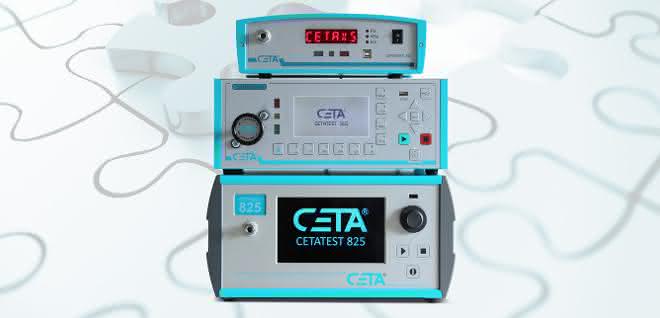
Leak testing using compressed air can be used to test the leak tightness against liquids, as the viscosity of air is lower than that of liquids. The differential pressure test method is often used here, in which the leakage-related pressure drop is measured as a pressure difference against a tight reference volume. The minimum leak rates that can be detected with this method are in the order of 10-3 mbar*l/s. If the leak only consisted of a single hole, this would have a diameter of around 20 micrometers at a test pressure of one bar.
The size of the products that are tested for leaks ranges from small-volume microswitches with a volume of 0.1 milliliters to tanks with a capacity of 1,000 liters. Depending on the application, Ceta leak testers with overpressure or differential pressure sensors are used. Available pressure ranges are between minus one and 30 bar up to 400 bar with the pressure increase method (e.g. testing injection valves).
Leak testing
Typical leak testing tasks include testing for oil or water leaks. Many products can be tested using suitable methods: products that can be filled directly (housings, gearbox covers, containers, lights), objects whose internal and external tightness must be ensured (ball valves, gears), components with pressure equalization elements (diaphragms) and encapsulated test parts (sensors, microassemblies, clocks).
Leak testers with calorimetric mass flow sensors and various measuring ranges (up to 600 ml/min) are used to detect the smallest leaks in large-volume test parts. Here, the mass flow caused by the leakage is determined directly. Very low leakage rates down to 10-6 mbar*l/s (corresponds to a hole diameter of 0.1 micrometers at one bar test pressure) can be detected with hydrogen leak testers. The patented and highly sensitive method is based on the detection of gases or vapors that escape from the test part in the event of a leak. It can be used to detect forming gas (five percent hydrogen, 95 percent nitrogen), alcohols, solvents and generally volatile organic gas or vapor mixtures. These are either present in the test part per se or are introduced beforehand as tracer gas.
Flow test
In addition to leak testing, there are products that are tested for flow rate. With the Ceta flow testers, a range from 3 ml/min to 200 l/min can be mapped with different laminar measuring sections. Typical products for which the flow rate is tested are pipes, cooling ducts, valves, exhaust systems and membranes. The test devices are usually integrated into automated series production lines. Various industrial interfaces are available for the connection.
Customers from the automotive, e-mobility, fittings, heating and air conditioning, medical technology, packaging and household appliance industries use Ceta test devices for quality assurance and production validation. The company is certified according to DIN ISO 9001 and the calibration laboratory (D-K-19566) is accredited as a DAkkS calibration laboratory (according to DIN EN ISO/IEC 17025) for the measurand pressure up to 60 bar (also for on-site calibrations).
The decision as to which test method is suitable depends on many factors, including the special properties of the test part, the test parameters, the production cycle and the specifications for measuring equipment capability. as
Hall 3, Stand 3320


You might also be interested in
Housing and inserts for plenty of power
Lapp presented the expansion of its Epic Power series at SPS 2023: four new M23 circular connector inserts and three new M23 housings. The special feature: all housings can be combined with any of the four inserts.
 read more...
News and product updates from Smartgas
Portable gas analyzers for outdoor use
Smartgas is starting the second half of the year with a series of updates to existing products and a number of new products. Portable analyzers expand the range of applications, while new accessories such as protective housings and heating modules...
read more...Everything accurate in switch cabinet construction
To ensure smooth work processes, tools for processing enclosures and housings must function flawlessly and reliably. Häwa rounds off its punching range with the Multi-Press 500.
read more...Shafts and conversion parts
The Rodriguez range includes ball bushings including matching housings, shaft brackets, crossbars and supports.
read more...Cooling and temperature control units
Hygienic packaging sells safely
In few industries are the requirements for hygiene in the production process as strict as in the food sector - the health of consumers has top priority. This results in enormous challenges for all machines and components involved, especially in...
read more...Simple tool change in seconds
With the CMS, Schunk is launching a user-friendly, manual change system for quick component replacement. In addition to its simple and convenient operation, the CMS also stands out with its extensive range of optional modules and complementary end...
read more...Motion controller for small drives
Medium power range covered
Faulhaber has another housing-less and compact motion controller in its range, which is particularly suitable for integration in device construction and medical technology applications.
read more...Welding solutions in the name of resource efficiency
At the Welding & Cutting trade fair in Essen (September 11-15), Fronius will be focusing on the major drivers in welding technology. Quality requirements are increasing in all industries, but the required welding specialists are scarce. In...
read more...Safe solutions for cable installations
From thick power cables to thin sensor lines, cables and lines must be routed safely through systems and machines. A challenge that should not be underestimated, explains Jörg Sokat, Head of Product Management at Pflitsch.
read more...