
Safety and diagnosis
Smart protection
Guards are suitable for protecting people from machines with dangerous overtravel or other sources of danger. This calls for flexible solutions that offer several different components. In addition to the protective function, such a door system can be used efficiently with an intelligent diagnostic solution. By Martin Bellingkrodt
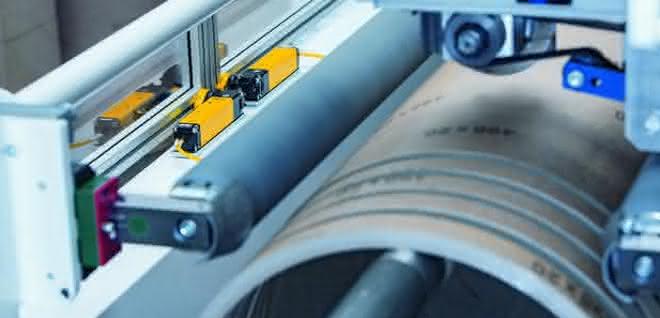
Systems are becoming increasingly complex and modular. At the same time, functional safety is an important aspect. For example, when using guards, systems must stop immediately if a safety gate to a hazardous area is opened. Depending on the application, individual solutions consisting of a combination of sensors, escape release and an operating and push-button unit are often required here.
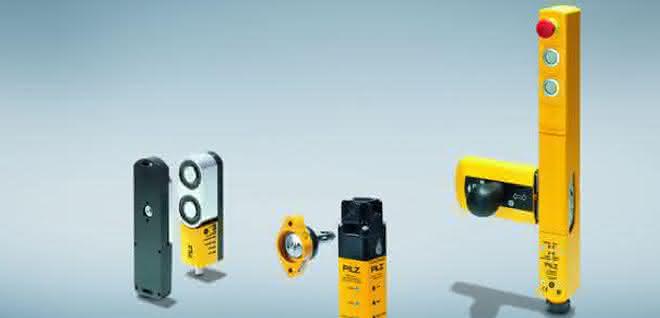
The safety gate sensors PSENslock and PSENmlock form the core of the modular safety gate system from Pilz. The former offers safe position monitoring with process guard locking in one. The PSENmlock, on the other hand, can be used for personnel and process protection up to the highest safety category PL e thanks to safe interlocking and safe guard locking.
A variant with series connection is also available for the PSENmlock sensor. Depending on the application, users can select the right safety gate sensor and combine it with the components required for their application to create a customized solution.
Despite its modularity, operating a safety gate system should be simple. Commands such as activating, stopping or acknowledging the machine or system can be controlled via a suitable push-button unit on the safety gate. The PITgatebox push-button unit, for example, can be used to operate and control the safety gate sensors. Individual applications can be implemented from the preconfigured variants with different combinations of pushbuttons, key-operated switches and emergency stop buttons. Even in harsh industrial environments, the PITgatebox with its robust die-cast zinc housing works reliably as it is resistant to impact, vibration and collision. With its slim housing, space-saving installation on standard profile systems is possible.
Options for a safe escape
In a difficult situation, the worker must be able to leave the isolated danger zone quickly. The escape release takes care of this in the safety gate system. Two versions of the escape release are therefore available as optional accessories for the safety gate sensors PSENmlock: The PSENml escape release is connected directly to the base unit via a rod, while the PSENml escape release cordset is mounted on the sensor via a push-pull cord.The remote version with push-pull cord allows the safety gate system and the escape release to be mounted separately. The latter therefore does not specify where the sensor must be installed. Finally, customers can complete their individual safety gate solution with matching door handles for swing and sliding doors.
The modular system therefore enables a range of combinations for individual safety gate solutions that can be used from stand-alone machines to extensive, interlinked systems. Further possibilities arise for the safety gate sensor PSENmlock with series connection if the user combines the system with a diagnostic solution such as Safety Device Diagnostics (SDD). This makes it possible to query the status information of the intelligent sensors, read out their configuration parameters and visualize actions.
The safety sensors of the safety gates are connected in series according to a standardized procedure: OSSD outputs (Output Switching Signaling Device) of one sensor are connected to inputs of the following sensor. Previously, the designer had to wire all the sensors individually in the control cabinet using complex, expensive star cabling in order to control them individually. In addition, only 1 bit was transmitted, namely the information as to whether a sensor had detected the actuator or not.
One cable, many safety doors
Together with the safe safety gate system PSENmlock, this diagnostic solution can also be used to control safety gates individually despite the extensive single-cable solution. If maintenance work or a tool change is due in a system, for example, users can define which doors may be opened after shutdown. Without SDD, all safety doors connected in series would open at once when the unlocking function is requested.
The single-cable solution also extends the limits of series connection: it makes it easy for the machine manufacturer to add another module. The fact that one system offers several functions means that a PSENmlock can be used flexibly. It can also be adapted to different requirements: for example, for accessible or non-accessible doors and for "connected in series" or not.
Diagnostic options
What diagnostic information can now be recorded? First of all, the status of the safety sensors and the status of their inputs and outputs. Warnings regarding overvoltage or undervoltage can also be read out, which can occur particularly with long cables if they have not been carefully measured beforehand. This is because the diagnostic solution can cover a total of 900 meters, which means that large high-bay warehouses, intralogistics applications or extensive steel industry plants can be connected via a single-cable solution.
All sensors can be managed centrally via a master gate in the diagnostic system, which makes it much easier to monitor multiple safety devices. The fact that device properties such as article and serial numbers, the product version number or equipment identifiers can also be stored makes it easier to locate a sensor and replace it in the event of a fault. As the diagnostic solution can be used to record a wide range of diagnostic data on site or remotely, it is also suitable for predictive maintenance.
Applications with Industry 4.0 requirements can therefore be implemented easily and safely with modular solutions such as the safety gate system. An individual solution is created using the modular principle, which can be used efficiently with the appropriate diagnostic tool. The series connection for safety sensors and the direct evaluation of data from the sensor not only enable significantly increased availability. Thanks to its modular approach, it also represents an adequate diagnostic solution for the factory of the future.
Martin Bellingkrodt, Product Manager Sensors at Pilz / am


You might also be interested in
Helu makes its first trade fair appearance under a new brand name
Helu Kabel will be presenting itself as Helu for the first time at Hannover Messe 2026, showcasing system solutions, Heluchain cables and new industrial luminaires.
 read more...
Strategic realignment with brand relaunch
In future, Helukabel will trade as Helu
The Helukabel Group is parting with part of its name: in future, the company will only operate under the Helu brand. With this step, the specialist for electrical connection technology is underlining its strategic development from a classic cable...
read more...Modular plant construction for corrugated board
Insight into the production of corrugators at BHS Corrugated: Automated, modular and equipped with Helukabel components.
read more...Best quality for the steel
Conditions in the steel industry are harsh and inhospitable. The machines used must be able to withstand the demanding environmental conditions in order to deliver the best quality at all times.
read more...If the standard cable is not sufficient
Lapp offers cables for countless applications - but not for all of them. From time to time, the developers have to modify a standard cable or develop a special cable.
read more...Slight decline in sales, strong investments
The Lapp Group has not been spared from the weakening global economy. However, the company only recorded a slight loss in the past 2024 financial year.
read more...Electrical connection technology
Cables and wires for industrial automation
Heukabel offers system solutions for cable routing from a single source. The subsidiary EKD Systems specializes in tailor-made cable drag chains made of steel, stainless steel and plastic, which are used in moving machines and systems as well as in...
read more...Lapp relies on Ultramid from BASF
Mobile charging of electric vehicles
The automotive industry is currently undergoing the biggest transformation in its history. The boom in battery electric vehicles in particular is presenting the industry with major challenges. Lapp, as a supplier of cables and connection...
read more...Cable handling application
At this year's Motek, ArtiMinds Robotics is showcasing a robot-based automation solution for the sensor-assisted assembly of flexible cables in connector housings.
read more...