
Quality assurance
Improve manual assembly processes
Human Assistance Camera. The Ricoh SC-10 is designed to both provide assembly instructions to the operator and to verify that each step has been carried out correctly. The easy-to-use, self-contained camera inspection system, which is already in use in many different manufacturing environments in Japan, is available from Stemmer Imaging.
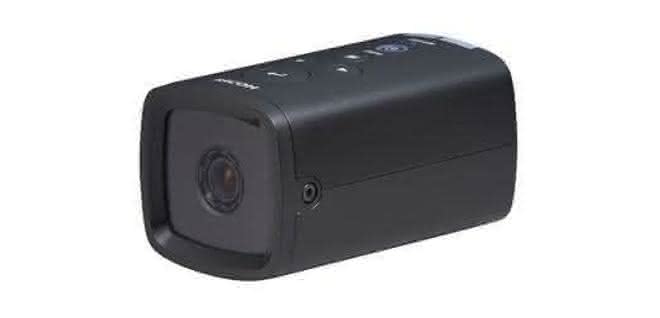
A set of work instructions can be loaded into the camera and displayed on a monitor while the camera scans the workpiece. The employee follows the assembly instructions on the screen while the system compares the work steps with the stored template and only releases the next work step once the previous one has been carried out correctly. This reduces errors, helps the employee to master new tasks and also records the entire work process.
The Ricoh SC-10 automatically detects production status and identifies incorrect or missing parts by comparing patterns, colors or textures. With the addition of a barcode reader, part or serial numbers and user IDs can be captured and the appropriate work instructions selected. Each completed step is saved in a CSV file, as well as the corresponding time spent and optional inspection recordings. The system can therefore also be used to analyze assembly processes and for traceability.
The camera has internal software that can be configured using a mouse and keyboard. Installation instructions and the status of the work process can be displayed via a monitor connected to HDMI. No PC is required. Work instructions and inspection reports can be saved on an SD card or via the internal network (an Ethernet connection is available). pb
Features of the Ricoh SC-10:
- Check that all parts have been placed correctly.
- Check the arrangement of the parts.
- Check whether the work steps have been carried out in accordance with the specifications.
- Check whether any parts are missing.
- Check that all installed parts are correct.
- Visual inspection to avoid human error and reduce rework costs.
- Check that the packaging and packaging sizes are correct.


You might also be interested in
Sustainability Through Simulation
Digital material selection reduces CO2 emissions by 40 percent
The use of digital material simulations can significantly reduce CO₂ emissions during the development and manufacturing of components. A real-world project by Schunk and Cadfem demonstrates how data-driven material selection can yield savings of up...
 read more...
From ERP System to AI Platform
RNA, based in Aachen, manufactures up to 2,000 custom-designed feeding systems annually and handles all order processing through a central ERP platform.
read more...Cybus Brings in Siemens Executive Stefan Schwab to Lead the Company
The Hamburg-based software provider Cybus will have a dual leadership structure going forward: Stefan Schwab will join co-founder Peter Sorowka as co-CEO.
read more...Artificial Intelligence for the Physical Space
Alibaba Expands Qwen Model Family with a Robotics Suite for Physical AI
Alibaba is expanding its Qwen model family with a robotics suite for Physical AI. The three models—for manipulation, navigation, and simulation—are designed to assist autonomous robots with complex tasks in real-world environments.
read more...5 Challenges for AI Projects in Manufacturing
Manufacturing companies have high hopes for AI. IFS highlights the five most common reasons why AI projects fail.
read more...Implementing Manufacturing Software: 5 Practical Tips
To remain competitive in the market in the future, more and more companies are considering digitizing their CNC manufacturing processes. The right software solutions can make process knowledge transparently accessible and significantly reduce the...
read more...AI automation specialist reorganizes...
Generation change at Insiders Technologies
After almost 30 years at the helm, Werner Weiss is handing over the management of Insiders Technologies. Andree Albrecht takes over the management after a transition phase.
read more...Intelligent brownfield networking
Many industrial companies are struggling with established plant structures and proprietary interfaces. Stefan Klaus' presentation will show in a practical way how brownfield environments can be efficiently networked with open technologies and made...
read more...Factory-X in practice
How can set-up processes in highly variant production be automated efficiently? Markus Benndorff from soffico shows how Factory-X, industrial data rooms and modular architectures create new possibilities for flexible production concepts.
read more...