
3D LiDAR multi-layer scanner
Sensor for 3D object detection
At the SPS 2019 trade fair, Pepperl + Fuchs, manufacturer of industrial sensors and sensor systems, presented the new R2300 multi-layer scanner.

High-precision LiDAR laser measurement technology is integrated into the compact and integration-friendly housing of the sensor for 3D object detection, which evaluates a total of four scan planes and can therefore detect and measure objects in their length, width and height. Various design innovations in the sensor ensure high detection reliability and availability even in demanding applications.
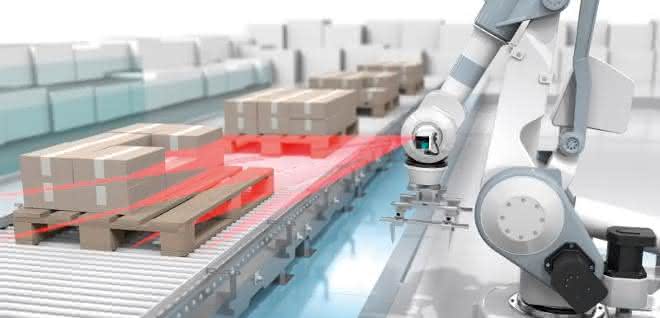
With a height of just 58 millimetres, the very compact and space-saving R2300 is a 3D LiDAR sensor (Light Detection And Ranging) for optical angle and distance measurement in stationary and mobile applications. With the help of four slightly fanned scanning planes - generated by a rotating mirror cube inside the sensor housing - a non-contact 3D scan of the surroundings is made possible.
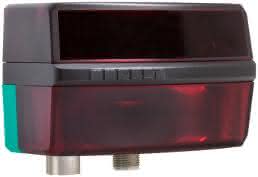
The R2300 from Pepperl + Fuchs has a measuring range opening angle of 100°, offers large measuring ranges of up to ten meters on bright objects and up to four meters on dark surfaces, a measuring rate of 50 kHz and selectable scan rates of 12.5 or 25 Hz with up to 4,000 pixels per scan. The multi-layer scanner therefore covers the most important requirements of a wide range of applications. It is also possible to customize the monitoring field - either by selectively masking outer areas of the detection field or by mounting a second R2300 side-by-side, which increases the field of view to 180°. A unique selling point for 3D sensors is the low angular resolution of just 0.1°, which, according to the company, no other comparable LiDAR or multi-layer sensor currently achieves. In conjunction with the small infrared light spot typical of lasers, the R2300 is able to reliably detect even delicate object structures and contours.
Designed for high robustness and availability
The application scenarios for the R2300 - including intralogistics, mobile equipment and robotics - made it necessary to design the multi-layer scanner to be particularly robust. For this reason, the sensor housing is made of robust plastic and the electronics are permanently installed in the sensor head and thus protected against vibrations. The R2300's Pulse Ranging Technology (PRT) not only ensures extensive independence from object and surface properties, but also maximum immunity to interference from ambient light, HF lamps and optical reflections from the operating environment. Another unique feature of the R2300 in the multi-layer scanner market is the mechanical separation of the transmitter and receiver within the optical unit. The separating element in the sensor head reliably prevents an optical short circuit, which can occur if the windshield is dirty and reflects part of the emitted light directly back onto the receiver element. As a result, the R2300 guarantees continuously correct measurement results and a high level of detection reliability in the application - with significantly reduced maintenance requirements. For the user, this means minimized downtimes, significantly longer cleaning intervals and improved availability and process reliability.
Pilot laser simplifies commissioning
The integrated pilot laser of the R2300 makes it easier to align the sensor to surfaces or specific targets during commissioning. It is switched on for alignment and is only active during commissioning. No other aids are required - because the red, visible laser beam is identical to the actual infrared measuring laser.
Measured value output as raw data
The R2300 outputs measured values for angle, distance and remission with the corresponding time stamp. The data is transmitted via the sensor's Ethernet interface, allowing it to be made available to a wide range of automation systems. In the foreseeable future, the R2300 will not only be available in a switching version, but will also offer additional connection options that can be integrated easily and cost-effectively thanks to the flexible interface module.


You might also be interested in
ebm-papst is growing again thanks to AI and data centers
ebm-papst returned to a growth trajectory in fiscal year 2025/26. Air Technology, data center applications, and artificial intelligence are driving revenue and investment.
 read more...
SPE on the Verge of a Market Breakthrough
Single Pair Ethernet (SPE) has moved beyond the conceptual phase and is increasingly being implemented in industrial settings. The focus here is not only on higher data rates and simplified cabling, but above all on the issue of system integration...
read more...More than 900 exhibitors already registered
Around six months before the start of the trade fair, more than 900 companies have registered for SPS 2026 in Nuremberg. The trade fair focuses on industrial AI, cyber security and digital transformation.
read more...Virtual PLCs in practice: How vPLCs make production systems more flexible and scalable
The increasing networking of IT and OT is fundamentally changing industrial automation. The IT/OT Integration Summit shows how modern technologies can make production environments more efficient, flexible and future-proof. The event will focus on...
read more...Sales growth in a turbulent market environment
Thanks to innovations and a focus on strategic industrial markets, Sick was able to moderately increase its sales in the 2025 financial year. In a turbulent market environment, the company was able to maintain its position and gain market share with...
read more...Siemens presents new AI agent
Siemens is launching 'Eigen Engineering Agent', an AI for automation technology. The solution is integrated into the TIA Portal, has been tested with over 100 companies and is designed to significantly accelerate engineering processes.
read more...Schaeffler keeps sales almost stable
Schaeffler generated revenue of EUR 23.5 billion in 2025 and increased EBIT before special items to EUR 936 million. At 266 million euros, free cash flow was significantly above the prior year and forecast. Net income remained negative due to high...
read more...Advancing artificial intelligence together
Helukabel is stepping up its activities in the field of artificial intelligence and is now a member of the IPAI. The innovation and collaboration platform for companies, research facilities, institutions and administration has set itself the goal of...
read more...New impetus for ifm sales
Two new positions were filled at ifm at the start of 2026: Markus Wolf becomes Managing Director Sales Germany, Sven Quant takes over the position of Central Managing Director in the Process Sensors division within the ifm Group.
read more...