

Sensors
Force Sensors for Precise Measurement Applications in the Automotive and Mechanical Engineering Industries
GTM’s K-Series force transducers are designed to measure tensile and compressive forces in industrial manufacturing processes, research environments, and highly automated testing systems. According to the manufacturer, the sensors are characterized by high precision, stability, and versatility. Their robust design, high linearity, and compact construction make them suitable for applications in the automotive and mechanical engineering industries, among others.
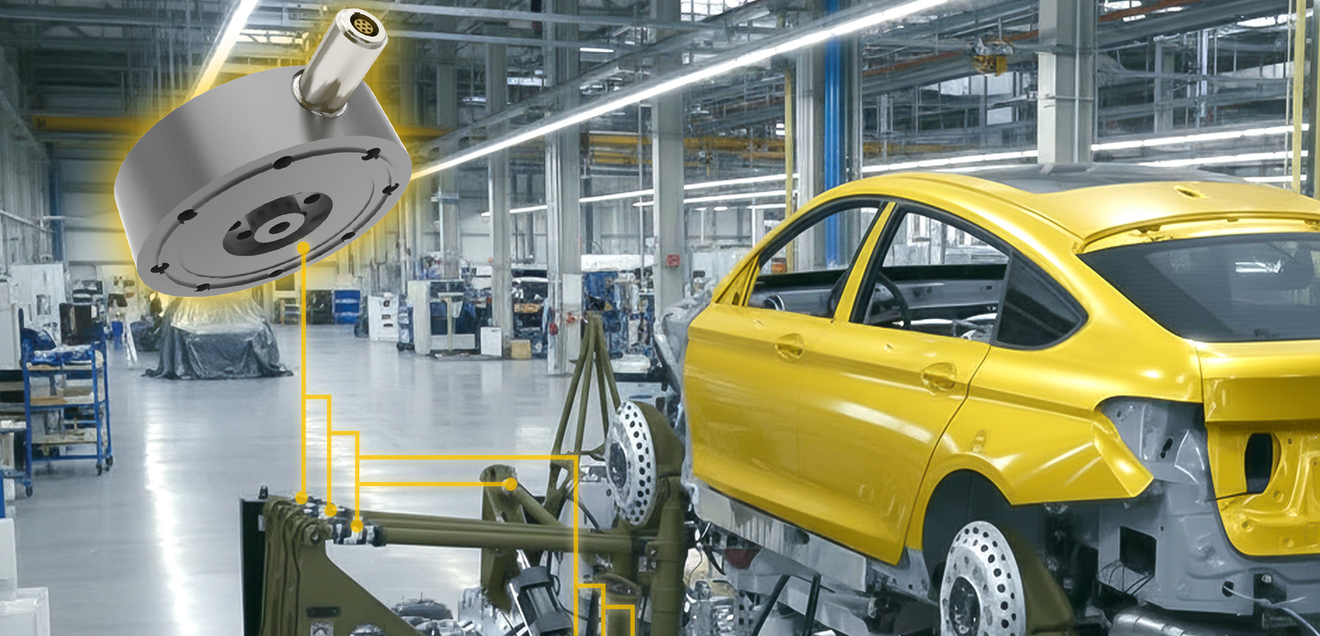
The K-Series force sensors operate on the flexural ring principle, which, according to GTM, is the only integrated measurement method used for measuring tensile and compressive forces. This is said to make the sensors largely insensitive to parasitic influences such as shear forces, bending moments, torsional moments, or temperature fluctuations. According to the manufacturer, the sensors’ robust design allows them to withstand loads of up to 300% of the rated force without breaking and up to 150% of the rated force without zero-point drift. This makes them suitable for applications in materials and component testing, in production processes for process control and quality assurance, and for use in static and dynamic testing machines.
The K Series is used in a variety of applications, including the automotive and mechanical engineering industries. In these sectors, the force transducers are used, for example, to measure force in chassis and steering test benches, to monitor assembly forces during bearing and bolt press-fitting, or to validate clutches and transmission components. According to the manufacturer, they deliver precise measurement results across the entire measurement range, from a few newtons to several hundred kilonewtons. Vibrations, temperature fluctuations, and humidity are not expected to affect measurement accuracy. In addition, the sensors are compatible with all market-leading measurement systems.
Force sensors are also used in the development and testing of modern vehicle tires. Among other things, they measure vertical, braking, and lateral forces on tire test stands and perform material analyses of rubber compounds. In production, the sensors monitor the bonding forces during assembly and vulcanization. According to GTM, the K-series force sensors maintain consistently high accuracy even under dynamic loads. Their temperature-compensated design and long-term stability also make them ideal for endurance and fatigue testing.
GTM offers an online configurator to help customers select the right model. Using this tool, customers and prospective buyers can configure and order the appropriate K-Series force sensor from more than 13,000 variants.


You might also be interested in
Software-Defined Manufacturing Enters Industrial Practice
More than 100 experts from industry and technology gathered at Xentara Connection Day to discuss software-defined manufacturing, Physical AI, AI, Edge AI, and the modernization of existing production facilities.
 read more...
Artificial Intelligence in Manufacturing
Trumpf and IPAI Are Expanding a European AI Network for Industry
The high-tech company Trumpf is an official partner of the IPAI AI network in Heilbronn. Together, the partners aim to exchange experiences, develop new AI applications for industrial use, and advance the development of artificial intelligence in...
read more...Case Study: Networked Manufacturing Platform for Toolmaking
Using a networked manufacturing platform, Escha GmbH & Co. KG, a manufacturer of industrial fastening technology, has comprehensively modernized its toolmaking operations.
read more...From ERP System to AI Platform
RNA, based in Aachen, manufactures up to 2,000 custom-designed feeding systems annually and handles all order processing through a central ERP platform.
read more...Predictive Maintenance in the Powertrain: Stöber Is Gradually Expanding Its Approach
Step by step, the company is continuing to develop predictive maintenance: from monitoring to predictive maintenance to smart powertrains.
read more...Eric Goos Appointed to the Board of Sumitomo Drive Technologies
Sumitomo Drive Technologies EMEIA continues to expand its leadership team: Eric Goos has been appointed to the board and will serve as managing director of Cyclo Drive Germany GmbH.
read more...The AKIMI Research Project at WZL
Agent-Based AI Aims to Simplify Robotics for Small and Medium-Sized Businesses
The AKIMI research project is developing an agent-based AI designed to significantly simplify the setup, programming, and reconfiguration of robotic systems for small and medium-sized enterprises. The goal is to make robotics more flexible and...
read more...Soft grippers for delicate foods
Irregularly shaped, fragile, and varying in size and weight: products such as potatoes, baked goods, and dairy products push mechanical grippers to their limits.
read more..."As rebar gets thicker, automation has to keep up."
Larger wire diameters, greater performance, higher efficiency: How can rebar processing machines be adapted to changing market requirements using new drive technology and an open automation architecture? A user report.
read more...