
Digital position query
Check workpiece clamping automatically
Increased process reliability and early error detection are important factors in a profitable and flexible production environment, especially in the context of increasing automation. With the new monitoring unit, Erwin Halder provides a solution that, in conjunction with the Halder support elements, automatically checks the position of a workpiece before and during machining.
Ever shorter delivery times and smaller batch sizes combined with increasing demands on quality and precision are presenting the manufacturing industry with major challenges. In order to continue to produce economically, quickly, reliably and flexibly, the answer in many areas is Industry 4.0. "The more automated a manufacturing process is, the more data must be automatically recorded, transferred and ultimately evaluated from the application. This also applies to workpiece clamping. It is an important factor for productivity, as the tools and machines used can only deliver full quality and performance if the parts to be machined are clamped reliably, reliably and precisely," says Bernd Janner, Sales Manager at Erwin Halder.
Check the exact position of the workpiece
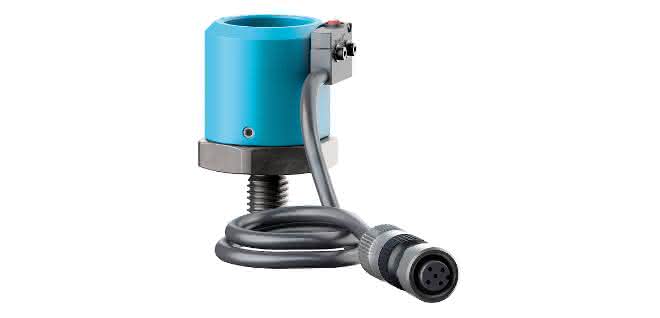
The compact monitoring unit consists of a height-adjustable, blue anodized aluminium sleeve with a switch sensor attached to the outside. Thanks to its design in accordance with protection class IP67 and a special sheathing on the connection cable, it can be used in the machine room without hesitation. The base body of the unit, made from burnished heat-treated steel, can be quickly and easily screwed into all standard fixture systems with an M8 or M12 thread. The respective support element is then screwed into the sleeve. This means that existing Halder support elements can continue to be used. The support elements are available in case-hardened steel with a flat, crowned or ribbed support surface and in plastic (PEEK) with a flat support surface.
When the component is placed in the device on the support element, the sensor automatically checks whether the workpiece is in a specific position. The system can be extended to monitor several positions. If the workpiece is in the correct position, the sensor transmits an electrical signal, which is simply transmitted via a cable connection.
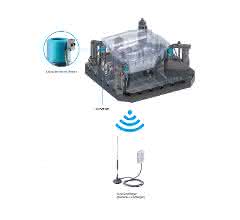
Models with signal cable and with radio transmission
"As in most cases there are only limited possibilities in the machine room to run a signal cable to the outside, we offer an optional radio module for the monitoring unit," says Bernd Janner. A transmitter and receiver with antenna are also required for the radio connection. The transmitter is placed anywhere in the engine room and connected to up to four sensors via a socket cable. It transmits the signal to the receiver outside the machine - depending on the material and thickness of the machine cladding, safely over 40 meters and further. Installing the radio module is also very simple. No complex programming is required; each scanning unit simply needs to be registered using the teach function with just a few button presses.
Space problems are not an issue, as the scanning unit is comparable to the support elements, only slightly higher. The radio unit is also very compact and can be placed slightly outside the fixture without interfering with the workpiece. "The cable, switch and receiver are specially designed for the harsh conditions in a machine tool, so there is no risk of short circuits. With IP67, the unit is dustproof and protected against temporary submersion," adds Bernd Janner.
There are several conceivable options for evaluating the electrical signal from the monitoring unit. For example, it can be connected directly to the machine control system, via additional software to a PC or other evaluation devices with potential-free relay outputs. The release for processing is then also controlled there.


You might also be interested in
Helu makes its first trade fair appearance under a new brand name
Helu Kabel will be presenting itself as Helu for the first time at Hannover Messe 2026, showcasing system solutions, Heluchain cables and new industrial luminaires.
 read more...
Strategic realignment with brand relaunch
In future, Helukabel will trade as Helu
The Helukabel Group is parting with part of its name: in future, the company will only operate under the Helu brand. With this step, the specialist for electrical connection technology is underlining its strategic development from a classic cable...
read more...Modular plant construction for corrugated board
Insight into the production of corrugators at BHS Corrugated: Automated, modular and equipped with Helukabel components.
read more...Best quality for the steel
Conditions in the steel industry are harsh and inhospitable. The machines used must be able to withstand the demanding environmental conditions in order to deliver the best quality at all times.
read more...If the standard cable is not sufficient
Lapp offers cables for countless applications - but not for all of them. From time to time, the developers have to modify a standard cable or develop a special cable.
read more...Slight decline in sales, strong investments
The Lapp Group has not been spared from the weakening global economy. However, the company only recorded a slight loss in the past 2024 financial year.
read more...Electrical connection technology
Cables and wires for industrial automation
Heukabel offers system solutions for cable routing from a single source. The subsidiary EKD Systems specializes in tailor-made cable drag chains made of steel, stainless steel and plastic, which are used in moving machines and systems as well as in...
read more...Lapp relies on Ultramid from BASF
Mobile charging of electric vehicles
The automotive industry is currently undergoing the biggest transformation in its history. The boom in battery electric vehicles in particular is presenting the industry with major challenges. Lapp, as a supplier of cables and connection...
read more...Cable handling application
At this year's Motek, ArtiMinds Robotics is showcasing a robot-based automation solution for the sensor-assisted assembly of flexible cables in connector housings.
read more...