
Secure danger zones
Smart Process Gating: reinventing muting
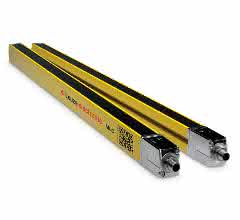
The "Smart Process Gating" muting process, which dispenses with signal-emitting sensors, is based on the safety light curtains of the MLC series from Leuze electronic and is integrated in the MLC 530 SPG variant.
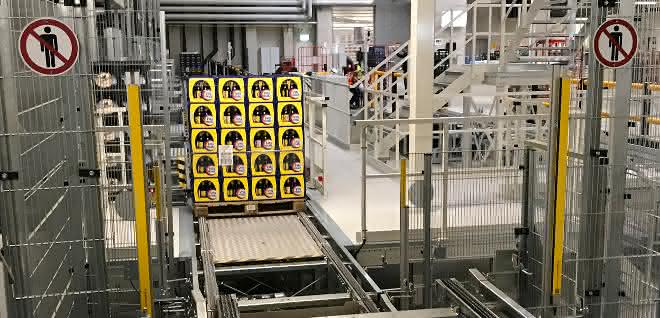
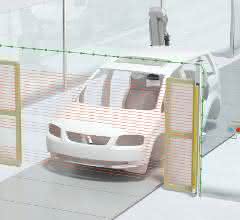
Handling and assembly systems often contain hazardous areas that need to be secured against unauthorized access. At the same time, however, material must be transported into and out of the danger zone. Examples of such systems can be found in intralogistics, the automotive and packaging industries. In practice, these requirements are met by optoelectronic protective devices installed at the infeed and outfeed stations. These protective devices must be designed in such a way that they detect the approach of the transported goods to the protective field and then temporarily bridge the protective field. This ensures that the transported goods can pass through without interference. However, the protective field may only be bridged when the transported goods are approaching - access for persons must be prevented.
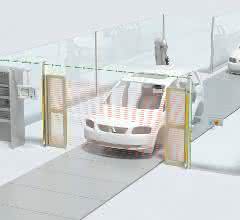
Until now, additional sensors were required to detect the transported goods - and therefore also to distinguish between people. These are also known as muting sensors. The Smart Process Gating (SPG) method fulfills these requirements without the use of additional sensors.
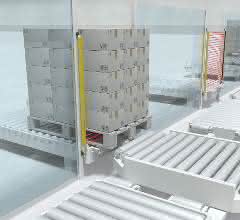
The functional principle
The SPG method is based on type 4 safety light curtains from the MLC 500 series from Leuze. It is implemented in the MLC 530 SPG variant. The basic principle of the SPG method uses two control signals: The first signal (CS = Control Signal) is provided by the system control (PLC). The time for generating the CS switching signal must be set so that the transported goods are closer than 200 millimetres from the protective field. This is necessary to prevent people from slipping through.
The second signal (PFI = Protective Field Interruption) is generated by the safety light curtain itself when the protective field is interrupted by the transported goods. This also starts the gating of the protective field. Gating ends either after a fixed time (t), after the transported goods have left the protective field again, or by actively resetting the CS switching signal.
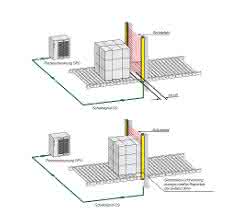
Signal sequence in detail
After the system control has sent the switching signal to the safety light curtain, the transported goods must enter the protective field within four seconds (t1). On entry, the safety light curtain generates the second signal (PFI) and thus starts the bridging of the protective field. In the default setting, the transported goods must pass through within ten minutes, otherwise the receiver of the safety light curtain switches to the interlocked state. Alternatively, a timeout extension of up to 100 hours can be activated if required to allow downtimes during a shift change or over a weekend without interlocking the processes.
When the transported goods leave the protective field, the safety light curtain resets the signal it generates (PFI) as soon as the transported goods leave the protective field. Depending on the selected operating mode, the protective field is then either switched back on automatically by the safety light curtain after one or two seconds (t2) or the gating is ended by the control system. Access guarding is now active again.
Application-optimized operating modes
To adapt to different areas of application, the SPG process works in three operating modes. These are implemented in the MLC 530 SPG safety light curtain.
The "Standard" operating mode is primarily used for intralogistics applications. The integrated filter time of one second allows the light beams of the light curtain to have a clear view for a time window of up to one second as the transported goods pass through, i.e. they are not interrupted by the transported goods. This also allows gaps in the transported goods, such as those that can occur when loading a pallet, without the gating process being terminated.
After the transported goods have left the protective field, the protective function is reactivated after one second if the automatic gating end is used. When the transported goods leave the protective field, it must also be ensured that there is no gap greater than 200 millimeters between the transported goods and the protective field to prevent people from entering. In the event that the transported goods move more than 200 millimetres away from the protective field within the re-activation time of one second, the gating can be ended prematurely using the "End by control" function. This is done by resetting the CS signal. The gating is then ended within 0.1 second and the protective function is reactivated.
The "Standard" operating mode can be operated with a standard or safety PLC, depending on the required performance level. The timeout extension to 100 hours is supported.
The "Qualified stop" and "Partial gating" operating modes are optimized for low conveyor speeds, such as those found in the automotive sector. At low speeds, it is possible for the conveying process to come to a standstill within a very short time. As the SPG process requires the protective field to be interrupted no later than four seconds after activation by the switching signal (CS), these operating modes have the additional "qualified stop/restart" function. This allows an initiated SPG sequence to be specifically interrupted within the four seconds (qualified stop) and then restarted. This means that the process can continue to run without interruption even in the event of an unplanned stop.
In these operating modes, two switching signals from the PLC with antivalent signal edges are used. The PLC switching signal (CS) and the timer stop signal (TH), which initiate the gating sequence and also control the qualified stop and restart. The TH signal must alternate with the CS within 0.5 seconds. These operating modes require a safety PLC. The timeout extension to 100 hours is supported.
Requirements for a safe solution
The integration of an SPG application into a system must be viewed as a system solution in terms of safety. This is created through the interaction of the safety light curtain, system control and, if necessary, mechanical elements. For this, the system manufacturer needs experience in safety design, as he programs the gating sequence in the PLC, for example, and creates the safety system solution himself. He is therefore responsible for the implementation of the overall system. It is therefore important to take the necessary safety requirements into account when installing an SPG. These are described in the corresponding operating instructions.
An important requirement is for the system control (PLC) to know the current position of the transported goods. The PLC needs to know when the transported goods reach or leave the protective field in order to send the necessary switching signals to the safety light curtain at the right time. This is necessary because the protective field must be interrupted within four seconds of the PLC switching signal being applied. In addition, the maximum distance of 200 millimetres must be maintained between the transported goods and the light curtain at the start of the gating sequence (retraction) and at the end of the gating (extension).
When the switching signals are generated by the control system, it should be noted that they cannot be triggered directly by people, i.e. they cannot be easily manipulated. There are no special requirements for the type of information acquisition. The information can, for example, be obtained from known sequences or additional signal sources.
Knowledge of the position is often easy to derive, especially in extension applications. Examples of this are outfeed stations on cross conveyors, outfeed from machining centers and outfeed when using active conveyor belts.
Synchronization beams and protective field length
The transmitter and receiver of the safety light curtain must remain synchronized in order to receive a valid protective field signal. The top or bottom light beam of the safety light curtain is used for synchronization - i.e. they work as synchronization beams. During active protective field bridging, these beams may be interrupted simultaneously for a maximum of 60 seconds to ensure that the gating function remains safe. In typical intralogistics applications, the gating function is only active for a few seconds - the time required for the transported goods to pass through the light curtain. As this time is well below the permissible value of 60 seconds, the synchronization beams do not place any special requirements on the dimensioning of the protective field length.
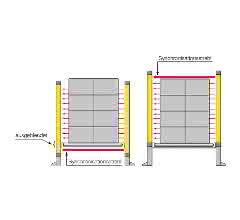
If the transported goods require longer than 60 seconds to pass through the light curtain or if the maximum permissible time-out values of ten minutes or 100 hours are to be used, it must be ensured that at least one synchronization beam always remains free. This can be achieved in two ways:
The uppermost beam serves as the synchronization beam. The height of the light curtain is selected so that the synchronization beam always runs above the highest point of the transported goods. The lowest beam serves as the synchronization beam. The protective field is arranged so that the synchronization beam runs below a conveyor section, for example. The beams of the safety light curtain are partially interrupted by the conveyor section. This area can be blanked out with the "fixed beam blanking with 1 beam tolerance" function.
Standards and specifications
The specification of the MLC 530 SPG safety light curtains is designed in accordance with the safety-relevant international standards. The data of the sensor itself is Type 4 (IEC/EN 61496), Performance Level PL e/ Category 4 (EN ISO 13849-1) and SIL 3 (IEC 61508). The sensors and the associated documentation for integrating the solution are certified by an independent body. All aspects to be observed for use are described in the operating instructions. Jörg Packeiser/as


You might also be interested in
ebm-papst is growing again thanks to AI and data centers
ebm-papst returned to a growth trajectory in fiscal year 2025/26. Air Technology, data center applications, and artificial intelligence are driving revenue and investment.
 read more...
SPE on the Verge of a Market Breakthrough
Single Pair Ethernet (SPE) has moved beyond the conceptual phase and is increasingly being implemented in industrial settings. The focus here is not only on higher data rates and simplified cabling, but above all on the issue of system integration...
read more...More than 900 exhibitors already registered
Around six months before the start of the trade fair, more than 900 companies have registered for SPS 2026 in Nuremberg. The trade fair focuses on industrial AI, cyber security and digital transformation.
read more...Virtual PLCs in practice: How vPLCs make production systems more flexible and scalable
The increasing networking of IT and OT is fundamentally changing industrial automation. The IT/OT Integration Summit shows how modern technologies can make production environments more efficient, flexible and future-proof. The event will focus on...
read more...Sales growth in a turbulent market environment
Thanks to innovations and a focus on strategic industrial markets, Sick was able to moderately increase its sales in the 2025 financial year. In a turbulent market environment, the company was able to maintain its position and gain market share with...
read more...Siemens presents new AI agent
Siemens is launching 'Eigen Engineering Agent', an AI for automation technology. The solution is integrated into the TIA Portal, has been tested with over 100 companies and is designed to significantly accelerate engineering processes.
read more...Schaeffler keeps sales almost stable
Schaeffler generated revenue of EUR 23.5 billion in 2025 and increased EBIT before special items to EUR 936 million. At 266 million euros, free cash flow was significantly above the prior year and forecast. Net income remained negative due to high...
read more...Advancing artificial intelligence together
Helukabel is stepping up its activities in the field of artificial intelligence and is now a member of the IPAI. The innovation and collaboration platform for companies, research facilities, institutions and administration has set itself the goal of...
read more...New impetus for ifm sales
Two new positions were filled at ifm at the start of 2026: Markus Wolf becomes Managing Director Sales Germany, Sven Quant takes over the position of Central Managing Director in the Process Sensors division within the ifm Group.
read more...