
Safety laser scanner
Brings safe movement to the MRK
The new Microscan3 Pro safety laser scanner from Sick has extended functionalities for robotics applications and mobile applications. In addition, interfaces for Profinet Profisafe and for Ethernet/IP CIP Safety offer improved integration flexibility.
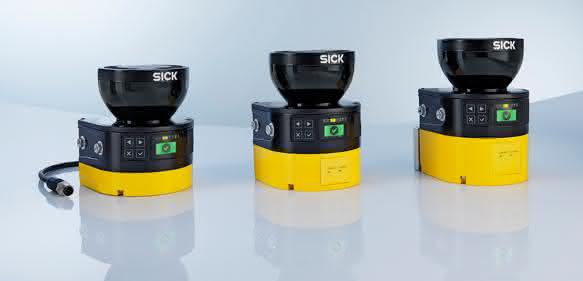
With up to eight simultaneous protective fields and 128 individual fields of the Microscan3 Pro, up to 128 monitoring scenarios can be set up for specific applications. The movement sequences of robots and vehicles can thus be monitored in fine increments - handling and transport processes can be carried out with better movement continuity, fewer stops and therefore higher productivity. According to the manufacturer, a particular additional benefit for automated guided vehicles (AGVs) is the ability to use the measurement data from the safety laser scanner for vehicle navigation.
Adapted driving behavior
With the help of up to 128 possible protection, warning and contour detection fields, the safe driving, braking and acceleration behavior of autonomous vehicles is automatically adapted to individual conditions such as vehicle load, speed or route layout. This enables smoother and more efficient driving behavior - even in curves or when approaching transfer points or detected obstacles. This increases the overall intralogistical productivity of the vehicles. In addition to safety-related monitoring, the Microscan3 Pro also provides high-precision measured values that can be used for vehicle navigation. Continuous contour detection by the safety laser scanners provides the basis for vehicle positioning and navigation.
In robotics, the extended functionalities also enable a more individual design of warning and protective fields and monitoring scenarios as well as more finely granulated motion control. Human-robot applications in particular benefit from this. The movement control of a robot within its planned operating environment can be adapted to the position of a human using the information from the Microscan3 Pro. Depending on the speeds and travel distances, the safety distances are permanently monitored and the robot slows down, stops or changes its direction of movement depending on the actual degree of danger. If the distance between the operator and the machine increases beyond the minimum distance again, the robot system can automatically continue its movements at the usual speeds and travel distances.
Flexibility in network integration
With the Profinet Profisafe and Ethernet/IP CIP Safety network interfaces, the safety laser scanners can be integrated into communication structures that are widely used in robotics and AGV systems. The Ethernet-based transmission of safety-related data and non-safe data to a safety controller takes place via a common cable.
The connection options of these safety laser scanners to a Profisafe or CIP safety master are interesting for robot manufacturers, for example, as many robots have a slave/master function with Profisafe or CIP safety. AGV manufacturers also benefit from the improved connectivity if, for example, they change the control concept of their vehicles from a standard to a safety control system, which in turn supports safe fieldbuses. Finally, the interfaces for Profinet Profisafe and Ethernet/IP CIP Safety make it possible to choose between automation systems from different manufacturers in both AGV and robotics applications.
The safety laser scanners in the microScan3 product family are used for horizontal and vertical safeguarding of hazardous areas in stationary and mobile applications. Regardless of the equipment variant, all devices offer ranges of up to 5.5 meters. Their protective fields can be configured for specific applications in graduated resolutions between 30 millimetres and 200 millimetres. According to Sick, one of the unique technological features is its SafeHDDM (High Definition Distance Measurement) scanning technology. With this high-resolution, digital process for safety-related time and distance measurement, 88,000 laser pulses are emitted instead of only around 600 to 800 pulses with conventional time-of-flight measurements. In conjunction with the special, digitized evaluation, this makes it possible to generate more stable measured values and also detect the prescribed minimum emission values of 1.8 percent more reliably. as


You might also be interested in
Helu makes its first trade fair appearance under a new brand name
Helu Kabel will be presenting itself as Helu for the first time at Hannover Messe 2026, showcasing system solutions, Heluchain cables and new industrial luminaires.
 read more...
Strategic realignment with brand relaunch
In future, Helukabel will trade as Helu
The Helukabel Group is parting with part of its name: in future, the company will only operate under the Helu brand. With this step, the specialist for electrical connection technology is underlining its strategic development from a classic cable...
read more...Modular plant construction for corrugated board
Insight into the production of corrugators at BHS Corrugated: Automated, modular and equipped with Helukabel components.
read more...Best quality for the steel
Conditions in the steel industry are harsh and inhospitable. The machines used must be able to withstand the demanding environmental conditions in order to deliver the best quality at all times.
read more...If the standard cable is not sufficient
Lapp offers cables for countless applications - but not for all of them. From time to time, the developers have to modify a standard cable or develop a special cable.
read more...Slight decline in sales, strong investments
The Lapp Group has not been spared from the weakening global economy. However, the company only recorded a slight loss in the past 2024 financial year.
read more...Electrical connection technology
Cables and wires for industrial automation
Heukabel offers system solutions for cable routing from a single source. The subsidiary EKD Systems specializes in tailor-made cable drag chains made of steel, stainless steel and plastic, which are used in moving machines and systems as well as in...
read more...Lapp relies on Ultramid from BASF
Mobile charging of electric vehicles
The automotive industry is currently undergoing the biggest transformation in its history. The boom in battery electric vehicles in particular is presenting the industry with major challenges. Lapp, as a supplier of cables and connection...
read more...Cable handling application
At this year's Motek, ArtiMinds Robotics is showcasing a robot-based automation solution for the sensor-assisted assembly of flexible cables in connector housings.
read more...