
Cyber Resilience
Always one step ahead of cyber criminals
Cybercrime is now omnipresent. What can companies and IT managers do to ensure that these attacks remain unsuccessful?

The more complex a system, the more diverse the opportunities to throw it off balance - this insight may sound simple, but it has enormous implications for IT and communication environments. Because while digital infrastructures are becoming increasingly complex, cyber criminals are bursting with ingenuity and zest for action. With a sophisticated cyber resilience strategy, management and IT security managers can keep an eye on the big picture and gain a decisive edge.
Attacks on IT systems are not an isolated phenomenon. A computer is attacked by a criminal hacker every 39 seconds. These are the findings of a study by the University of Maryland. This adds up to over 116,000 criminal attacks per year on a single Internet-enabled device. An expensive joke that could cost the global economy more than six trillion US dollars a year, according to Cybersecurity Ventures. For IT security managers, it is clear that they need holistic security concepts if they want to put a stop to cyber criminals - and preferably before any significant damage has been done. Attacks can have a wide variety of targets: Industrial espionage, damage to image, manipulation or paralyzing operations are just a few examples.
The key to modern security strategies is to always be one step ahead of data thieves and IT saboteurs and to be able to react quickly and, above all, in a targeted manner when in doubt. With cyber resilience, companies rely on a holistic catalog of methods that is just as versatile as the illegal toolboxes of cyber crooks - and thus enables proactive and active intervention that limits the damaging effects of attacks or even prevents them altogether.
The most common tricks used by cyber criminals
According to a Bitkom study from 2018, seven out of ten industrial companies were affected by cyber attacks in the previous two years. Given that the demand for remote services increased significantly in 2020 and that there was a noticeable shift of processes to the public cloud at the same time, this trend is not set to decline in the foreseeable future.
One glaring vulnerability is access data and passwords. On the one hand, these are stolen, on the other hand they are automatically tried out using brute force methods until authentication is faked with a random hit. Alternative access to applications or hardware, so-called back doors, are an equally popular method used by intruders. Malware is also very popular. In its 2020 situation report, the BSI explains that the variety of malware programs is constantly increasing - an increase of around 117 million variants was registered between the beginning of 2019 and mid-2020.
Social engineering, which essentially aims to defraud employees of their data through personal manipulation, should also not be neglected. Finally, in addition to threats that affect companies from the outside, there are a number of security risks that arise from within the organization or the system. These include unclear access authorizations or improperly configured applications as well as user errors that are immediately exploited by cyber criminals.
Cyber resilience closes the security loop
Although it would be ideal to completely eliminate security vulnerabilities and thwart attacks entirely, this intention is not realistic. This is because national and international cybercrime networks are now so adept and efficiently organized that they quickly adapt to standard protection mechanisms. Their activities are designed to constantly discover new gaps in systems. Firewalls, email encryption, etc. are still indispensable here, but they can never offer 100% protection. For this reason, it is important to systematically identify vulnerabilities and blind spots, to be on site when the attack succeeds at such a predetermined breaking point and to initiate effective measures that intercept an attack as well as possible.
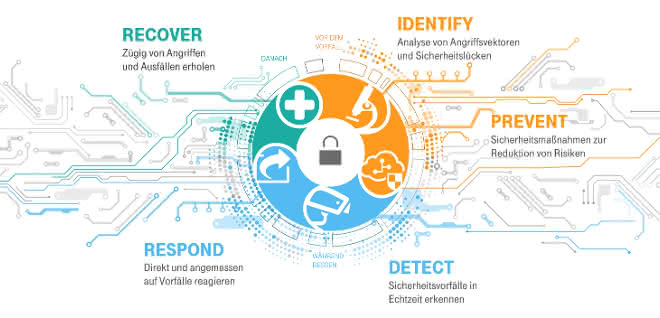
All measures - both proactive and reactive - must be continuously optimized and adapted to the behaviour and methods of hackers. Far-reaching cyber resilience is achieved when individual security, recovery and business continuity methods become a closed cycle that begins with the identification of risks (Identify), derives protective measures from this (Protect), recognizes threats as far as possible automatically (Detect), responds to these threats in a targeted manner (Respond), restores normal conditions in all areas of the infrastructure (Recover) and uses the analysed findings from security incidents to optimize cyber resilience mechanisms. Companies that use adaptive AI algorithms for this purpose are even able to better assess future threats and their characteristics (predictive security).
Identify: Recognize and evaluate risks
A comprehensive and effective cyber resilience strategy requires one thing above all: a clear view. Where are the weak and predetermined breaking points in the system and how far-reaching is the risk posed by these neuralgic system areas? How could an attack occur? These questions are not only relevant during operations, but should also be considered during the development of new solutions and system components. This is why DevSecOps mechanisms and automated scanning and testing activities are increasingly becoming the standard for secure IT infrastructures. What is also charming about these types of solutions is that they keep an eye on the entire life cycle of a software in the spirit of end-to-end cyber resilience and therefore record and evaluate all security-relevant events.
Protect: Define security mechanisms
The results of the Identify process have a direct impact on the selection and design of preventive security measures. Ultimately, the solutions and processes used for this purpose must be specifically coordinated so that they neither create redundancies nor unintentionally leave gaps open. Constantly adapting the underlying metrics and functions ensures that the developed concepts "learn" and that the established mechanisms remain responsive. Raising staff awareness is just as important as using smart software: after all, even the best email encryption is useless if employees carelessly disclose sensitive information or fail to keep their access data under lock and key.
Detect: Detect deviations, recognize attacks
This stage of the cyber resilience cycle shows how valid the classification of vulnerabilities from the Identify phase is and how well the monitoring tools used can evaluate the resulting metrics. Learning, AI-based monitoring tools use defined parameters to automatically detect whether there are irregularities in the infrastructure that indicate an attack - this is made possible by monitoring network communication and intelligent pattern recognition, among other things. The incidents range from criminal hackers accessing the internal database, acute denial-of-service (DOS) attacks or data-stealing Trojans to bots that distort the statistics of your own website through spamming and thus drive up cost-per-click fees, for example.
Respond: Implement measures in a planned and prudent manner
The challenge in this phase is to prevent damage and shield business operations from a threat as much as possible. One thing is clear: if the detect mechanisms identify a threat quickly and efficiently, countermeasures can also be initiated with a correspondingly short response time. Just as important as a high detection speed is a catalog of measures that is as differentiated as possible. The more targeted and versatile an incident response plan is, the easier it is to reach straight into the right drawer in the event of a security incident. This makes it possible to plan a step-by-step response to an incident - both for minor, everyday security incidents such as a bot that simulates real user behavior and for a serious sabotage attack that puts the operational processes of the entire company at risk.
Recover: damage repair and system stability
Harmless incidents such as a bot attack can be remedied with simple means. It is often sufficient to block the malware, document the attack in the log and restore the system from the backup - without malware, of course. In the case of more severe attacks, however, more extensive recovery measures are required in order to restore a stable system status as quickly as possible and thus return to normal operation. Depending on the nature and severity of a security-relevant event, the processes defined in the business continuity and disaster recovery strategies come into play here.
Predict: Predictive analyses
This important stage of the process closes the cycle of an intelligent cyber resilience strategy by integrating the monitoring and analysis results from security incidents and using them to develop targeted assessments and predictions for new, potential threats. The predictive evaluations flow directly into the identification of security-relevant vulnerabilities in the company infrastructure. AI-based monitoring tools create the necessary framework for automated detection and evaluation processes, which are essential for responsive and accurate tactics to achieve cyber resilience.
It's obvious: a security strategy that aims to ensure the highest level of data and system protection even in complex IT environments must be more than a collection of individual measures. Cyber resilience depends on all security-relevant processes being optimally coordinated and the underlying solutions continuously learning. In this way, companies can effectively counter the high level of inventiveness of cyber criminals and always stay one step ahead.
Frank Schönefeld, Head of Business Area Digital Reliability and Member of the Management Board and Katja Tietze, Senior Business Development Manager and Consultant, both T-Systems Multimedia Solutions


You might also be interested in
ESTIA aims to strengthen Europe's cloud
New tech alliance for EU sovereignty
Twelve companies, including Dassault Systèmes, are founding the European Sovereign Tech Industry Alliance (ESTIA). The initiative aims to strengthen Europe's technological independence and define requirements for sovereign cloud services. The start...
 read more...
Deutsche Telekom and Nvidia launch one of Europe's largest AI factories
With the Industrial AI Cloud in Munich, Deutsche Telekom and NVIDIA are creating one of the largest AI factories in Europe. Companies can train AI models, carry out simulations and access 10,000 GPUs.
read more...Leveraging data potential with AI and streaming
Huge data treasures are still lying dormant in many manufacturing companies. And yet it is high time that these treasures were unlocked. There is often a lack of resources and capacity to make data usable in real time. Streaming production data can...
read more...More awareness of noise
Dematic offers solutions that are tailored to different cloud environments and reduce environmental impact through reduced material consumption and improved energy efficiency.
read more...Generative AI in the automation environment
The mechanical engineering and automation industry is undergoing profound change. This transformation is being driven by more volatile global trade, geopolitical crises and increasing market pressure, which demands greater agility, technological...
read more...Rigid data structures have had their day
The traditional data center is no longer the center of data. A hybrid cloud storage approach enables manufacturing companies to both meet the current requirements of data-intensive processes and future-proof their infrastructure.
read more...Software as a service in three stages
CIM Database Cloud is a new out-of-the-box solution from Contact for end-to-end digital product development.
read more...How production can benefit from AI
Together with AI technology, IIoT networking makes it possible to better control machine parameters and optimize quality with predictive quality. Downtimes and set-up times can also be further minimized. Cloud platforms also make these technologies...
read more...More expertise for digital engineering
Altair, a computational science and artificial intelligence (AI) company, has acquired OmniV, a technology from Michigan, USA-based software company XLDyn.
read more...