

Giving lightweight construction a profile
Pultrusion: A process that forms fibers under tension
Pultrusion is a fully automated manufacturing process in which fibers are passed through a resin bath and then drawn through a heated mold as impregnated material. Once hardened, a profile with particularly high mechanical strength is created. It can be drawn directly into the desired geometry and manufactured in any wall thickness, with hollow chambers or undercuts if required. Properties can be specifically adjusted by combining different fibers and resin systems.
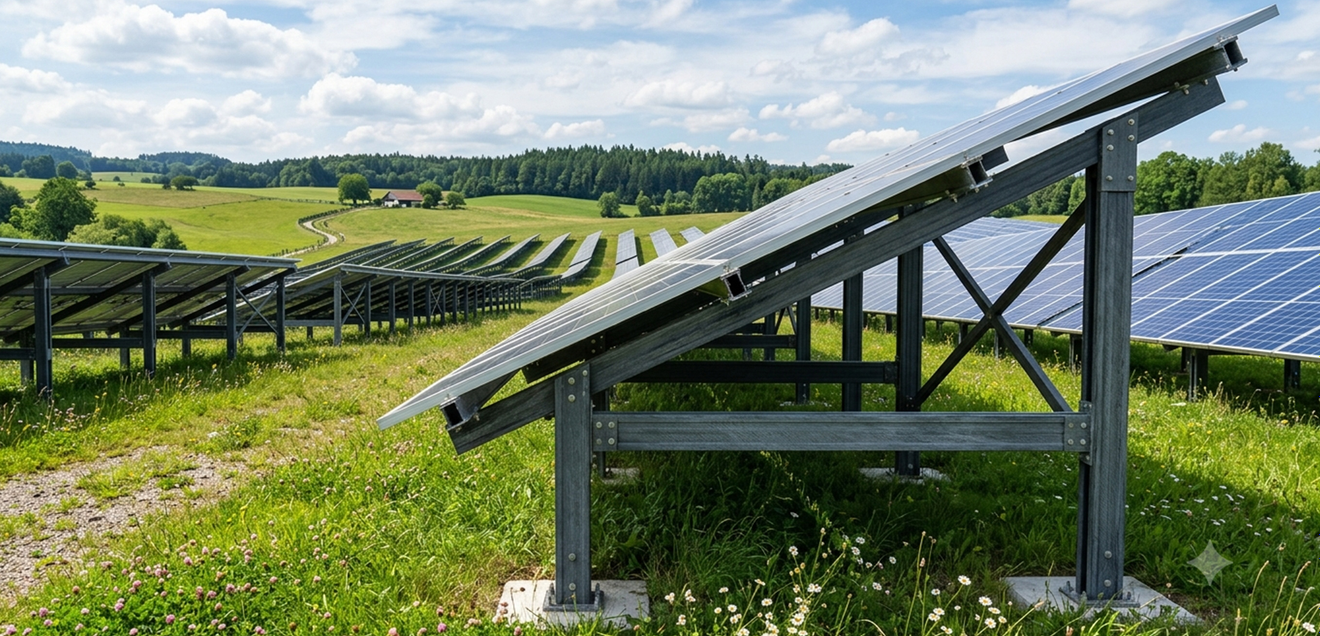
The advantages lie not only in the material performance, but also in the process itself: high production speeds, low manufacturing costs and consistent quality are making pultruded profiles increasingly attractive - even for applications that were previously reserved for other materials. These include solar systems, rotor blades for wind turbines and components in electric car batteries. In concrete structures, on the other hand, the profiles are already considered superior to traditional steel reinforcements as they do not corrode.
Lightweight, long, high-strength and versatile
Pultruded profiles are characterized by an unusual combination of low weight and high rigidity. It is precisely these material properties that open up new fields of application in energy and transportation infrastructure, but also in industrial production itself.
They are already being used in the substructures of solar installations, for example. There, large panels not only have to be supported, but also permanently stabilized against wind loads. Similar requirements apply to the rotor blades of wind turbines, where torsion-resistant structures are specifically used.
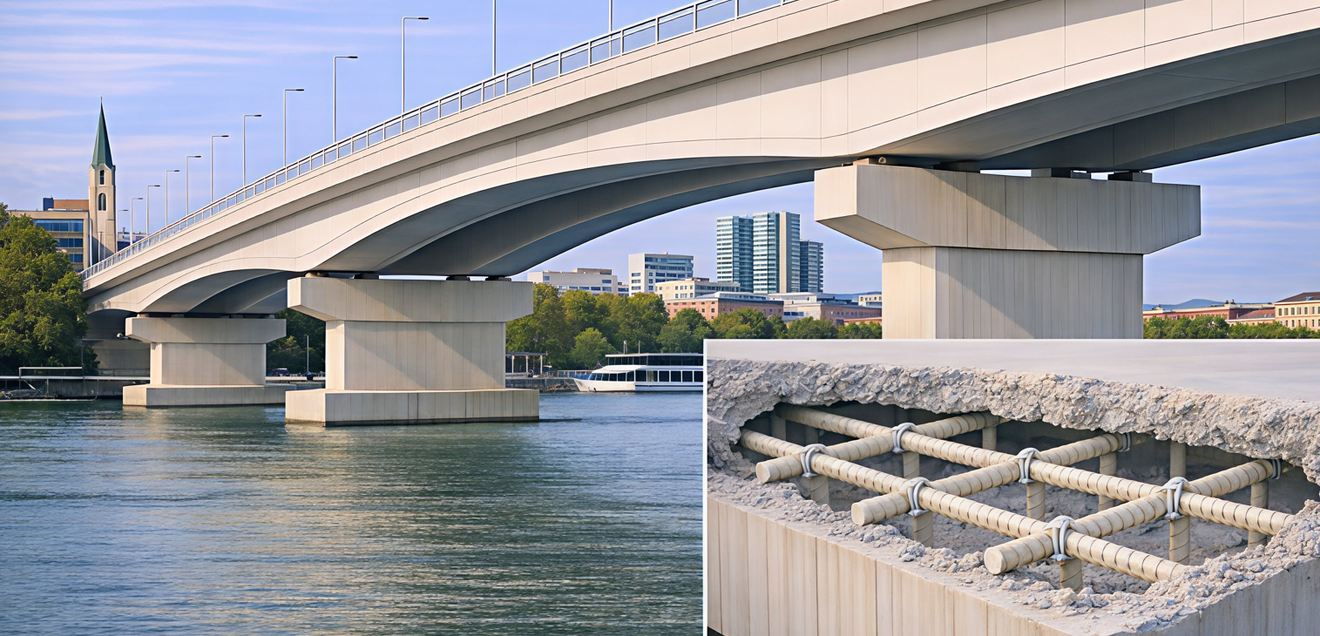
Profiles are also increasingly coming into focus in civil engineering and building maintenance. Pultruded concrete reinforcements (GRP rebars) are superior to steel in certain applications, as they are resistant to salt and corrosion and can significantly extend the service life of bridges and tunnels. The material does not rot, is extremely resistant to chemicals and insensitive to the effects of the weather.
Lightweight, crash-proof and electrically insulating structures are also used in battery housings and underbody protection systems for electric vehicles. In rail vehicles, on the other hand, cable guides and electronic components can be integrated directly into the pultruded profile - an approach that is aimed at multifunctional components instead of subsequently assembled individual solutions.
Sustainability as a driver: the transformation of resin systems
One of the main reasons for the current "career prospects" of profiles is the further development of the resin systems used. For a long time, pultrusion was predominantly based on thermosetting systems, which are not recyclable after curing.
In the meantime, however, the focus is increasingly shifting towards sustainable alternatives. Thermoplastic matrix systems in particular are regarded as a key technology. They not only enable complete recycling at the end of the life cycle, but also subsequent formability under the influence of heat.
This also makes pultruded profiles interesting from an ecological perspective for applications with high service life requirements and simultaneously increasing sustainability requirements - for example in energy infrastructure or transportation.
Complex profile geometries on an industrial scale
At the Fraunhofer IWU, the pultrusion process has been continuously developed and technically differentiated over the past ten years. Today, the institute is one of the few facilities that can produce complex profile geometries on an industrial scale.
The portfolio includes classic resin bath processes as well as highly reactive 2K systems and thermoplastic pultrusions - both reactive and melt-based. The ability to produce curved pultrusion profiles is also particularly emphasized; according to the institute, it is the only research facility in the world with this capability.
The scientific work covers the entire value chain: from component design and simulation-supported process development to production and analysis. The materials used range from highly reactive resin systems and thermoplastics to carbon and natural fibers.
The Fraunhofer IWU is also working on cross-sectionally variable profiles and graded structures. The aim is to control the degree of curing locally in order to optimize the bond strength within a component. The integration of metals or sensors is also possible. Process steps such as impregnation, curing and warpage are not only monitored, but also simulated.
"Giving lightweight construction a profile": research meets industry
A symposium on the topic will be held in June. The sixth edition of the symposium on June 16 and 17, 2026 will also mark an anniversary: ten years of pultrusion at Fraunhofer IWU. Under the motto "Giving lightweight construction a profile", the focus will be on the exchange between research and industry.
Live pultrusion with a 'ProxximaTM' resin system for the production of a new class of thermoset polyolefins will be demonstrated. Polymer chains are chemically cross-linked to create a non-meltable, particularly dimensionally stable and temperature-resistant network. The system is based on Nobel Prize-winning catalyst technology and has a significantly lower carbon footprint compared to conventional thermosets. It also has an extremely low viscosity and adjustable reactivity, which should further increase the cost-effectiveness of the processes.
A second focus is on hybrid profiles, the development of which the institute has driven forward over a decade in several publicly funded projects. The results of the inline production of such structures, which can absorb large amounts of energy in vehicle construction, particularly in the event of a crash, will be presented. At the same time, they are compatible with conventional joining methods such as welding - a result of modified, now patented pultrusion processes.
A material system between efficiency and transformation
Pultruded profiles are therefore increasingly moving at the interface between traditional lightweight construction and material technology transformation. Their industrial relevance is growing in areas where high mechanical strength, low mass and economical production need to come together - and where new requirements for sustainability and functional integration are emerging at the same time.
The process itself, long regarded primarily as a niche technology, is thus developing into a building block of future industrial material systems.


You might also be interested in
Research at the Intersection of Fiber...
New Fiber-Optic Technology Reduces Energy Consumption in Photonic Computers
Frozen at -196 °C: A new liquid-core fiber combines light and sound with high efficiency, opening up new avenues for quantum computing and photonics.
 read more...
A quantum computer that performs calculations using oscillations
When it comes to storing information, quantum computers have so far run up against technical limitations. Instead of electromagnetic storage, researchers are now using mechanical vibrations. Their vibrating memory can store significantly more...
read more...Hydrogen Pipelines Put to the Test
New real-world lab tests safety and resilience
The Federal Institute for Materials Research and Testing (BAM) is opening a real-world laboratory to study pipelines and components for the safe operation of future hydrogen networks.
read more...Research Platform for the Energy Supply of the Future
For the first time, the Karlsruhe Institute of Technology (KIT) is bringing together key hydrogen technologies in a single research environment. The facility is intended to demonstrate how the production, storage, transport, and use of hydrogen can...
read more...When the quantum computer arrives
The Research Race to Ensure the Security of Critical Infrastructure
How can we protect our critical infrastructure from attacks by quantum computers in the future? As part of the QUEST project, Darmstadt University of Applied Sciences is researching new methods—post-quantum cryptography—designed to withstand even...
read more...VDE study on electrical engineering
More retirements than graduations
According to a VDE analysis, more than 30,000 electrical engineers will retire by 2029 without enough graduates to replace them. This is due to falling student numbers and high drop-out rates.
read more...Green hydrogen directly from the sun and water
A start-up project at the Karlsruhe Institute of Technology (KIT) aims to fundamentally simplify the production of green hydrogen: Mass-produced photoreactor panels are to be used to produce hydrogen directly from sunlight and water - without...
read more...Fraunhofer shows industrial future between AI, data and new materials
At Hannover Messe 2026, the Fraunhofer-Gesellschaft will be presenting solutions for a resilient industry: from AI and data rooms to hydrogen technologies and material and recycling innovations.
read more...The bottleneck is in the system
Is the transformation of the industry failing due to "German Angst"?
A recent ISF study examines what is slowing down change in German industrial companies. According to the results of the study, the causes of innovation bottlenecks often lie in internal structures and a lack of strategic orientation.
read more...