

Photonic microchips with 3D connector
How a 3D system makes photonic chips industrially viable
It sounds like a technical side note, but it could be a decisive step for the industrial production of photonic systems: physicists and chemists at Heidelberg University have developed a photonic microchip in such a way that in future it should be just as easy to connect as an electronic component - via a "plug".
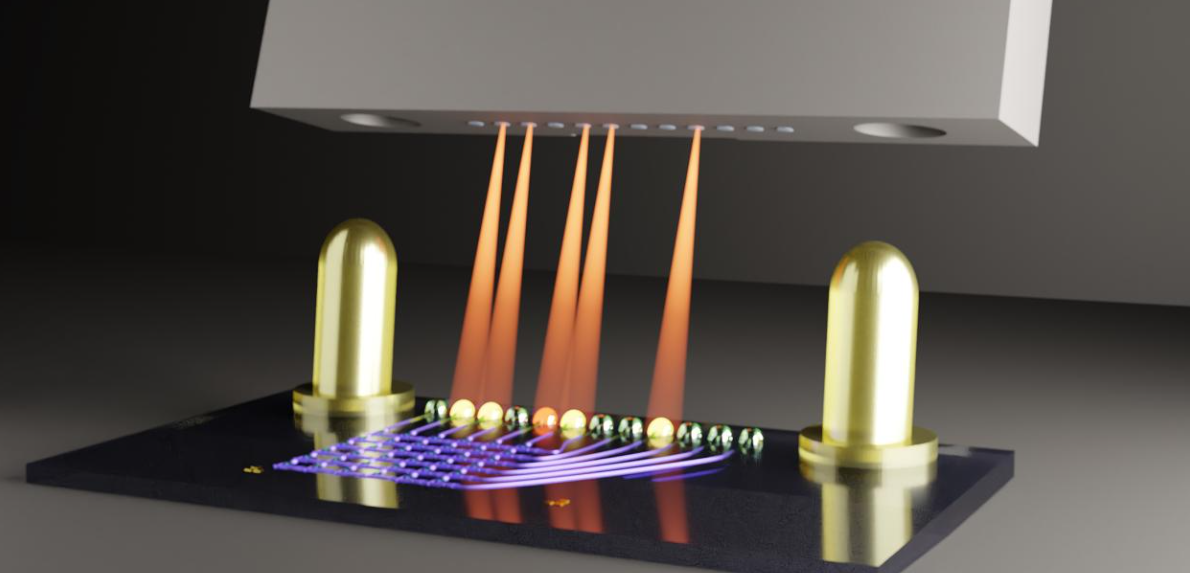
The vision behind it is as pragmatic as it is ambitious. Instead of putting optical chips into operation with complex experimental adjustments, the coupling of optical fibre and chip is to be standardized, reproducible and automatable. The new connection concept was developed under the leadership of Prof. Dr. Wolfram Pernice at the Kirchhoff Institute for Physics. It could form the basis for faster and more cost-effective production of photonic integrated systems - and thus for technologies that play a central role in data centers, communication networks or future quantum architectures.
Photonic integrated circuits (PICs) use light instead of electrons to transmit information. They offer extremely high bandwidths, minimal delay times and are also considered more energy-efficient than conventional electronic systems. All optical components, such as waveguides, are integrated directly on the chip. Bulky arrangements of mirrors and lenses are replaced by compact structures. Their innovation potential ranges from quantum communication to neuromorphic computing and high-speed optical communication.
However, the technological hurdle is particularly evident at a crucial point: when coupling the data in and out. Optical fibers are generally used to ensure that the light reaches the chip with minimal loss. These must be positioned with an accuracy of less than five micrometers in all spatial directions - otherwise a large proportion of the signals will be lost. Until now, this adjustment has been carried out using so-called active alignment. In this process, the optical fibers are precisely aligned for maximum light transmission during operation and then fixed in place. According to the Heidelberg researchers, however, this process is slow, cost-intensive and difficult to automate.
An alternative solution to date has been to integrate microlenses on fibers and chips in order to increase the alignment tolerances. However, this method also has its limits. The production of such lenses is complex and only works for a narrow wavelength range - a disadvantage that limits the high bandwidth of photonics as a key advantage.
The team from Heidelberg is therefore taking a different approach: a novel connection concept that mechanically standardizes the coupling between fibre and chip. Fibre optic cables are precisely arranged in a glass block and provided with standardized alignment holes. The counterpart is created directly on the chip surface - manufactured using high-precision 3D microprinting. This element acts like a "connector".
The actual coupling takes place via three-dimensionally printed total reflection couplers. They redirect the light waves with low loss and are designed as super broadband components for the wavelengths between 1,500 and 1,600 nanometers that are typical in telecommunications. They guarantee practically constant transmission in this range. "Thanks to this innovative plug-in solution, we guarantee that no data is lost during the coupling process," explains Erik Jung, a doctoral student in Prof. Pernice's research group.
With the new concept, the researchers also succeeded in efficiently controlling a neuromorphic photonic processor with 17 ports - i.e. 17 communication endpoints. This demonstrates the practical feasibility of the approach.
"Our approach shows how broadband, low-loss and scalable connections for light-controlled microchips can be easily realized. This 'connector' paves the way for automated, reproducible and efficient mass production of photonic integrated systems," says Wolfram Pernice.
According to Erik Jung, the connection concept is compatible with hybrid systems in which electronics and photonics are combined. At the same time, modular and flexibly reconfigurable architectures are supported. The "connector" could therefore become a central component for next-generation computing and communication systems - for example in optical sensor technology.
The work was carried out together with researchers from the Institute for Molecular Systems Engineering and Advanced Materials at Heidelberg University. They are embedded in the Cluster of Excellence "3D Matter Made to Order". The results were published in the journal Science Advances.
Original publication:
Jung, E., Gehring, H., Brückerhoff-Plückelmann, F., Krämer, L., Vazquez-Martel, C., Blasco, E., & Pernice, W. (2025, September 26). Ultrabroadband plug-and-play photonic tensor core packaging with sub-dB loss. Science Advances. DOI:10.1126/sciadv.adz1883


You might also be interested in
New Resin Opens Up 3D Printing for the Optics Industry
With BMF Clear, Boston Micro Fabrication has introduced an optically transparent photopolymer resin for micro-precision 3D printing that achieves a light transmittance of over 90 percent at layer heights of 10 micrometers or more and is suitable for...
 read more...
3D Printing in the Defense Sector
Formnext Launches 2026 Defense Summit
Formnext is expanding its program to include the security and defense sector and will host the first Formnext Defense Summit in 2026. The event will focus on the potential of additive manufacturing for resilient supply chains, industrial...
read more...UltiMaker Doubles Speed in Industrial 3D Printing
With the Factor 4 Plus, UltiMaker is introducing a new version of its industrial desktop 3D printing platform, which operates at up to twice the print speed of the standard model. The platform is designed for use in manufacturing and defense...
read more...Stratasys takes over MarkForged
Stratasys is acquiring MarkForged from Nano Dimension for USD 42.5 million, thereby expanding its portfolio in the field of fiber-reinforced composites. The acquisition also strengthens the company's software and materials expertise in industrial 3D...
read more...Timo Göbel, Head of BMW Additive Manufacturing
"Clearly on course for broad industrialization"
The BMW Group's Additive Manufacturing Campus (AMC) is setting the course for the next stage of industrialization. Under the leadership of Timo Göbel, additive manufacturing is being further integrated into all stages of the vehicle life cycle. In...
read more...Real-time control to make recycling materials economical
The Fraunhofer IAPT is researching AI-based closed-loop processes for industrial 3D printing with recycled plastics. The aim is to achieve less waste, greater process stability and profitable printer farms.
read more...Forum Solutions 4AMIndustry shows ways into industrial application
Additive manufacturing has developed dynamically in recent years and has long outgrown its status as a purely innovative technology in many industries. Nevertheless, companies still face the challenge of integrating AM into their production...
read more...Alliance aims to drive forward industrial 3D printing
Machine components, electrostatically shielded transport containers, large components for the automotive, rail and aviation industries or specific medical products straight from the printer - the potential applications of additive manufacturing are...
read more...Stratasys simplifies post-processing for 3D printing
Stratasys has launched a partner program for post-processing solutions to facilitate the creation of end-to-end AM workflows. The first partner is PostProcess Technologies, whose automated systems for FDM, PolyJet, SLA and P3 can now be purchased...
read more...