
Cloud and edge solutions
Facets of the digital transformation
The integration of cloud and edge solutions in cyber-physical production systems opens up new potential in automation. Among other things, research focuses on economic solutions for the challenges of digitalization.
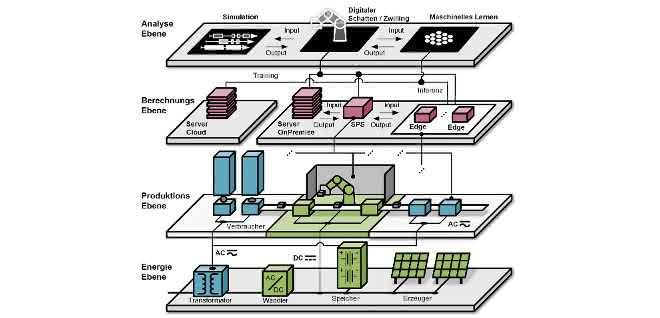
Global trends such as mass customization, digitalization and artificial intelligence are having a massive impact on the development of cyber-physical production systems (CPPS), thereby shaping the production facilities and value networks of the future. Digitalization in particular is opening up new opportunities in automation, with the integration of edge and cloud solutions being key topics.
The challenges are manifold and range from the hardware to the control and platform level: from changing communication requirements, the mapping of entities in modular services, the pre-processing and transfer of large amounts of data for ML-based analysis, to new, edge- and cloud-based approaches for the control and regulation of automated production systems.
The FAPS Chair conducts research into a broad range of topics in order to evaluate economic solutions to the challenges posed by digitalization. The following examples from the Automated Production Systems research area give an impression of the research topics.
System programming meets ML
The increasing complexity is also noticeable in the commissioning of production systems. Although IEC 61131 and IEC 61499 are standards that define the procedure and scope of functions, the specifications set out in these standards do not keep pace with the development of modern programming paradigms.
One concrete example is the lack of library-based provision of ML algorithms, which cannot be directly integrated as function blocks in the programming of automated production systems. This prevents automatically derived process improvements at runtime and in real time.
To address these challenges, which are caused by hardware and communication limitations, outdated programming paradigms and backward tool chains, we investigate possibilities to integrate real-time capable, event-driven communication in CPPS, approaches to increase efficiency in the context of ML and to extend existing tool chains in automation.
Edge-based intelligent production
Autonomous, intelligent production systems are the key to being able to react to the fluctuating demand for individualized products or to disruptions on the store floor. These can adapt their behaviour intelligently and optimally to changes in the environment, the system objectives or the system at runtime and in real time by perceiving their environment via a comprehensive, pervasive sensory system, building a consistent representation of the world - a world model - and initiating actions to optimize a target function based on this. The implementation is essentially limited by three factors: the amount of sensor data required to create a world model, the limited computing power in the control technology and the necessarily very short reaction times in real-time systems. In this context, we are investigating, among other things, ways to aggregate sensor data close to the data source by integrating edge devices into the automation architecture. In addition, we have greatly expanded the computing power of a CPPS so that computationally intensive algorithms can be evaluated quickly and actions can be triggered in real time.
Energy and load management
In addition to time, cost and quality-related optimization, energy and resource efficiency is also an integral part of the research canon. Energy and load management systems (ELMS) face the prospect of an explosion in data availability in process real time. The use of cloud-based ELMS in the production environment is limited by two factors: On the one hand, the amount of data collected by sensor nodes and sent over the network for analysis is limited by the required response time. In addition, this data represents safety-critical process characteristics. To meet these challenges, sensor-related, intelligent processing of the resulting data in edge devices is a promising solution. We are researching how classic control components and edge devices are developing from simple data collectors and brokers into data-processing end devices. They must be able to execute computationally intensive ML algorithms, pre-select potentially interesting data and transform it into a more abstract, secure form with higher information density.
J. Fuchs, D. Kißkalt, Prof. Dr.-Ing. Franke
Briefly explained: The MHI e.V.

The Wissenschaftliche Gesellschaft für Montage, Handhabung und Industrierobotik e.V. (MHI e.V.) is a network of renowned university professors - institute directors and chair holders - from German-speaking countries. The members conduct both fundamental and application-oriented research on a wide range of current topics in the fields of assembly, handling and industrial robotics. Further information on the society, its members and activities: www.wgmhi.de
Briefly explained: FAPS

The objective of the Chair of Factory Automation and Production Systems (FAPS) at FAU Erlangen-Nuremberg is to network all sub-functions of a factory into an overall computer-integrated concept. The FAPS currently has around 120 employees at two locations conducting research in the fields of automated production systems, engineering systems, biomechatronics, electronics production, electrical engineering, on-board networks and home automation. Prof. Jörg Franke's research focuses on innovative manufacturing processes for mechatronic products. Intensive interdisciplinary cooperation is practiced in twelve fields of technology. Over 80 percent of the research work is carried out in cooperation with partners from industry.


You might also be interested in
"We are clearly different from the competition"
The IT company 21unity offers a range of hardware and software services, as well as traditional services. Andreas Mühlbauer spoke to Managing Director Anja I. Gondolf about the company's appearance at the Hannover Messe, its services and future...
 read more...
Think digital, act local
When it comes to industrial damping technology, on-site advice is often very valuable for engineers and designers.
read more...Plagiarius 2024 negative prize
On January 26, 2024, the Plagiarius campaign awarded its dreaded "Plagiarius" negative prize for the 48th time to manufacturers and retailers of particularly brazen counterfeits and fakes.
read more...Spindel Full Service records second-best...
Maintenance as an economic success factor
Spindel Full Service, the spindle repair specialist from Baden-Württemberg, can look back on its second-best financial year in its history - with 15% growth compared to the previous year. And the further forecast also looks good.
read more...Thyssenkrupp and Novelis cooperate
Platform for the circular economy
With a platform for the circular economy in the automotive industry, the two companies Thyssenkrupp Materials Services and Novelis want to set new standards for the recycling of used materials. The open platform will enable access to larger...
read more...How production can benefit from AI
Together with AI technology, IIoT networking makes it possible to better control machine parameters and optimize quality with predictive quality. Downtimes and set-up times can also be further minimized. Cloud platforms also make these technologies...
read more...Marco Ghirardello takes the lead
Fanuc has appointed Marco Ghirardello (48) as the new President and CEO of Fanuc Europe. Ghirardello succeeds Shinichi Tanzawa, who has led the company since 2016 and will take on a new role at Fanuc's headquarters in Japan.
read more...Efficient robot monitoring
Microchips are installed almost everywhere - whether in smartphones, washing machines or cars. With increasing digitalization, the demand for semiconductors has been growing rapidly in all areas of the economy for years.
read more...Everything on one platform
Functional and powerful tools are essential for professional work on the construction site, in the workshop or when carrying out repairs.
read more...