

Digital twin in battery production
Faster to more powerful batteries
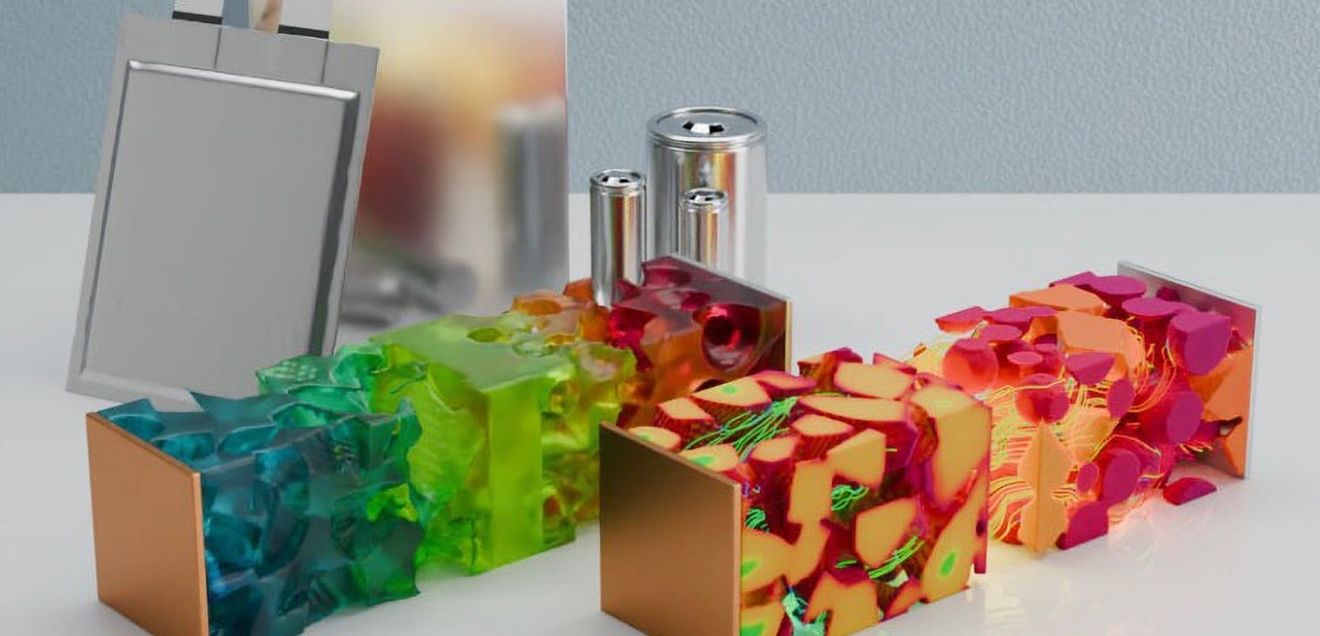
The demand for batteries for electric cars and energy storage systems is growing rapidly. The Fraunhofer ITWM relies on digital simulation tools and innovative measurement systems to ensure that their production works reliably and efficiently. The researchers are developing models for key steps in battery production across the entire production chain - for example for mixing, coating or drying the electrodes. This allows processes to be digitally analyzed and optimized even before they are implemented in the factory. The virtual images help to avoid errors that would otherwise occur in the production process. Rejects can be reduced.
With the Battery and Electrochemistry Simulation Tool BEST, for example, the Flow Processes department provides simulation software that can be used to model lithium-ion batteries three-dimensionally on the computer - from electrode microstructures to the behavior of complete cells. BEST offers a wide range of services, from predicting cell performance and optimizing charging strategies to investigating ageing and degradation phenomena. "With BEST, we can predict how batteries will behave during operation; cell properties are predicted using physically based simulations on virtual copies of real batteries. For example, we are investigating the influence of design parameters such as the layer thickness of the electrodes used to specify the batteries on battery behavior," explains Deputy Head of Department Dr. Jochen Zausch. "We also take into account other influencing factors such as material properties and application scenarios." BEST can be combined with other software tools and is also available as part of the BatteryDict module of the GeoDict software from the Fraunhofer ITWM spin-off Math2Market. In the future, simulations will also be possible via a web platform in the Fraunhofer cloud without having to install BEST directly.
The portfolio also includes FOAM, a software tool that simulates the foaming of battery modules in the context of battery production. Cells in a battery module must be thermally insulated from each other and mechanically fixed to protect them from overheating. To achieve this, cylindrical cells are often arranged next to each other and the spaces between them are filled with a foam. The liquid medium foams up, hardens and forms the foam that encloses the cells. "With FOAM, we can simulate the spread and expansion of the foam and use the results to examine in advance whether all areas that need to be filled are reached and whether the foam distribution is homogeneous," says Zausch.
After the foaming process has been completed in the production of a real battery, the position of the cells must be checked to ensure that the cell positions have not changed during curing. Are the cells in the desired position? Is the thickness of the layer covering the cells homogeneous? This is where the Fraunhofer ITWM's terahertz measurement technology comes into play for precise quality control. It uses electromagnetic radiation in the frequency range between microwaves and infrared to test materials contactlessly and non-destructively.
Inline thickness measurement of coatings on battery foils
In the coming years, 1000 production lines for electrode foils are to be built in Europe, with similar figures for Asia and North America. Only non-contact systems can be used to monitor quality inline during production. Researchers in the Material Characterization and Testing department have therefore expanded their expertise in terahertz measurement technology for inline coating control of battery foils. "Battery foils are the main components in lithium-ion battery cells. Continuous monitoring of the material parameters - coating thickness and conductivity of the electrodes - is crucial for product quality. We use our terahertz measurement technology to monitor them inline during production," says Dr. Daniel Molter, scientist at the Fraunhofer ITWM. The measurements are carried out inline on single and multi-layer coatings of anode and cathode foils at various points in the wet or dry process - always non-contact, non-destructive and without the need for radiation protection measures.
Fraunhofer ITWM researchers will present their digital simulation tools for the production and design of battery cells as well as the innovative inline layer thickness measurement system for anode and cathode foils at the Battery Show Europe in Stuttgart from June 9 to 11, 2026 at the Fraunhofer Battery Alliance booth.
Battery Show Europe, Hall 1, Stand A47


You might also be interested in
Preventing Interference from Harmonics
Harmonics are underestimated sources of interference in electrical power grids. Particularly in wastewater treatment plants and water treatment facilities, harmonic distortion leads to poorer power quality and associated costs: additional heating of...
 read more...
Operating commercial vehicles efficiently with high-voltage distributors
High-voltage distribution units (HV PDUs) from Rose Systemtechnik enable the efficient operation of electrical construction machinery, commercial and municipal vehicles. The HV PDUs ensure optimum power distribution between the vehicle's...
read more...Best quality for the steel
Conditions in the steel industry are harsh and inhospitable. The machines used must be able to withstand the demanding environmental conditions in order to deliver the best quality at all times.
read more...Energy systems for industrial trucks
Still develops new lithium-ion battery
The intralogistics expert Still is expanding its battery portfolio with a new lithium-ion battery. This covers the most common application profiles in the industry. It is manufactured and installed at the Hamburg site.
read more...Energy efficiency through high efficiency
One of the most important components in the field of automation applications is the DC supply voltage. Cost-sensitive miniature machines in particular require economical power supplies.
read more...How AI and the cloud are challenging sustainability
The rapid rise of artificial intelligence is driving up the energy consumption of data centers and jeopardizing global sustainability goals. Schneider Electric presents six practical solutions to meet the new requirements.
read more...Autonomous transport systems for electrolyzer production
The LPS and the RIF Institute for Research and Transfer are developing an automated conveyor concept for the series production of electrolysers. The modular system uses AMRs that communicate with each other and utilize the existing building...
read more...Lenze and Rittal enter into technology...
Alliance for power distribution and intelligent drive technology
Lenze and Rittal have entered into a technology partnership to jointly lead power distribution and drive technology into the future. RiLineX as the new standard platform for busbar systems and market-leading compact inverters from Lenze form the...
read more...Producing battery cells flexibly and sustainably
The industry needs more and more battery cells. However, their production in gigafactories consumes enormous amounts of energy. In addition, the large production lines are very inflexible. A possible alternative has now been successfully tested at...
read more...