
Conveyor technology
Autonomous transport systems for electrolyzer production
The LPS and the RIF Institute for Research and Transfer are developing an automated conveyor concept for the series production of electrolysers. The modular system uses AMRs that communicate with each other and utilize the existing building infrastructure. The concept shows how automated transport solutions support the scalability of electrolyser production.
Germany's current National Hydrogen Strategy (NWS) aims to build at least 10 gigawatts of electrolysis capacity by 2030. In order to achieve this ambitious goal, it must be possible to produce electrolysers efficiently and cost-effectively in series. However, electrolysers are currently largely manufactured by hand, which is time-consuming, cost-intensive and prone to errors. The H2Giga project FertiRob focuses on the development and testing of automation solutions for the (partially) automated series production of electrolysers. The aim is to make the production and assembly of electrolysers and their stacks significantly more efficient through modular, flexible and scalable production systems. FertiRob brings together 16 partners from industry and research who are jointly developing and testing digital twins, innovative production technologies and demonstration systems to enable high-quality and efficient electrolyser production on a gigawatt scale.
The modular transport system with AMRs
A new type of logistics concept is being implemented at the Research Building Center for the Engineering of Smart Product-Service Systems (ZESS) at Ruhr University Bochum (RUB). The main challenge was to manage the automated assembly of a water electrolyzer to validate a modular concept. Two AMRs are used for this, which ensure the material flow between two fully automated demonstrators and a warehouse.
The special features of the implemented transport system:
Building integration: The mobile platforms communicate with the BIM model of the building. BIM (Building Information Modeling) is a digital, data-based representation of the entire building structure and technology that provides all relevant information centrally. This enables the robots to open doors and request elevators independently. The warehouse is located on the 4th floor of the ZESS research building, allowing the AMRs to work across floors
Precision docking: A precision docking station was designed for exact positioning in the cabling cell, on which the AMRs are optimally positioned. Any remaining deviations in the range of ±1 mm are compensated for by the integrated sensors and actuators in the robots of the production cell
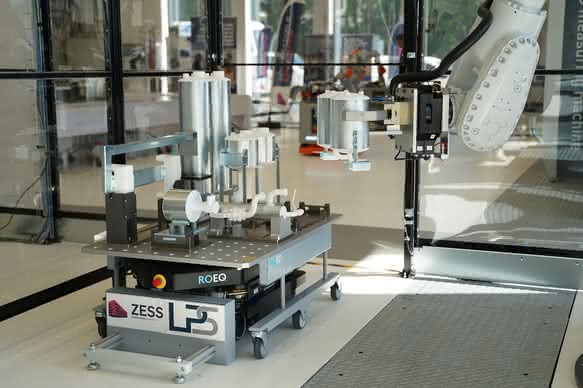
Innovative workpiece carriers: Special workpiece carriers have been developed for the safe transportation of enclosures and electrolyser components. These enable the components to be provided in the exact position and ensure an efficient material flow in automated production
Matrix production and fleet management
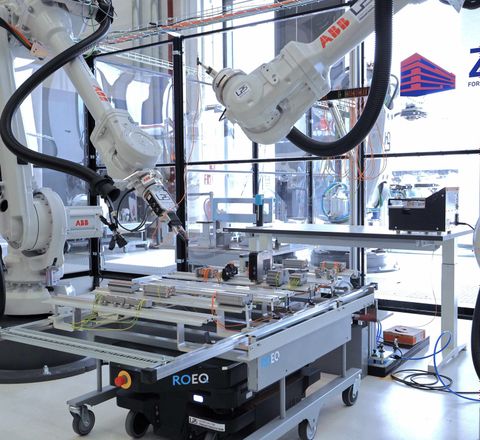
The implemented conveyor concept with AMRs enables matrix production that is characterized by high flexibility, versatility and resilience. In contrast to classic production lines, different product variants and quantities can be realized efficiently. In our application, the mobile robot platforms connect the warehouse, the cabling cell and the assembly cell of the electrolyzer. In the warehouse, the required components are loaded onto the workpiece carriers of the AMRs. The platforms transport these to the cabling cell and dock onto the precision docking station. Figure 1 shows the AMR with a control cabinet on the workpiece carrier, while two industrial robots initiate the fully automated cabling process.
The assembly cell specializes in the final assembly of the electrolyser. Here too, an AMR brings the modular components, such as stacks, gas separators or pre-assembled tubes, to the demonstrator. Figure 2 shows how the AMR stands at the cell with a loaded workpiece carrier and an industrial robot picks up one of the components to install it in the electrolyser. Fleet management controls the parallel and efficient cooperation of the AMRs so that both robots are involved in production without long downtimes. As demand increases, the fleet can be easily expanded, which underlines the scalability of the system.
Results and outlook
The H2Giga project FertiRob has integrated the demonstrators and has already presented them several times. The flexible conveyor concept for the production of electrolysers has been successfully validated. The automation solutions developed show how the scalability of electrolyser production can be significantly supported, making an important contribution to the energy transition. The approaches for intelligent transport systems developed in the FertiRob project also have potential for numerous other fields of application in industrial production. With the ongoing development of the hydrogen economy and the expansion of electrolyser production, the concepts and technologies developed will make a significant contribution to the industrialization and upscaling of water electrolysis - a prerequisite for the economical production of green hydrogen on a gigawatt scale.
The H2Giga project FertiRob is funded by the Federal Ministry of Education and Research (BMBF) under the reference number 03HY113A.
Sezer Şahan, Idris Yorgun, Bernd Kuhlenkötter, LPS, Chair of Production Systems (LPS)


You might also be interested in
A quantum computer that performs calculations using oscillations
When it comes to storing information, quantum computers have so far run up against technical limitations. Instead of electromagnetic storage, researchers are now using mechanical vibrations. Their vibrating memory can store significantly more...
 read more...
Hydrogen Pipelines Put to the Test
New real-world lab tests safety and resilience
The Federal Institute for Materials Research and Testing (BAM) is opening a real-world laboratory to study pipelines and components for the safe operation of future hydrogen networks.
read more...Research Platform for the Energy Supply of the Future
For the first time, the Karlsruhe Institute of Technology (KIT) is bringing together key hydrogen technologies in a single research environment. The facility is intended to demonstrate how the production, storage, transport, and use of hydrogen can...
read more...When the quantum computer arrives
The Research Race to Ensure the Security of Critical Infrastructure
How can we protect our critical infrastructure from attacks by quantum computers in the future? As part of the QUEST project, Darmstadt University of Applied Sciences is researching new methods—post-quantum cryptography—designed to withstand even...
read more...VDE study on electrical engineering
More retirements than graduations
According to a VDE analysis, more than 30,000 electrical engineers will retire by 2029 without enough graduates to replace them. This is due to falling student numbers and high drop-out rates.
read more...Giving lightweight construction a profile
Pultrusion: A process that forms fibers under tension
Pultrusion is developing from a niche process into a key process for lightweight construction and sustainable fiber composite structures. The Fraunhofer IWU shows applications from energy to mobility.
read more...Green hydrogen directly from the sun and water
A start-up project at the Karlsruhe Institute of Technology (KIT) aims to fundamentally simplify the production of green hydrogen: Mass-produced photoreactor panels are to be used to produce hydrogen directly from sunlight and water - without...
read more...Fraunhofer shows industrial future between AI, data and new materials
At Hannover Messe 2026, the Fraunhofer-Gesellschaft will be presenting solutions for a resilient industry: from AI and data rooms to hydrogen technologies and material and recycling innovations.
read more...The bottleneck is in the system
Is the transformation of the industry failing due to "German Angst"?
A recent ISF study examines what is slowing down change in German industrial companies. According to the results of the study, the causes of innovation bottlenecks often lie in internal structures and a lack of strategic orientation.
read more...