
Technology transfer
Artificial intelligence you can touch
Scientists at the Bremen Institute of Structural Mechanics and Production Systems are working with industrial companies to develop and operate an experimental space for experiencing artificial intelligence in a production environment.
In the course of digitalization, a drastic social change is taking place, which is characterized not least by the introduction of AI-based technologies into everyday professional and private life. In this context, there is a lack of low-threshold communication and learning concepts that make it possible to experience artificial intelligence for yourself, get to know how it works and thus reduce fears and recognize potential.
Experience artificial intelligence live
The KI_Café is a method that includes a learning and teaching concept for experiencing artificial intelligence for employees of small and medium-sized enterprises (SMEs) and consists of two pillars. The first pillar is the repeated organization of learning and experimentation spaces where visitors can try out exhibits on the topic of AI and talk about artificial intelligence with AI experts and colleagues over a coffee. These experimentation rooms are designed in the style of an exhibition stand and are set up directly in the factories on the production floor in order to pick up employees in their familiar production environment and make access to the learning and experimentation room as low-threshold as possible.
AI as an aid in the assessment of tool wear
The second pillar of the AI_Café is the interdisciplinary development of an AI-based system to support the optical wear assessment of milling tools. The system uses artificial intelligence methods to classify milling tools according to their wear condition based on image data. It is implemented in a test bench demonstrator and exhibited in the experimental rooms at the current stage of development. The transparent development process allows the expertise of employees to be used in relation to cutting edge quality control.
Regular workshops, in which employees from different areas of the company can participate and contribute their ideas to the design, accompany the development work. At the same time, the workshops impart further knowledge about how AI-based technologies work.
The classification of milling tool wear was chosen as a proxy process, as every company involved in machining is confronted with tool wear. It will therefore be possible for many SMEs to imitate the KI_Café method using the guidelines published at the end of the project.
Enthusiasm about the KI_Café experimental room
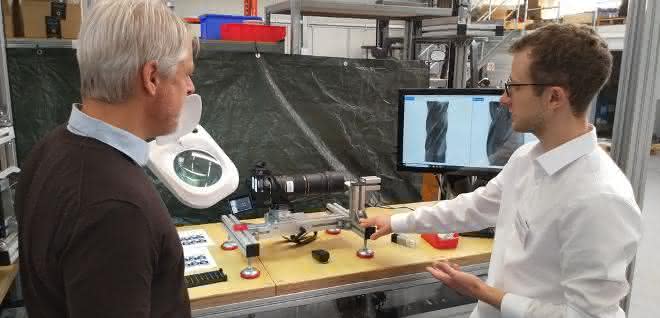
In September and October 2021, the KI_Café experimentation room was operated for the first time. A device for recording image data of worn and non-worn milling tools served as an entry point for interdisciplinary discussions between employees and AI experts. The image data collected by this recording device is required for teaching the AI algorithm as part of the development of the test bench demonstrator.
As the experiment rooms are held in a relaxed atmosphere, a coffee machine was set up as an exhibit in keeping with the theme of AI, which enables hot drinks to be ordered using voice commands. Discussions about how this and other exhibits work aroused the visitors' enthusiasm for the potential applications of AI-based systems. Based on the impressions gained, discussions were held about possible application scenarios to make everyday working life easier. It could be shown that the KI_Café experimental space is a low-threshold offer for exchanging ideas about and getting excited about artificial intelligence, which visitors would use again. The feedback from visitors to the experimental rooms was consistently positive.
Further information on the KI_Café project can be found at http://www.inqa.de under the keyword KI_Café. The KI_Café project is funded by the BMAS as part of the "INQA-Lern- und Experimentierräume KI" funding guideline.


You might also be interested in
Plagiarius 2024 negative prize
On January 26, 2024, the Plagiarius campaign awarded its dreaded "Plagiarius" negative prize for the 48th time to manufacturers and retailers of particularly brazen counterfeits and fakes.
 read more...
Ivalua honors winners of the Generative AI...
AI-supported "add-ons" for buyers within 48 hours
Ivalua, provider of cloud-based spend management solutions, announced the winners and innovations of the first Generative AI Innovation Cup. The competition took place in December 2023. It was open to all Ivalua partners and employees - more than...
read more...Efaflex celebrates 50 years of high-speed...
The emphasis is on "fast"
Since day one, Efaflex has wanted to use new technologies as early as possible and drive progress in the industry. This year, the family business is celebrating its 50th anniversary under the motto "Fast Forward".
read more...Security of supply even during power outages
In the winter of 2022, Germany was worried about energy shortages. The drugstore retailer dm did not paint any horror scenarios, but nevertheless saw the possibility of controlled, temporary, regional power cuts (brownouts).
read more...Safety technology in mechanical engineering
Modules with new functions
Euchner's product highlights at EMO 2023 include the communication-capable solenoid interlocks.
read more...Transforming the paper industry towards climate neutrality
Together with partners from industry and research, Voith is developing a project for the optimization of energy and material flows in paper production. The aim of the research project is to develop a digital framework that enables effective process...
read more...Up to 95 percent less flue gas thanks to direct extraction
The requirements for occupational safety measures and safety technology are also constantly increasing in welding technology. The Technical Rules for Hazardous Substances (TRGS) stipulate that welding fumes and harmful substances must be extracted...
read more...Competitive advantages with large machines
Whether 3D-printed components for machines and systems, prototypes or aids for design: additive manufacturing is almost indispensable for modern companies in mechanical and plant engineering and automation if they want to play in the premier league.
read more...Transport technology from the modular system
Many transport tasks can be realized with the help of linear technology. Pre-configured solutions are available to simplify the interaction between the linear unit, motor, gearbox and controller. This minimizes the effort required for research and...
read more...