
Display
Pull principle: definition and advantages
When dealing with lean production, there is no way around the pull principle. What are the reasons? What advantages does the pull principle offer?
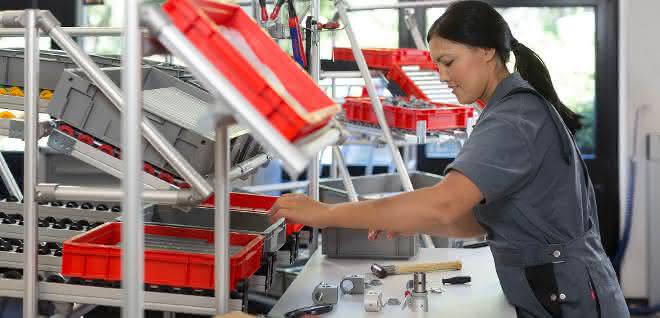
First, the definition: The pull principle is a concept for controlling the material flow in a production system. Those who organize their own production according to the pull principle only produce when there is a concrete demand. The decisive advantages are the avoidance of overproduction and extensive inventories as well as reduced throughput times and increased productivity. Find out about all the other advantages of the pull principle in the free guide from item Industrietechnik.
In lean production, high stock levels are one of the 7 types of waste (muda). Waste here means "pointless activity" - meaning that no contribution is made to value creation. The primary goal of lean production is to avoid waste. This is linked to an increase in added value and the careful use of materials. The example of the pull principle makes this particularly clear, especially when compared with the traditional push principle.
Comparison of the push and pull principle
The push principle relies on forecast-based production plans based on sales figures. The push principle ties up financial and physical resources due to excessive stock levels. Due to permanent storage, retrieval and interim storage, the material flow is interrupted, which leads to long throughput times. Each process must be controlled and planned separately. The batch size is then calculated for each production step without taking the entire value chain into account. There is no upper limit for the stock, especially as parts that are not currently required are put into storage. This leads to overproduction due to excessive stock levels, long lead times and unavailable parts (despite high inventory levels).
In contrast, production according to the pull principle is not based on demand estimates. Instead, production is geared towards current demand, thus increasing flexibility. Overproduction and excessive warehousing can thus be avoided. The advantages of the pull principle also include shorter throughput times and improved delivery performance. In the continuous improvement process (CIP), three pull methods follow one after the other: Kanban, the FIFO principle and finally one-piece flow (OPF). As there is no intermediate storage with OPF, throughput times and stock levels are the lowest here.


You might also be interested in
Modular system for higher productivity
Working ergonomically and efficiently - at Liebherr, employees are the mainstay of the entire production process. This is also the case in Colmar, where the company develops and manufactures large diesel engines.
 read more...
Expansion of the lean production toolkit
The lean production system kit from Item contains components for fast and sophisticated production equipment construction. In gravity-driven processes (Karakuri applications), Item roller conveyors are often used in combination with flaps and lifts...
read more...A new shelf in just a few clicks
With the Item engineering tool, simple design is also possible for lean production. Item presented its expanded digital tool at Logimat.
read more...With lean production to the breathing factory
When Lenord + Bauer built the new building at its Gladbeck site, the aim was to link the purchasing, warehouse, equipment construction and quality assurance departments directly to the production layout based on the material flow.
read more...New castors and slide rails from item
The highest demands are placed on carriages and roller carriages in Karakuri/low-cost automation. They need to be robust and easy to move at the same time. To meet these requirements, item has developed the D30/D6-16 T1 roller with ball bearings.
read more...Standardized in design, flexible in use
Automated guided vehicles are increasingly in demand in production and logistics as they automate processes efficiently - but in addition to the vehicle, the right peripherals are also crucial for safe operation. A new solution consisting of a...
read more...Logimat 2025: Solutions from the modular...
Transporting small parts with gravity
Item will be presenting various solutions for efficient material flow at Logimat 2025. The basis is the well-known Item modular system, which the manufacturer has expanded with new components.
read more...Hybrid Energy: Flexible Power Supply for Industry
Whether it’s a delay in grid connection, peak loads in the production process, or maintenance work—industrial companies today need flexible energy solutions that combine reliability of supply, cost-effectiveness, and sustainability. Hybrid energy...
read more...NIS2, KRITIS umbrella law, new obligations: Why industrial security is now a top priority
For many industrial companies, security is finally no longer an issue that can be put off. With NIS2, significantly stricter requirements for risk management, reporting structures and responsibilities have been in force in Germany since December...
read more...