
Monitoring
Process visualization and preventive tool monitoring
A key aspect of Industry 4.0 is always the monitoring and control of manufacturing and machining processes. MotorView, developed by BMR 2020, offers a powerful solution for integrating a process monitoring system for inverters and motors.
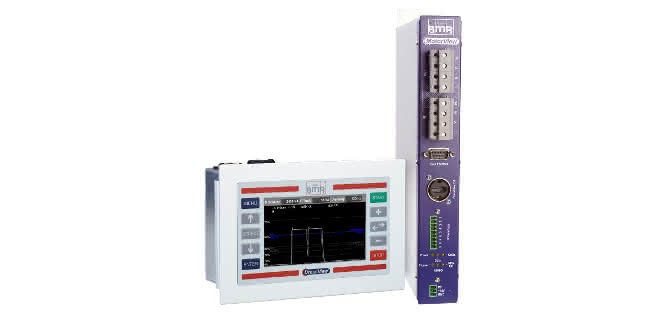
It is suitable for all applications in which a spindle inverter system is used, such as milling machines, which often involve several operations with different milling cutters. Here, MotorView allows each machining step to be tracked directly.
Any machine can be equipped with this measuring device. This applies both to the design of new machines and to the retrofitting and reconditioning of older machines.
MotorView is divided into two components, a sensor part and a display part. Integration is extremely simple: the sensor part is simply clamped or looped into the motor cables between the inverter and the driven motor. As a result, the motor phases run via the device, which records and stores all information about voltages and currents without affecting the process.
The display part is connected to it via a cable and graphically displays the recorded load status of the spindle. A digital and serial interface is available for communication and integration with the machine control system.
"Motorview has its ear directly on the process, so to speak, and can record and display the data on the load status of the spindle with extreme sensitivity," explains BMR development engineer, Dipl.-Ing. Frank Buchholz. "The load status of the motor usually also maps the machining process, which allows valuable conclusions to be drawn as to whether the process is running properly or whether problems are looming," continues Frank Buchholz.
This brings us right back to the topic of Industry 4.0, as predictive maintenance, i.e. predictive tool monitoring, can prevent unplanned machine downtime.
MotorView also becomes an instrument for quality assurance and, in the long term, helps to reduce production costs. By detecting reductions in cutting performance due to blunting tools at an early stage, it offers the user the opportunity to change tools in good time before the process quality deteriorates or, in the worst case, the tool breaks.
In addition to these important functions, it detects other problems at an early stage, such as bearing wear on the spindle, failure of a motor cable, detection of control oscillations or parameterization errors in the drive system. Thanks to the sensitive sensor technology, a direct image of the machining process is always possible.


You might also be interested in
Helu makes its first trade fair appearance under a new brand name
Helu Kabel will be presenting itself as Helu for the first time at Hannover Messe 2026, showcasing system solutions, Heluchain cables and new industrial luminaires.
 read more...
Strategic realignment with brand relaunch
In future, Helukabel will trade as Helu
The Helukabel Group is parting with part of its name: in future, the company will only operate under the Helu brand. With this step, the specialist for electrical connection technology is underlining its strategic development from a classic cable...
read more...Modular plant construction for corrugated board
Insight into the production of corrugators at BHS Corrugated: Automated, modular and equipped with Helukabel components.
read more...Best quality for the steel
Conditions in the steel industry are harsh and inhospitable. The machines used must be able to withstand the demanding environmental conditions in order to deliver the best quality at all times.
read more...If the standard cable is not sufficient
Lapp offers cables for countless applications - but not for all of them. From time to time, the developers have to modify a standard cable or develop a special cable.
read more...Slight decline in sales, strong investments
The Lapp Group has not been spared from the weakening global economy. However, the company only recorded a slight loss in the past 2024 financial year.
read more...Electrical connection technology
Cables and wires for industrial automation
Heukabel offers system solutions for cable routing from a single source. The subsidiary EKD Systems specializes in tailor-made cable drag chains made of steel, stainless steel and plastic, which are used in moving machines and systems as well as in...
read more...Lapp relies on Ultramid from BASF
Mobile charging of electric vehicles
The automotive industry is currently undergoing the biggest transformation in its history. The boom in battery electric vehicles in particular is presenting the industry with major challenges. Lapp, as a supplier of cables and connection...
read more...Cable handling application
At this year's Motek, ArtiMinds Robotics is showcasing a robot-based automation solution for the sensor-assisted assembly of flexible cables in connector housings.
read more...