

Sandwich complexes
New molecules for high-tech materials
Rare earths are a component of many high-tech products. A team at KIT is working on new possibilities for the use of the elements, producing so-called sandwich complexes with rare earths, which could serve as new molecular materials for more powerful storage media or displays in the future.
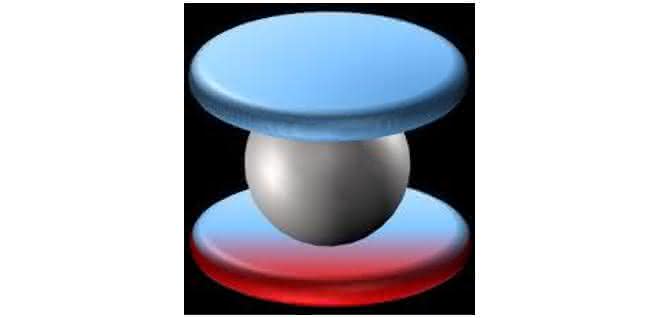
Sandwich complexes are chemical molecules whose properties are still largely unknown. The compounds consist of two ring structures between which a single metal atom is "sandwiched". Simplified, the complexes look like tiny sandwiches. In order to investigate whether the molecules are suitable as an innovative basis for future materials, Professor Peter Roesky, Head of the Chair of Inorganic Functional Materials at the Institute of Inorganic Chemistry (AOC), and his team are producing different variants of the sandwich complexes in the laboratory. The scientists use various elements from the rare earth group as metal atoms in the middle of the compounds. The experimental molecules also differ in terms of their ring structures. In addition to carbon, the rings consist of a variable proportion of other elements. The researchers are experimenting with different ring sizes. The project aims to systematically vary the size and composition of the rings in order to establish a structure-activity principle. "We are investigating what influence the structure of the sandwich complexes has on their physical properties," explains Roesky. "In particular, we are investigating the magnetism and luminescence of the molecules."
To date, rare earths have generally been integrated into solid-state materials that are used in high-tech products. The elements can be found in LED lights, cell phone displays and wind turbine magnets, for example. With the production of his planned molecular compounds with rare earths, Roesky is pursuing an approach that has hardly been considered in applications to date.
Ideally, the scientists could, among other things, obtain molecules that behave like tiny magnets. Such compounds are also known as single-molecule magnets. One day, the novel complexes could be used to produce storage media that have greatly increased storage capacities with the same physical size. Roesky and his team are also experimenting with rare earth elements, which are already used in phosphors. Sandwich complexes containing these elements could later be used to produce optimized displays, for example. "Our project serves to create a basic understanding of these novel substances," explains Roesky.
Special funding for high-risk research
As the scientists are at the very beginning of a new field of research with their project, success is not guaranteed. Through Reinhart Koselleck Projects, the DFG specifically funds such high-risk projects and gives established researchers the opportunity to implement innovative ideas. Across all disciplines, only eight of them were funded by a Reinhart Koselleck project in Germany in 2019. Roesky is the first KIT scientist to receive this financial support. The funds, which are designed to run for five years, can be used freely.


You might also be interested in
Gateway with improved fault diagnosis
Schmersal is launching a new version of the SD gateway for its SD bus. According to the group, users benefit in particular from the improved fault diagnostics that the new SDG Fieldbus Gateway enables.
 read more...
AI trends for engineers: where is the journey heading?
According to Gartner, companies that have adopted AI engineering practices have a competitive advantage: by 2026, they could outperform their competitors by around 25 percent in terms of the number and time required to operationalize AI models....
read more...Industrial-grade version of the Raspberry Pi
"The more performance, the more use cases"
The new version 4 of the open source IPC "Revolution Pi" (RevPi) from Kunbus is set to be launched as an industrial-grade version of the Raspberry Pi in mid-2023.
read more...Digital assistance systems make manual production easier
Increasing productivity in the face of a shortage of skilled workers and a growing number of product variants is a challenge for many medium-sized industrial companies. Software-based assistance systems such as elution two assembly from Elabo offer...
read more...Platform for hydrogen and fuel cells
Around 500 companies presented their solutions for the production, transportation, infrastructure, storage, refuelling and consumption of hydrogen at the Hannover Messe.
read more..."Using DC technology consistently"
The DC-Industrie2 project recently came to an end and the follow-up project, ODCA, has been launched. In an interview with Andrea Gillhuber, Dr. Hartwig Stammberger and Dr. Jan Stefan Michels spoke about the potential of DC technology and its...
read more...Artificial intelligence in Germany
AI arrives in the industry
At the start of the Hannover Messe, Microsoft's Head of Germany Marianne Janik called for greater use of artificial intelligence (AI) in Germany.
read more...Feinmess Suhl at the Control 2023
High-precision testing equipment and monitoring systems
At the Control international trade fair for quality assurance, Feinmess Suhl will be presenting innovations in the field of test equipment for product measurement and systems for test equipment monitoring.
read more...Continuously developing innovations
In the run-up to the Hannover Messe, Andreas Mühlbauer spoke to Oliver Winzenried, CEO of Wibu-Systems, about the innovations the company is presenting in Hannover and the technological trends at the trade fair.
read more...