

Stainless steel for tool and mold making
Plastic mold steels in comparison
Around 60 million tons of plastic (19% of the global volume) were produced in Europe alone in 2016. The main customers are packaging manufacturers and suppliers to the automotive, electrical and medical industries. At the end of the chain are products such as plastic bottles, car seats and syringes. Each of these plastic products has its origin in a mold or tool made of stainless steel. And with every material, it's the finer details that count.
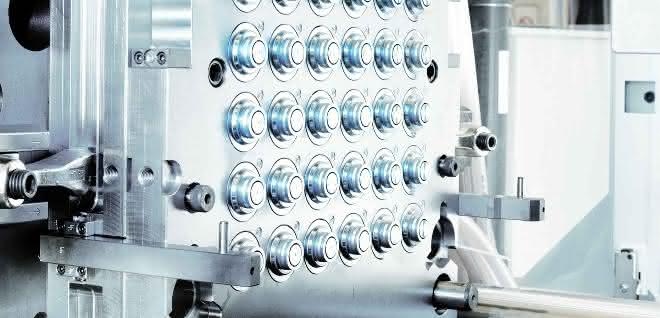
The trend in plastic mold making is towards molds made entirely of stainless steel. The advantage: they are highly resistant to condensation and cooling water as well as acid deposition. One of the most important prerequisites for a long service life of the respective plastic mold is improved corrosion resistance. However, the advantages that arise for manufacturers of plastic parts through the increasing use of "all stainless" mold structures also pose a problem for mold makers. This is because all stainless steels available to date can only be machined with a high level of machining effort.
Growing demand for plastics
Due to the constantly growing demand for plastics, the greatest challenge for stainless steel suppliers is to offer plastics processors solutions that are both economical and reliable. After all, flawless plastic products can only be created with high-quality tool steel. Deutsche Edelstahlwerke has adapted to the increasing individual requirements of this industry and offers a package of so-called "All Stainless" materials. It consists of three tool steels:
- Formadur 2083 Superclean,
- Formadur PH X Superclean,
- Corroplast.
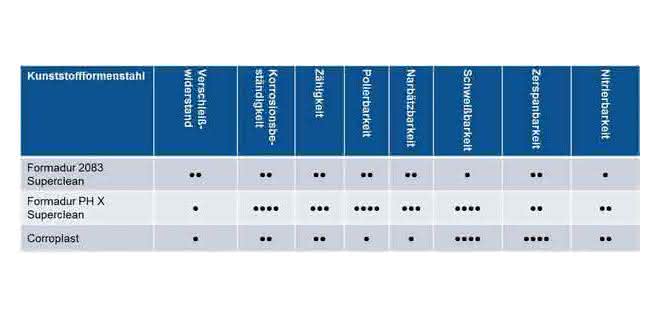
All three materials have three essential properties: Corrosion resistance, hardness and machinability. Nevertheless, each material has its own special properties.
The most important factors in material selection are the degree of machining, polishability, operating environment and wear resistance requirements. Which of the three materials is used is therefore determined by the customer's individual application.
Polishable all-rounder: Formadur 2083 Superclean
Formadur 2083 Superclean offers very good wear resistance after hardening and tempering to the desired case hardness, so that this material is also used for knives. The ESR remelted (electroslag remelting) plastic mold steel is also suitable for high polishability requirements and can be used in plastics processing for injection molding, compression molding and extrusion molding. This all-rounder falls slightly short in terms of weldability and nitridability, but delivers good values in the areas of corrosion resistance, toughness and machinability. Despite its good corrosion properties, there is no need to do without graining.
Low-carbon acid blocker: Formadur PH X Superclean
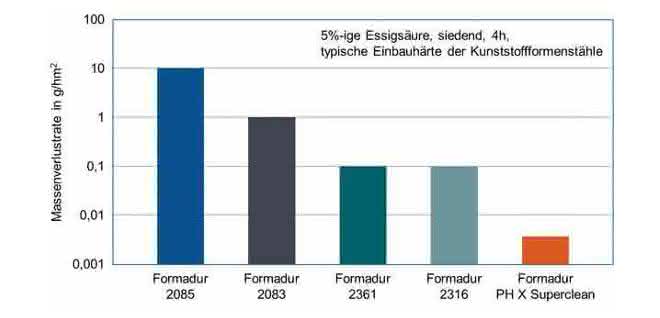
The highly corrosion-resistant Formadur PH X Superclean has the advantage that it does not need to be additionally hardened and tempered, as the material already has a case hardness of 38 to 42 HRC after hot forming and heat treatment. Formadur PH X Superclean is a precipitation-hardenable tool steel: it has very high strength combined with good toughness. The material is primarily used for molds that need to be highly resistant to condensation and cooling water. Due to its high resistance, Formadur PH X Superclean is particularly suitable for processing plastics such as PVC or aminoplastics, as the molds are often attacked by acid deposits. This is proven by corrosion tests and ageing tests (see Fig. 1 for results). Thanks to its homogeneous, almost carbide-free structure, the ESR-coated special steel is the first choice in terms of polishability. If the user attaches great importance to weldability, Formadur PH X Superclean also shows its strengths, as it contains very little carbon.
With Corroplast, all the desired properties are set during heat treatment. It is characterized above all by good machinability and machinability with consistently good corrosion behaviour. The balance between these two properties is unique in Corroplast compared to other tool steels. Only polishability has to be compromised. However, the latter property is also less important, as the main areas of application for Corroplast are base plates, body parts and plastic molds. The only standard requirements here are polishability and resistance to condensation and cooling water. Mold maintenance is extremely low when using Corroplast, which is primarily due to its high corrosion resistance. It can be said that the more difficult the climatic conditions, the better Corroplast feels. Even contact corrosion, such as between the mold frame and mold frame insert, has no effect on the material.
In plastics processing, steel is used in an environment characterized by heat, condensation and coolant. In addition to corrosion resistance, good machinability is the be-all and end-all for the material. Alloying elements such as chromium, manganese and sulphur therefore play an important role in the production of Corroplast. They are added during steel production and, in the optimum ratio, play a key role in determining hardness, machinability and corrosion resistance. The exact adjustment of the properties of Corroplast is ultimately achieved through targeted metallurgical treatment for sulphur distribution and, of course, during heat treatment. Here, the steel is heated to over 800 °C in a controlled manner and quenched in water or polymer. This treatment promotes the characteristic, very homogeneous structure of the tool steel.
Tests under laboratory conditions
In order to estimate the corrosion resistance and determine the appropriate test method, the user must know what type of corrosion attack is present. Corrosion behavior is a system property. Corresponding tests only provide a classification of the steels in the same test setup. In order to be able to evaluate the corrosion behavior of Corroplast, for example, several tests were therefore carried out on behalf of DEW under laboratory conditions in chloride-containing media, condensates and under slightly acidic conditions:
- Electrochemical tests using current density-potential curves in HCl pH 3 and HCl pH 5 (electrolyte solution) at room temperature,
- Constant climate test (condensation water test) according to DIN EN ISO 6270 and evaluation according to DIN EN ISO 10289,
- Aging tests according to DIN 50905, analogous media as for the electrochemical tests,
- Testing of Corroplast at Cambridge Material Testing Ltd. by means of aging tests according to ASTM G48-03.
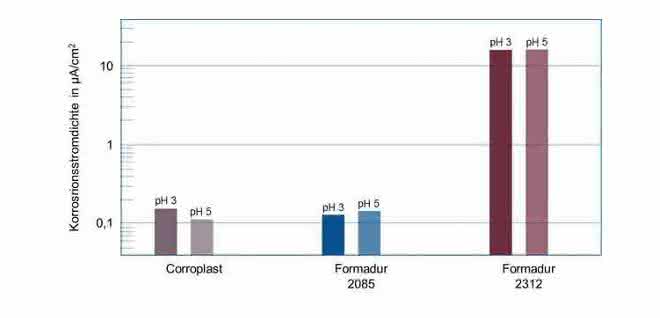
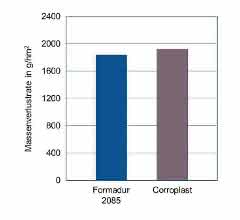
The sulphur-alloyed materials Formadur 2085 and Formadur 2312 were also examined for comparison. Some of the test results are presented below. Figure 2 shows the evaluation of the corrosion current density, which can be used as a measure of the corrosion rate. This showed that the corrosion resistance of Corroplast is comparable to that of Formadur 2085, but is still considered to be significantly more resistant than the conventional Formadur 2312. In the ageing tests according to DIN 50905, the ranking of the steels was confirmed, with the corrosive attack being almost the same for Corroplast and Formadur 2085. The results of the aging tests according to ASTM G48-03, Method A are shown in Figure 3.
This test also shows the same sequence. As expected, Corroplast has a slightly higher mass loss rate under these test conditions, i.e. it is attacked more than Formadur 2085. In the constant climate test, the evaluation is carried out using point and spot cards with a rating scale of 1 to 10, where 10 describes the best surface condition after the test. Both Formadur 2085 and Corroplast were rated 9. In the condensation water test, only the slightest differences were found between Corroplast and Formadur 2085.
The application determines the material
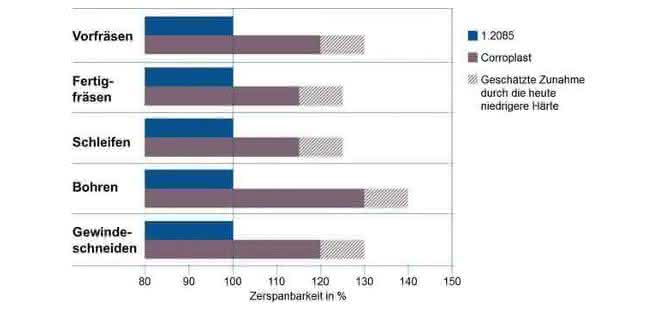
The good machinability of Corroplast compared to the material Formadur 2085 is also confirmed by the tests carried out in five different machining processes: roughing, finishing, grinding, drilling and milling.
Lower processing costs and more efficient processing are the advantages for mold makers and end users of using the special steel Corroplast.
As can be seen from the individual property descriptions and corresponding laboratory tests, the choice of material is very important in the plastics industry. Even modern plastic mould steels are not "all-rounders", but their performance properties are optimized for specific applications - and the user should be familiar with these.
Kathrin Eger, Daniel Kipp, Dr. Philipp Niederhofer, Dr. Hans-Günter Krull, all Deutsche Edelstahlwerke / ag


You might also be interested in
In-house exhibition Bielefeld 2026
How DMG Mori thinks about the factory of the future
DMG Mori will be showcasing turning and milling expertise, automation solutions and additive manufacturing along the Machining Transformation (MX) at the Bielefeld 2026 in-house exhibition.
 read more...
Up to 50 percent higher cutting speeds
The current market situation is putting pressure on companies that rely on carbide tools: Rising raw material costs, volatile supply chains and limited predictability are putting pressure on the industry. Fette Werkzeugtechnik, a member of the LMT...
read more...A robot for all occasions
Industrial robots take on many tasks. Even milling with accuracies in the sub-millimeter range is now possible.
read more...High metal removal rate for high maneuverability
Large module gears for ship drives place high demands on machining. Switching from skiving to 5-axis simultaneous milling with high-feed tools considerably shortens the roughing process. Process parameters and a well thought-out tool selection are...
read more...Schunk shows flexible systems for electronics production
Schunk Electronic Solutions will be exhibiting modular, flexible systems for electronics production at Productronica 2025 - from stand-alone depaneling systems to fully integrated inline solutions.
read more...Hydraulic 4-jaw chuck for automated workpiece clamping
HWR Spanntechnik presents a hydraulically actuated 4-jaw chuck for automated workpiece changing. The clamping device is designed to enable short set-up times, precise clamping and high productivity in automation.
read more...Corner, face and plunge milling
Paul Horn is expanding the DA milling system for corner, face and plunge milling. With the DA65 variant, the system offers a larger cutting insert compared to the existing DA62.
read more...World premieres at the EMO 2025
From September 22 to 26, 2025, Grob will be presenting several innovations at EMO Hannover. The focus of the trade fair appearance will be on the latest 4- and 5-axis universal machining centers and the associated automation solutions.
read more...Flexible and efficient processing
New high-performance CNC series
Fanuc's presentation at EMO will focus on the new FS500i-A CNC series. The new CNC generation offers high user-friendliness, process optimization as well as digital and network technologies.
read more...