
Specify stacker
Working safely with assistance systems
Hyster Europe offers various assistance systems to support forklift drivers and prevent operating errors. The aim is to reduce the risk of damage to industrial trucks and goods and reduce maintenance costs.
"In many companies today, more loads are being transported at ever increasing speeds. They are also often heavier and need to be lifted higher," says Daniel McNeil, Application Solutions Manager at Hyster Europe. "Forklift drivers therefore need to be specially trained. At the same time, it is the task of the purchaser to specify the forklift trucks so that they are optimally suited to the application and support the driver with assistance systems."
Companies should therefore observe the following points to ensure safe and prudent working practices:
Attention as standard
All forklift trucks should be designed in such a way that the driver has his surroundings and the operating conditions under control. For example, the driver's cab of Hyster Fortens forklift trucks provides optimum visibility so that drivers have a complete view of their surroundings. In addition, low whole-body vibrations, a low noise level and easily accessible and intuitive controls ensure a high level of comfort and user-friendliness.
Automatic obstacle detection
In companies where industrial trucks and pedestrians share traffic areas, Hyster's automatic obstacle detection makes it easier to recognize obstacles at an early stage and thus avoid costly damage.
The system uses ultrasound to detect obstacles in three predefined zones and warns the driver acoustically and via a distance display. When moving off, two side-mounted sensors monitor the surroundings and stop the truck as soon as an obstacle is detected. To continue driving, the driver must press the deactivation button. When reversing, two rear-facing sensors are used to immediately reduce speed if an obstacle is detected.
Roof sensor system
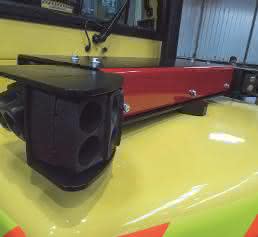
When forklifts switch between indoor and outdoor use, such as in warehouses or production facilities, a roof sensor system is extremely helpful. Using radar technology, the system detects whether the truck is under a warehouse ceiling and limits the speed to a preset value. This prevents damage to the infrastructure.
Overload detection
Handling loads with different or unknown weights can be a challenge. Overload detection helps the driver to adapt the truck to the respective load. This reduces wear and maintenance costs and at the same time achieves good load stability.
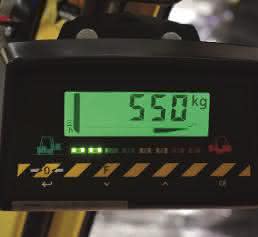
The overload detection system suitable for Hyster forklift trucks and warehouse trucks continuously measures load weight and load stability. As soon as the weight is too close to the overload limit, the driver is warned. The status is shown in traffic light colors on a clear LCD display and an acoustic warning signal also sounds.
To enable even more efficient operation, the weighing system can be combined with speed limitation functions. Using the roof sensor system or RFID systems in the warehouse floor, the speed of the truck can be limited for certain applications when the load weight reaches a set limit. This minimizes damage to the truck, load or infrastructure.
Pedestrian warning light
"Our assistance systems are not only designed to support the driver," explains McNeil. "We also offer options that effectively warn people sharing the road with forklifts. This can be a simple add-on such as the Hi-Vis seat belt or an advanced system such as the pedestrian warning light."
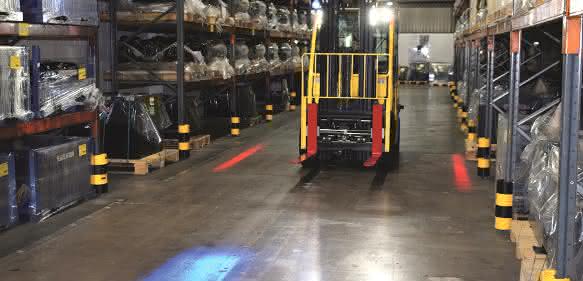
When the truck is in motion, LED lights at the front and rear are automatically activated. With a blue light beam projected onto the warehouse floor, they indicate to pedestrians that a truck is in the vicinity and in which direction it is traveling. In addition, red marker lights can mark an area around the truck to indicate to pedestrians the safe distance to be maintained.
Both technologies offer additional safety for applications where forklifts and pedestrians work in the same area. This includes, for example, racking warehouses where forklifts are constantly passing through aisles, warehouses with blind spots or environments with high noise levels. as


You might also be interested in
Predictive maintenance in retrofit
Predictive maintenance pays off. This is because early detection of impending failures means that systems can be serviced in a targeted manner before production downtime occurs. But how complex is it to integrate such a maintenance concept into an...
 read more...
Maintenance instead of replacement
The circular economy starts with the machinery
Sustainability in industry starts with machines, says our guest author from Deguma: How maintenance, modernization and the 5R strategy save resources, energy and CO₂.
read more...3D printing for unplanned requirements
The material fails and the machine suddenly stops? Then you need to take the right measures to be able to resume production quickly. Material failure in the form of faulty components or material wear in the frame are a risk for any production.
read more...High demands in terms of safety, application and robustness
Demanding work in the electrical trade and energy supply as well as smooth processes in production require innovative and customized measurement technology that scores points for safety, ease of use and resilience.
read more...Car meets e-bike: riding with lubrication-free polymer bearings
Studies show that the proportion of pedestrian and bicycle traffic is increasing in urban areas. With the JetBike, JetBike GmbH from Braunschweig presents a mixture of e-bike and car and relies on lubrication-free polymer bearings from Igus.
read more...Hydraulic hub for more efficient servicing
Bosch Rexroth presents a digital toolbox for service and maintenance. With a comprehensive range of digital services, the Hydraulic Hub simplifies and accelerates the service and maintenance of hydraulic products and increases machine availability.
read more...Arnold Umformtechnik expands after-sales...
Faster help with VR glasses
Arnold Umformtechnik is expanding the after-sales service for its machines to include digital remote services. The focus is on data security, simple operation and clear processes.
read more...147,000 euros per hour: high costs for German companies due to unplanned downtime
According to the "Value of Reliability" study, 67% of industrial companies in Germany experience unplanned downtime at least once a month. This costs the German economy 147,000 euros per hour. Nevertheless, reactive maintenance concepts are not...
read more...Maintenance starts with a maintenance planner
Legal requirements stipulate that machines and systems must be serviced regularly. The maintenance work serves to ensure occupational safety and economic efficiency.
read more...