
Konecranes for European XFEL
Superlaser: Cranes work at a depth of 38 meters
The European XFEL (X-Ray Free-Electron Laser) goes deep: modern technology generates extremely powerful X-ray laser beams up to 38 meters underground. This requires highly sensitive components - and sensitive cranes from Konecranes to bring them safely into position.
Sharp shooting in Hamburg: At the newly opened European XFEL (X-Ray Free-Electron Laser) research center, a superconducting linear accelerator generates X-ray laser flashes. Up to 27,000 flashes per second at a wavelength of 0.05 to 4.7 nanometers - a unique repetition rate worldwide. At 1.6 times 1025 (photons / s / mm2 / mrad2 / 0.1% bandwidth), the laser flashes are also a billion times more luminous than the best conventional X-ray sources.
This allows processes to be observed at an atomic level: the formation of a molecule or the reversal of magnetization, for example. Since 2017, research has been underway at the end of the 3.4-kilometer tunnel that runs from Hamburg-Bahrenfeld to Schenefeld. A total of eight double-girder overhead cranes and a single-girder overhead crane from Konecranes are used to move sensitive equipment safely underground.
X-ray laser shoots to a depth of six meters
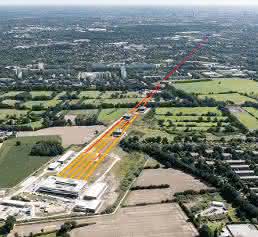
Depending on the nature of the landscape, the X-ray laser tunnel is between 38 meters and six meters deep. When the laser "shoots", X-rays are generated, well shielded underground. The openings in the shaft buildings, through which large components are inserted, are therefore sealed with heavy concrete slabs during operation.
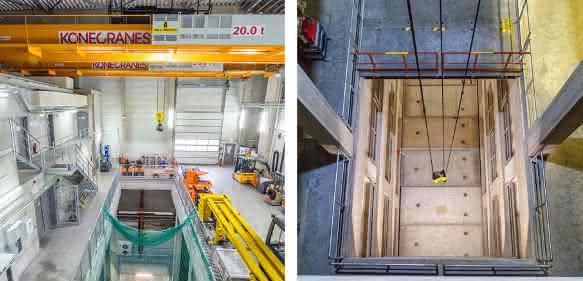
Two double-girder bridge cranes, each with a lifting capacity of 20 tons, are used at the tunnel entrance in Hamburg-Bahrenfeld. At 20.8 meters, they span the entire entrance hall and can also lift sensitive and heavy equipment synchronously and transport it into the access shaft. Another single-girder overhead crane is specially designed to lift pumps from the accelerator tunnel for maintenance.
Slow and smooth ride
"The sensitivity of our cranes was particularly important for this project," explains Niclas Maassen from Konecranes in Hamburg. "Extremely slow and jerk-free travel was the main requirement." To enable the safe transportation of sensitive equipment, Konecranes uses frequency inverters. This allows the lifting speed of the large crane systems at the tunnel entrance to be continuously adjusted from 0.5 to nine meters per minute. The frequency inverter automatically monitors the lifting speed and thus ensures smooth operation.
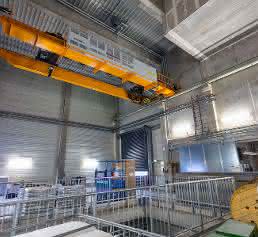
The trolley and crane travel speeds can also be infinitely adjusted - from 0.5 to 20 meters per minute and ten to 40 meters per minute. The high-quality freight must not swing back and forth in the access shaft. "In addition to the inverters, load sway damping is also used. This smart feature automatically controls the acceleration and deceleration of the bridge and trolley," says Maassen. This prevents swaying in the long shaft.
To enable the two double-girder bridge cranes at the front tunnel entrance to work together in a confined space, their drums for the long hoist cables are rotated so that they are parallel to the girder. "With such a large lifting height, you need equally long cables. By rotating the drums, we enable synchronous operation of the two large cranes even in a small space," says Maassen. In tandem operation, one crane operator steers both cranes simultaneously via radio remote control - the movements are automatically synchronized and no longer have to be coordinated by calling out.
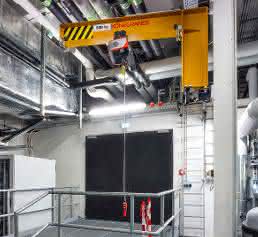
With a length of 3.4 kilometers, one access shaft is not enough. Four maintenance access points are therefore distributed at regular intervals along the tunnel. Concrete slabs also have to be lifted onto the shaft openings at these access points and high-quality components transported. For these tasks, Konecranes installed a total of four double-girder bridge cranes, each with two trolleys and a lifting capacity of two times ten tons. They each have a span of twelve meters and a lifting height of up to 21 meters and are also equipped with frequency inverters and load-sway damping.
In the experimental hall at the end of the tunnel system, a double-girder overhead crane with an eleven-metre span lifts equipment weighing up to 20 tons from the truck loading zone into the underground hall. In the vacuum laboratory above the hall, a double-girder overhead crane with a lifting capacity of five tons is used to transport particularly sensitive laboratory equipment - without jolting or swinging. "Our crane systems move a lot at the European XFEL, from large concrete slabs to expensive components," explains Niclas Maassen. "For smaller transport tasks, we have also equipped the European XFEL research center with wall-mounted slewing cranes and light cranes for loads from 500 kilograms to two tons." as


You might also be interested in
Helu makes its first trade fair appearance under a new brand name
Helu Kabel will be presenting itself as Helu for the first time at Hannover Messe 2026, showcasing system solutions, Heluchain cables and new industrial luminaires.
 read more...
Strategic realignment with brand relaunch
In future, Helukabel will trade as Helu
The Helukabel Group is parting with part of its name: in future, the company will only operate under the Helu brand. With this step, the specialist for electrical connection technology is underlining its strategic development from a classic cable...
read more...Modular plant construction for corrugated board
Insight into the production of corrugators at BHS Corrugated: Automated, modular and equipped with Helukabel components.
read more...Best quality for the steel
Conditions in the steel industry are harsh and inhospitable. The machines used must be able to withstand the demanding environmental conditions in order to deliver the best quality at all times.
read more...If the standard cable is not sufficient
Lapp offers cables for countless applications - but not for all of them. From time to time, the developers have to modify a standard cable or develop a special cable.
read more...Slight decline in sales, strong investments
The Lapp Group has not been spared from the weakening global economy. However, the company only recorded a slight loss in the past 2024 financial year.
read more...Electrical connection technology
Cables and wires for industrial automation
Heukabel offers system solutions for cable routing from a single source. The subsidiary EKD Systems specializes in tailor-made cable drag chains made of steel, stainless steel and plastic, which are used in moving machines and systems as well as in...
read more...Lapp relies on Ultramid from BASF
Mobile charging of electric vehicles
The automotive industry is currently undergoing the biggest transformation in its history. The boom in battery electric vehicles in particular is presenting the industry with major challenges. Lapp, as a supplier of cables and connection...
read more...Cable handling application
At this year's Motek, ArtiMinds Robotics is showcasing a robot-based automation solution for the sensor-assisted assembly of flexible cables in connector housings.
read more...