

Loading and unloading system
Palletizing system checks trays and products
IEF-Werner has developed a palletizing system for a customer that consists of a loading and an unloading system. The special feature: The trays are synchronized with an MES system via RFID tags and the products in them via barcodes.
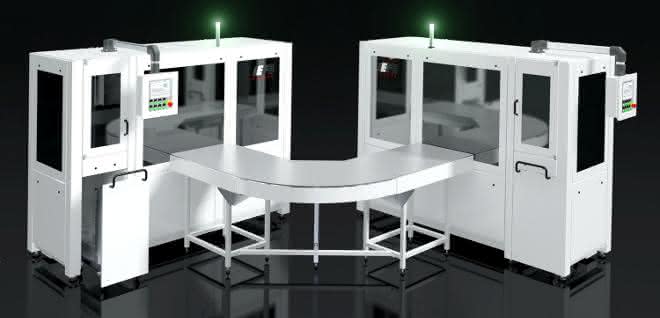
Fast and reliable automated loading and unloading of products from load carriers for the assembly of components plays a major role in many companies in the automotive, pharmaceutical, electronics and medical technology industries. This enables companies to work economically - especially in the series production of large quantities. With high-performance palletizing solutions, users can achieve a high level of efficiency in their processes. They also ensure the provision of components, as no manual errors can occur.
IEF-Werner offers palletizing systems and attaches great importance to short cycle times and high reliability. "We have developed an extremely economical solution for a customer that consists of a loading and unloading system," reports Stefan Deck, Managing Director at IEF-Werner. In this specific application, plate-shaped products measuring 310 by 410 millimetres and 0.1 to 1.5 millimetres thick were to be removed from trays and fed to a conveyor system for further processing. The plates are made of aluminum or copper alloys and have different structures. This means they also vary in weight. "We therefore have different products that have to be handled and recognized reliably by the system depending on the order," explains Deck.
Safety is the top priority
Up to ten plates of the same shape, material and weight are each contained in a plastic tray. To prevent the products from sticking together, there are intermediate layers of non-stick coated plastic between them. "The task was to separate the products, remove them from the trays and the process in the correct position, check them for correctness and feed them for further processing," explains Deck.
The operator takes a trolley on which several loaded plastic trays are stacked and pushes it into the loading system. When loaded, the trolleys weigh up to 150 kilograms. Each tray is fitted with an RFID tag to ensure that the right products are fed into production. Each load carrier should only contain single-variety products - "but you can't be completely sure," says Deck. That's why a barcode is printed on the top and/or bottom of each tray, which is scanned after removal from the tray.
The lifting axis uses its adapted pallet gripper to remove the top tray from the trolley and moves it to a transponder that reads the RFID tag. If the data is correct, the handling unit removes the top product from the tray. A scanner reads the barcode and sensors also measure the thickness. The system compares the data with the order in the operator's Manufacturing Execution System (MES). The handling unit then places the panel on the conveyor belt. If necessary, this is rotated in the process.
But what happens if the information on the barcode does not match the data in the system? "In this case, a signal and a warning message are sent to the operating personnel, prompting them to intervene and check manually. To prevent the layer pads from sticking to the product, an air pulse from a blow-off pipe is emitted at the same time as they are removed from the tray. The gripper then transports these intermediate trays to the storage unit provided for this purpose and the empty trays to its buffer storage unit.
"The advantages of this concept are particularly evident in interlinked systems and process steps," says Deck. "This is precisely where the right components need to be provided quickly and precisely so that they can then be fed to and removed from the subsequent processing steps in the specified position." as


You might also be interested in
Soft grippers for delicate foods
Irregularly shaped, fragile, and varying in size and weight: products such as potatoes, baked goods, and dairy products push mechanical grippers to their limits.
 read more...
Development Collaboration for Humanoid Robotic Hands Launched
Schunk is entering into a new development partnership with Robert Bosch Robotics. Their shared goal is to develop an industrial-grade robotic hand that can be integrated into various humanoid robot systems.
read more...Robot-controlled packaging of rolls
Koch Robotersysteme, a company specializing in the integration of robotic systems, has developed a complete, automated packaging line for packaging rolls based on Tentoma’s RoRo StretchPack packaging machine.
read more...Robotics and autonomous order picking
Locus Robotics acquires Nexera Robotics and expands autonomous warehouse logistics
Locus Robotics takes over Nexera Robotics and may have taken a decisive step towards truly universal warehouse automation. A new gripping technology should now make possible what was previously considered difficult to automate.
read more...Gentle wheel handling
The newly founded Eisenmann Robotics division develops new robotics concepts to increase the level of automation in modern production facilities.
read more...Gripping systems and vacuum generators
Schmalz is presenting new gripping systems and vacuum generators at Automatica. Exoskeletons, which allow employees to move heavy workpieces effortlessly, will also be on display.
read more...Smart universal gripper for power electronics
The power electronics manufacturer Semikron Danfoss uses the EGU 50 mechatronic parallel gripper from Schunk in a robotic cell. It handles different components and feeds them to a measuring line. With its functionalities, it meets all requirements...
read more...Schmalz takes over finger gripper from Soft Robotics
The vacuum specialist Schmalz is expanding its gripper portfolio and acquiring the mGrip product family from the US company Soft Robotics (SRI), including all finger gripper configurations, patents and the associated know-how.
read more...Soldering with special gripper
In order to make the mini wave soldering of large panels stable and reproducible, Eutect developed a special gripper that prevents the panel from bending, among other things.
read more...