
Inductive charging concept for AGVs
More energy without contacts
With in-process charging, the start-up Wiferion has developed an inductive fast-charging system with high levels of efficiency. The solution enables the intermediate charging of lithium-ion batteries, eliminating charging breaks and increasing AGV availability.
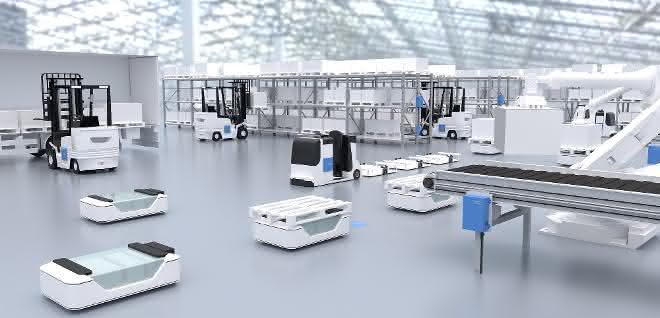
AGVs are used when it comes to automating internal material flows. They are available in various designs for different applications, for example as automated forklift trucks, underride tugs or in combination with lifting units. The advantages of AGVs are obvious: they are flexible, can be perfectly integrated into existing structures, take the strain off employees and can be used almost without interruption. In order to achieve maximum process efficiency, the vehicles must be permanently available. However, they require an appropriate supply infrastructure. Conventional energy storage systems for driverless transport vehicles are lithium-ion batteries, which can be easily integrated into intralogistics processes and can be recharged at any time. This high-performance technology impresses with its long service life and low operating and maintenance costs.
Disadvantages of charging concepts with plug and loop connections
Lithium-ion batteries are often charged using conventional charging contacts with plug or loop connections. Charging cables are usually connected during longer breaks or at the end of a shift. The energy level of the batteries drops continuously during operation and must therefore be compensated for by longer charging phases. As the batteries are not continuously recharged, they must be significantly larger and have a higher capacity than is actually necessary. If the entire vehicle fleet is charged after the end of the shift, energy consumption and the associated costs increase rapidly.
Special waiting areas must be set up for charging. For health and safety reasons, these are not located near the production areas, but further away, sometimes even outside. When the driverless transport vehicles drive to the charging stations during production, they are absent from the production process. An increased number of vehicles is therefore necessary to ensure an uninterrupted production workflow. As an alternative to the wired charging concepts, it is also possible to exchange complete battery trays in designated exchange stations. However, this exchange system requires an investment in additional batteries.

In addition, the swapping process ties up valuable vehicle and personnel capacity. If charging takes place via sliding connections, complex wiring and lowering kinematics are required to activate the contacts only at the time of charging. Otherwise, unwanted current flow and sparking can occur. These solutions are relatively expensive, inflexible, prone to faults and require structural intervention in the infrastructure.
Guidance systems: inductive, but expensive and inflexible
When AGVs are used in guidance systems, the vehicles follow a fixed track. Charging is inductive; however, extensive intervention in the infrastructure is required to install the conductors in the ground. The route must be permanently supplied with energy. The system is very costly and maintenance-intensive. There are also safety risks for employees, as a magnetic field is constantly generated. Guidance systems are relatively inflexible and can only be adapted to changing requirements with great effort. Every fleet expansion or route change becomes a problem. The efficiency of guidance systems rarely exceeds 60 percent.
Uninterrupted work processes thanks to in-process charging
Intelligent point charging systems with contactless energy transfer for charging lithium-ion batteries offer numerous technical and economic advantages. With the EtaLink series, Wiferion has developed a contactless fast charging system based on the principle of electromagnetic induction that enables intermediate charging with high currents.
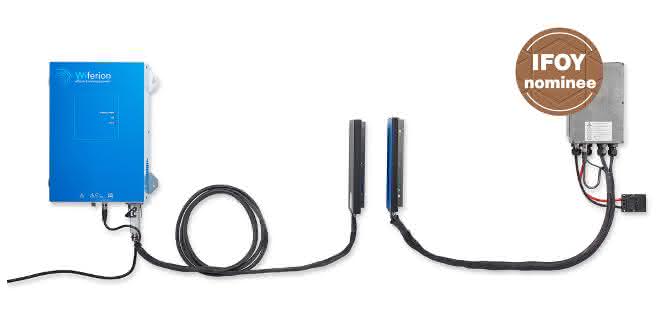
The system consists of a stationary transmitter unit and receiver electronics on the vehicle side. The patented charging technology includes a wallbox and a charging pad. The receiver electronics with receiver coil, mobile charging unit and energy storage unit are installed in the vehicle. The charging process begins fully automatically within one second of the vehicles reaching the charging pad. This in-process charging opens up completely new automation and production concepts. The transmitter unit can be installed quickly and easily at neuralgic points in the warehouse, for example on frequently used routes or at loading and unloading stations. This means that even the shortest downtimes can be used for charging. Work processes no longer have to be interrupted by charging processes and long charging breaks are no longer necessary. This increases availability by up to 30 percent and the vehicles can carry out their tasks 24/7. If processes or other requirements change, the system can be quickly adapted and conveniently repositioned.
Reduce battery capacity and increase efficiency
If the lithium-ion battery is temporarily charged during several short stops and supplied with a high charging current, the energy level never drops but remains constantly high. Only a small capacity range of the batteries is required to operate the vehicles. This allows the capacity of the battery used to be reduced by up to 30 percent - an enormous cost advantage. The efficiency of the fast-charging system results in only low thermal losses and enables a compact vehicle design. Integration into AGVs is based on the plug-and-play principle. Existing vehicle fleets can also be easily converted. The charging stations can be used by different types of vehicles, whether driverless transport systems, industrial trucks or smaller electric vehicles. Depending on requirements, systems with 24 volts or 48 volts are available.
The elimination of plug and sliding contacts also increases safety compared to previous charging systems. The in-process charging solution is completely maintenance-free and quick to install. No intervention in the infrastructure is required. No separate rooms, battery changes or additional batteries are required for the charging processes. The charging system has real-time data acquisition and therefore enables constant monitoring of the operating status. Any faults are transmitted to the fleet management system via the CAN bus. This allows possible vehicle failures to be predicted and prevented by taking appropriate measures.
With an efficiency of 93%, modern wireless charging systems are as efficient as the most powerful wired charging solutions. As a result, process-parallel charging meets the requirements for a fully automated, maintenance-free energy supply and could soon replace the current charging standard in intralogistics. The high availability of the system leads to a significant increase in the reliability and process efficiency of logistics and production facilities. as


You might also be interested in
Predictive maintenance in retrofit
Predictive maintenance pays off. This is because early detection of impending failures means that systems can be serviced in a targeted manner before production downtime occurs. But how complex is it to integrate such a maintenance concept into an...
 read more...
Maintenance instead of replacement
The circular economy starts with the machinery
Sustainability in industry starts with machines, says our guest author from Deguma: How maintenance, modernization and the 5R strategy save resources, energy and CO₂.
read more...3D printing for unplanned requirements
The material fails and the machine suddenly stops? Then you need to take the right measures to be able to resume production quickly. Material failure in the form of faulty components or material wear in the frame are a risk for any production.
read more...High demands in terms of safety, application and robustness
Demanding work in the electrical trade and energy supply as well as smooth processes in production require innovative and customized measurement technology that scores points for safety, ease of use and resilience.
read more...Car meets e-bike: riding with lubrication-free polymer bearings
Studies show that the proportion of pedestrian and bicycle traffic is increasing in urban areas. With the JetBike, JetBike GmbH from Braunschweig presents a mixture of e-bike and car and relies on lubrication-free polymer bearings from Igus.
read more...Hydraulic hub for more efficient servicing
Bosch Rexroth presents a digital toolbox for service and maintenance. With a comprehensive range of digital services, the Hydraulic Hub simplifies and accelerates the service and maintenance of hydraulic products and increases machine availability.
read more...Arnold Umformtechnik expands after-sales...
Faster help with VR glasses
Arnold Umformtechnik is expanding the after-sales service for its machines to include digital remote services. The focus is on data security, simple operation and clear processes.
read more...147,000 euros per hour: high costs for German companies due to unplanned downtime
According to the "Value of Reliability" study, 67% of industrial companies in Germany experience unplanned downtime at least once a month. This costs the German economy 147,000 euros per hour. Nevertheless, reactive maintenance concepts are not...
read more...Maintenance starts with a maintenance planner
Legal requirements stipulate that machines and systems must be serviced regularly. The maintenance work serves to ensure occupational safety and economic efficiency.
read more...