

Powered pallet conveyor
Modularity for automated pallet transport
Following the example of its Modular Conveyor Platform (MCP), Interroll is introducing the MPP (Modular Pallet Conveyor Platform), a modular platform for the powered conveying of pallets.
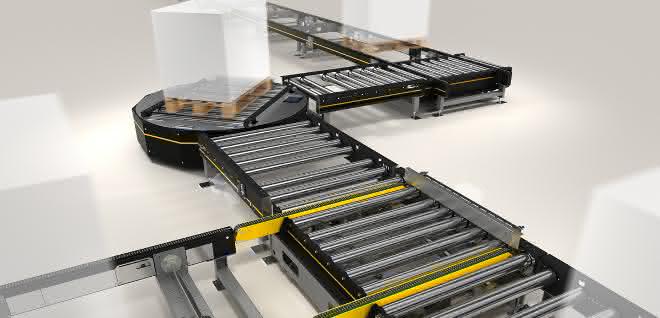
The reliable and efficient handling of pallets plays an important role in modern material flow. In many cases, the aim is to keep transport times between incoming and outgoing goods or between warehouse, production and order picking areas in the company as short as possible and to make them efficient through automation - and all this with lean planning processes, low assembly costs and flexible design options.
The MPP (Modular Pallet Conveyor Platform) are versatile pallet conveyors that can be combined in a flexible and modular way. In combination with the Pallet & Carton Flow flow storage system, the new pallet conveyor platform is suitable as a basis for creating comprehensive pallet storage and pallet conveying solutions for all kinds of applications. In contrast to the flow storage system, in which pallets are buffered on inclined tracks using gravity in intermediate storage areas, the MPP is a system for the powered conveying of pallets. Depending on the application scenario, the drive is provided by gear or drum motors, whereby even zero-pressure accumulation conveyor sections can be realized.
Flexible layout
Interroll emphasizes that the modular system can be conveniently planned and assembled using the company's Layouter tool. The MPP includes chain or roller conveyors as well as additional modules such as transfers and turntables. Special modules for special functions are available on request. The optimally coordinated modules are delivered pre-assembled, which minimizes the effort required for installation. Modifications or extensions to the system can also be carried out at a later date.
Depending on the design of the conveyor line and the choice of modules, pallets weighing up to 1,200 kilograms can be transported at a maximum speed of 0.5 meters per second. The temperature range in which smooth operation of the elements can be guaranteed is minus 28 to plus 40 degrees Celsius, meaning that the MPP can also be used in deep-freeze applications. Depending on the control system used, it is possible, for example, to design the system for different weights, to run at variable speeds or to integrate positioning functions.
Pallet inspection stations can also be installed on the conveyor line on request. This allows the dimensions, weight and integrity or suitability of the pallets for the conveyor line to be checked. Additional checks can also be carried out as an option, for example to ensure that only complete pallets with intact goods pass through the conveyor lines.
The new MPP was extensively tested before its market launch and subjected to extreme endurance and load tests. It complies with all relevant safety regulations and the noise level during operation is 68 dB(A). as


You might also be interested in
Lifting oven grates
Bharat Forge CDP is a supplier of forged chassis and engine components as well as non-automotive systems. Since 2020, the company has been working with Kito-ER2 electric chain hoists to lift furnace grates in the production hall.
 read more...
Mobile and intelligent handling solutions
Scaglia Indeva has been developing and producing industrial manipulators and handling solutions for more than half a century. The company will be presenting its latest products for logistics at LogiMat.
read more...Mink at the Hannover Messe 2023
Transportation on brushes
Technical brushes from Mink are suitable for the gentle transportation of sensitive workpieces. According to the manufacturer, the adaptability of the brushes to different surfaces ensures part quality and avoids rejects.
read more...Partial automation in wood processing
Rescue from the staff shortage
The Schnurr company in Nordrach in the Black Forest has been processing wood for almost 170 years. Today, the company is a sought-after partner when it comes to individual wooden packaging or sawn and planed wood.
read more...Products for better ergonomics
At Intec, Scaglia Indeva will be presenting innovative ergonomic products for intralogistics. The focus is on products for better ergonomics, smoother work processes and protection of employees against overload.
read more...New pallet roller for the warehouse
Conveyor technology specialist Rulmeca is expanding its range of conveyor rollers for pallets and other heavy goods with the XPS series.
read more...Individual energy management
When a Festoon cable carrier system for a crane system with a travel distance of 30 meters was to be replaced, Tsubaki Kabelschlepp designed a complete package consisting of chain and cables, guide channel including substructure and an individual...
read more...Plan and manage maintenance
The health and safety regulations and statutory inspection guidelines for operating equipment in companies are strict and extensive. As a result, it is not easy to keep track of all inspection regulations and periods in day-to-day operations.
read more...Fully automated conveyor system for battery systems
With a fully automated and flexibly expandable conveyor system for truck loading, a manufacturer of battery systems in the electric automotive industry is meeting the increasing demand.
read more...