
Operation successful, crane healthy
Konecranes checks overhead cranes using oil analysis
In order to transport the huge rolls of paper at the Palm paper mill safely day and night, the double girder overhead cranes must always function perfectly. Konecranes has therefore analyzed the gear oil of the cranes in detail.
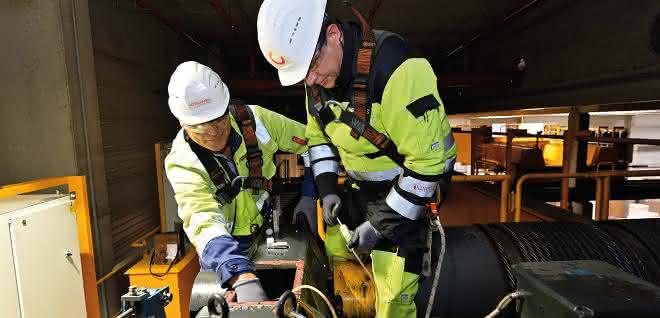
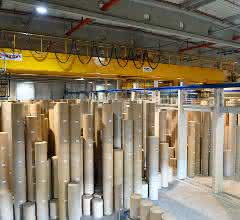
Paper remains one of the most important recyclable materials for the economy: according to the Association of German Paper Mills, the German paper industry sold around 23 million tons of paper, cardboard and paperboard in 2017 - 1.4% more than in 2016. The packaging industry in particular is hungry for paper, with sales in this sector increasing by 3.4% last year. Paper machine 6 (PM6) at the Palm paper mill in Wörth am Rhein is used in precisely this sector. The 650,000 tons of corrugated base paper it produces each year are rolled up and stored. In order to transport the large rolls safely day and night, the hoists of the eleven double-girder overhead cranes in the factory must be in perfect condition. Palm therefore commissioned Konecranes to inspect eight cranes. Following an oil analysis and an endoscopic examination, the maintenance experts completely replaced one hoist gearbox.
"The cranes are in use day and night," says Sven Bohrer, electrical engineer at the Palm paper mill. "If one were to break down, production would have to come to a standstill or at least be slowed down considerably until the damage is repaired. That would cost us time and money." Konecranes has therefore closely examined the gear oil in the hoists of eight of the eleven double-girder overhead cranes at Palm.
This is because the oil provides a deep insight: The abrasive metals and wear materials it contains allow conclusions to be drawn about the condition of the entire gearbox. Nico Zamzow, Vice President Industrial Service EMEA Central at Konecranes on the method: "The oil analysis protects the crane. It allows any damage to be detected and rectified at an early stage. In addition, plant operators can use the detailed analysis report to optimize the repair and maintenance of the cranes and thus extend their service life enormously."
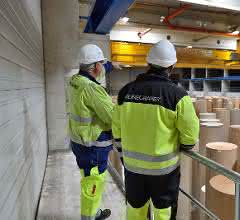
For the oil analysis at Palm, Konecranes experts take samples from the hoist gearboxes of the eight double-girder bridge cranes. "The samples are analyzed in our own laboratory. The employees in the laboratory compare the current condition of the oil with samples that we took in 2016," says Nico Zamzow. "This is how we ensure the validity and quality of the test results." The result for Palm: seven of the eight cranes are "healthy", with little to no foreign bodies or wear substances in the gear oil. However, the gear oil of automatic crane 5, which is used in the roller bearing, contains an increased ferrite content of 273 milligrams per kilogram of oil. Nico Zamzow: "Iron particles in the oil indicate increased wear, for example when metal parts rub against each other."
Crane Reliability Study reveals solution
If the cause of the wear is not rectified, this can cause lasting damage to the gearbox. "If the gearbox seizes up while a pulley is hanging on the hook, it becomes very difficult to recover it and repair the crane," explains Nico Zamzow. To determine whether damage has already occurred, the Konecranes experts use the Crane Reliability Study (CRS).
In the modular analysis, they check safety-relevant components such as the hoist gearbox, the steel structure, the drives and the crane's electrical equipment. The procedure is individually tailored to each crane using Konecranes' MainMan software. In addition, the maintenance experts interview crane operators and technicians on site. The results of the analysis are incorporated into a report for the operator - with specific recommendations for action. At Palm, Konecranes also uses an endoscope to examine the hoist gearbox. "Just like in medicine, we can use the endoscope to reach inaccessible areas without having to take the entire gearbox apart," says Nico Zamzow. "For the CRS, we use a special, oil-resistant model that was developed for industrial use and can be equipped with various lenses."
For the Konecranes service experts, it is clear after the endoscopic examination: the hoist gearbox must be replaced. In addition, the rope drum, the rope drum bearing, the slip ring assembly, the drum clutch and the motor clutch need to be replaced. "Because we detected the wear at an early stage, we can replace the old gearbox with a new one without affecting production," explains Nico Zamzow. as


You might also be interested in
Predictive maintenance in retrofit
Predictive maintenance pays off. This is because early detection of impending failures means that systems can be serviced in a targeted manner before production downtime occurs. But how complex is it to integrate such a maintenance concept into an...
 read more...
Maintenance instead of replacement
The circular economy starts with the machinery
Sustainability in industry starts with machines, says our guest author from Deguma: How maintenance, modernization and the 5R strategy save resources, energy and CO₂.
read more...3D printing for unplanned requirements
The material fails and the machine suddenly stops? Then you need to take the right measures to be able to resume production quickly. Material failure in the form of faulty components or material wear in the frame are a risk for any production.
read more...High demands in terms of safety, application and robustness
Demanding work in the electrical trade and energy supply as well as smooth processes in production require innovative and customized measurement technology that scores points for safety, ease of use and resilience.
read more...Car meets e-bike: riding with lubrication-free polymer bearings
Studies show that the proportion of pedestrian and bicycle traffic is increasing in urban areas. With the JetBike, JetBike GmbH from Braunschweig presents a mixture of e-bike and car and relies on lubrication-free polymer bearings from Igus.
read more...Hydraulic hub for more efficient servicing
Bosch Rexroth presents a digital toolbox for service and maintenance. With a comprehensive range of digital services, the Hydraulic Hub simplifies and accelerates the service and maintenance of hydraulic products and increases machine availability.
read more...Arnold Umformtechnik expands after-sales...
Faster help with VR glasses
Arnold Umformtechnik is expanding the after-sales service for its machines to include digital remote services. The focus is on data security, simple operation and clear processes.
read more...147,000 euros per hour: high costs for German companies due to unplanned downtime
According to the "Value of Reliability" study, 67% of industrial companies in Germany experience unplanned downtime at least once a month. This costs the German economy 147,000 euros per hour. Nevertheless, reactive maintenance concepts are not...
read more...Maintenance starts with a maintenance planner
Legal requirements stipulate that machines and systems must be serviced regularly. The maintenance work serves to ensure occupational safety and economic efficiency.
read more...