

Conveyor technology
Fully automated conveyor system for battery systems
With a fully automated and flexibly expandable conveyor system for truck loading, a manufacturer of battery systems in the electric automotive industry is meeting the increasing demand.
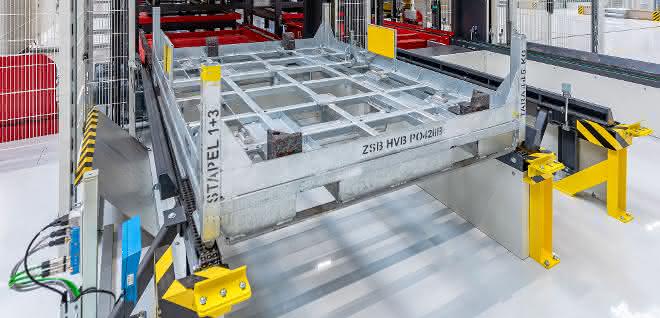
In 2030, many car manufacturers will say goodbye to the combustion engine for good. Manufacturers will switch exclusively to selling purely electric vehicles. In order to be able to meet the current steadily growing demand for electric models, battery manufacturers in particular will be forced to expand their capacities and ensure continuous production.
It is therefore more important than ever to automate internal material flows in order to guarantee safety, flexibility and quality in the long term. Not least in view of the fact that the majority of all automotive suppliers deliver "just in time" and production parts must be ready for delivery within a few minutes.
Specifically defined request
Around 1.5 years ago, a Leipzig-based supplier for electromobility approached the conveyor technology manufacturer Haro Anlagen- und Fördertechnik from the Sauerland region with this request. In its inquiry, the company had already specifically defined the requirements for the new conveyor system: An interface was to be installed from production for the onward transport to the car manufacturer's final assembly line for the transportation and storage of steel pallets for the battery cells.
With a maximum total weight of 21 tons, another special feature of the project was the load of the conveyed goods. Up to four pallets with a filling weight of one ton each are to be stacked on top of each other in the system in order to make the material flow as efficient as possible.
Stack up to four steel pallets
The Rüthen-based family business was ultimately able to meet these requirements with a well thought-out and comprehensive concept, as Haro Group design manager Markus Löseke explains: "We designed a system for our customer consisting of Triplex heavy-duty chain conveyors and vertical conveyors with a hydraulic pallet stacking function. This combination, which was manufactured according to the individual specifications of the battery cell manufacturer, enables a fully automated material flow from production through to loading the truck: first, the battery-loaded steel pallets are loaded onto the triplex chain conveyor in front of the stacker using an automated guided vehicle (AGV).
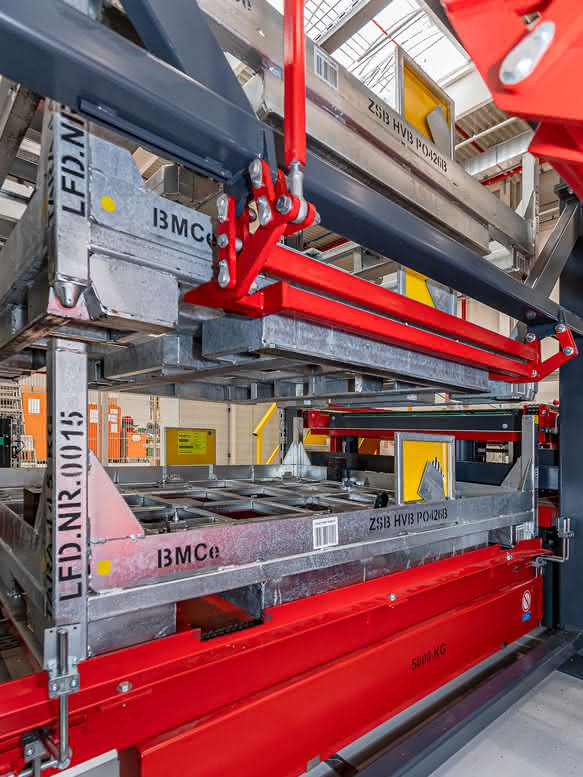
The hydraulic rack stacker, equipped with a two-strand triplex chain conveyor, enables up to four steel pallets to be stacked. Once the stacking process is complete, the four pallets are transported fully automatically along the approximately 22-metre-long conveyor to the truck transfer point. "The conveyor line consists of chain conveyors with particularly robust triplex chains that can easily withstand the high load of up to 5 pallet stacks with a total weight of 21 tons," says Löseke.
In addition, the motors of the chain conveyors are equipped with frequency inverters that allow the transport speed of the steel pallets to be individually adjusted. "This ensures smooth, even and safe conveying," emphasizes Haro's design management.
At the end of the conveyor section, the pallet blocks are then automatically transferred to the truck loading bridge: With the help of the chain conveyors, the conveyed goods are moved smoothly into the truck trailer for onward transportation. "Here too, the conveyor speed is adapted to the speed of the conveyors in the semi-trailer thanks to the frequency converters," says Haro. However, it is not only the loading of the trucks that is carried out in the manner described; the unloading of the empty pallets is also carried out in the same way. Before being reloaded, the empty pallets are transferred fully automatically from the semi-trailer to the parallel second conveyor line, which is connected via corner transfers, and run through the parallel path to the stacking point, where the steel pallets are then picked up by the AGV and transported back to production.
Redundancy and intelligent networking
In view of the constantly growing demand for battery cells for electromobility, a smooth and reliable production process is a top priority for the Leipzig-based supplier. In order to be able to rule out a production stop, both conveyor lines are each equipped with two emergency organization stations for forklift trucks. "If the AGV should ever fail, the pallets can also be loaded manually with a forklift in an emergency," says Markus Löseke, explaining the background to the dual loading option. And should one of the two systems fail completely, both conveyor lines can operate in reverse mode and be used for both loading and unloading the trucks. If the batteries are not available at the car manufacturer in time, production comes to a standstill.
In addition to preventing downtime in the age of Industry 4.0 and increasing digitalization, intelligent networking is also a top priority in this project. The system's process data, such as the system status or any error messages, are exchanged at any time via OPC UA. Light barriers, safety fences and personnel recognition also ensure safety for employees.
While the system has already been in use for almost a year, the automotive supplier is already planning to expand the existing systems and is thus making use of an intelligent concept from the Haro Group: with the help of the modular system, the systems from the Rüthen-based conveyor technology manufacturer can be flexibly expanded at any time - an option that is currently more important than ever, especially for suppliers of electromobility. And so the Leipzig-based company is already in contact with Haro to implement a further chain conveyor system in order to maintain its ability to deliver on time even during expected peak production figures and to meet growing demand.


You might also be interested in
Lifting oven grates
Bharat Forge CDP is a supplier of forged chassis and engine components as well as non-automotive systems. Since 2020, the company has been working with Kito-ER2 electric chain hoists to lift furnace grates in the production hall.
 read more...
Mobile and intelligent handling solutions
Scaglia Indeva has been developing and producing industrial manipulators and handling solutions for more than half a century. The company will be presenting its latest products for logistics at LogiMat.
read more...Mink at the Hannover Messe 2023
Transportation on brushes
Technical brushes from Mink are suitable for the gentle transportation of sensitive workpieces. According to the manufacturer, the adaptability of the brushes to different surfaces ensures part quality and avoids rejects.
read more...Partial automation in wood processing
Rescue from the staff shortage
The Schnurr company in Nordrach in the Black Forest has been processing wood for almost 170 years. Today, the company is a sought-after partner when it comes to individual wooden packaging or sawn and planed wood.
read more...Products for better ergonomics
At Intec, Scaglia Indeva will be presenting innovative ergonomic products for intralogistics. The focus is on products for better ergonomics, smoother work processes and protection of employees against overload.
read more...New pallet roller for the warehouse
Conveyor technology specialist Rulmeca is expanding its range of conveyor rollers for pallets and other heavy goods with the XPS series.
read more...Individual energy management
When a Festoon cable carrier system for a crane system with a travel distance of 30 meters was to be replaced, Tsubaki Kabelschlepp designed a complete package consisting of chain and cables, guide channel including substructure and an individual...
read more...Plan and manage maintenance
The health and safety regulations and statutory inspection guidelines for operating equipment in companies are strict and extensive. As a result, it is not easy to keep track of all inspection regulations and periods in day-to-day operations.
read more...Knoll Maschinenbau optimizes internal transport tasks
Manufacturing companies are constantly confronted with market changes and increasing customer requirements. Digitalization in the wake of Industry 4.0, corona-related material shortages, shorter delivery times and customer audits are just some of...
read more...