

Basics
Factors for selecting reusable transport solutions
Conveyor lines in distribution centers have a high demand for sturdy plastic containers with specially designed base rims. When selecting reusable transport solutions in the Logistics 4.0 environment, factors such as product protection and auto-ID markings also play an important role.
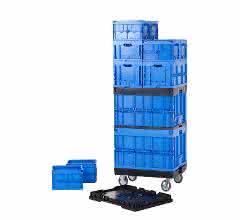
Optimum freight space utilization, low transport costs, real-time tracking of goods routes and a high level of product protection: companies that replace disposable packaging with reusable plastic transport solutions benefit from this. "Experience has shown that a container solution tailored to the processes and the transport route not only brings high added value financially through process optimization, but also in terms of the ecological footprint," explains Dominik Lemken, authorized signatory and Head of Project Management at Walther Faltsysteme. "Aldi Süd, for example, announced that it had saved more than 60 million cardboard boxes and thus more than 24,000 tons ofCO2 equivalents in 2017 alone by using reusable crates for transporting fruit and vegetables."
The more detailed information the container manufacturer has about the processes and requirements, the more precisely the solution can be designed. But what challenges do containers have to meet in an automated warehouse environment and for just-in-time delivery? And what do individually tailored solutions for different areas look like?
Identification of goods and containers in real time
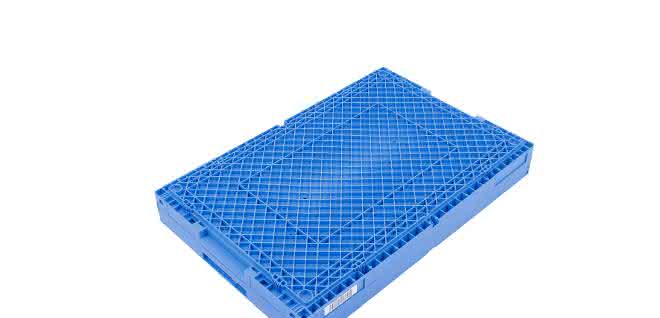
The contactless identification of containers and transported goods in real time is becoming increasingly important. Many companies are already demanding seamless process chains from their suppliers that enable goods to be traced. "Our intelligent load carriers meet the increasing requirements for the traceability of goods routes with integrated RFID transponders and in-mold barcode labels," explains Lemken. "For barcode labeling, we use an innovative technology that fuses the barcode label to the material. This means that the label cannot be lost and is also extremely scratch-resistant. The barcode even withstands cleaning processes with chemicals and remains legible."
This marking technology is not only used for numerous folding and collapsible containers, but also for the plastic Düsseldorfer pallet (KDP), a durable plastic pallet solution in the Düsseldorfer size (800 x 600 millimetres). The KDP guarantees the traceability of goods movements thanks to the in-mold barcode label and the latest RFID technology. Warehouse staff and suppliers can track the movement of goods in real time and thus reliably determine the location of the load carrier. This ensures smooth processes in the supply chain, minimizes pallet shrinkage and optimizes load carrier inventory management.
Making the most of freight space
Optimizing the logistics chain in conjunction with efficient intralogistics also involves making the best possible use of freight space on the further transport route: modular container solutions that can be reduced in volume and are precisely tailored to the product dimensions or stacking height in the truck can achieve high added value while keeping transport costs to a minimum. "With the fruit and vegetable collapsible boxes we have developed, we have set new market standards in terms of reducing the volume of containers. When folded, the box is 27.5 millimetres high and more than 11,000 crates fit into a truck," says Lemken.
Another example of the best possible use of freight space can be found at a large German drugstore chain: to optimize its store logistics, the company uses modular folding boxes that are picked for specific stores and automatically stacked on roll dollies. Once they have been transported to the store, the finished shipping towers can simply be rolled out of the truck to their destination. As a result, the drugstore chain benefits from better utilization of the transport volume of the trucks and the simplest and most time-saving handling of the transport containers in the store.
Conveyability of containers or trays
In an automated warehouse environment, transportability is also an important factor: a wooden pallet that has splintered at a corner and is no longer recognized by the camera system or AGV (automated guided vehicle) interrupts the efficient flow of materials. Runner bases of reusable transport solutions prevent heavy goods from deforming the containers and thus ensure optimum conveying of the boxes on the conveyor system. The type of conveyor technology used, such as roller conveyors, chain conveyors or shuttle systems, has different requirements for the optimum design and transportation of the containers.
As many of the containers are moved in combination with gripper and transport systems from different manufacturers, various other details need to be considered in the design: for example, robots require pockets for automatically stacking, unstacking and erecting the containers, to which the gripper arm can hold the base and pull up the frame. In addition to differences between manufacturers, special features in the material flow should also be clarified in advance. For example, if the containers are to be erected in pairs to increase throughput, this is another factor that needs to be taken into account when planning the design.
Product protection for sensitive goods
Another plus point for reusable plastic transport solutions is the high level of product protection: compared to cardboard boxes, plastic containers can be used along the entire transport chain and, depending on their design, provide reliable protection against environmental influences such as rain and moisture or improper handling. Users can achieve even better protection with lids or suitable interior fittings for the transport solutions. "A major problem for many manufacturers is the fact that expensive goods do not reach their destination intact. A high level of product protection with individually adapted containers can reduce breakage rates to a minimum," says Lemken.
The foldable Mega-Pack pallet boxes from Walther Faltsysteme are an example of reusable containers with a high level of product protection. "Our Mega-Pack pallet boxes can be customized on the inside. Specially shaped workpiece carriers, compartments or foams provide space for large and bulky machine parts while protecting sensitive product areas," says Lemken. "As a market leader in the field of heating, ventilation and air conditioning systems, one of our customers uses our container system to supply different production sites - with minimal breakage rates."
From hygiene to fire protection
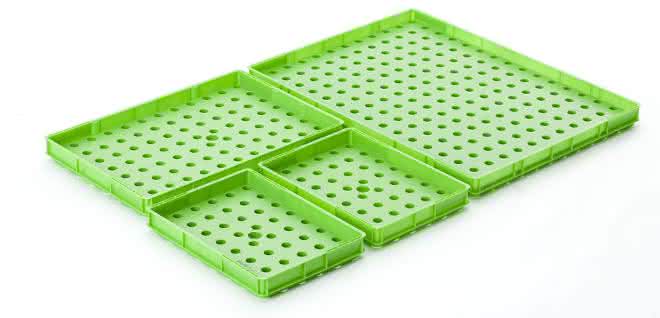
Another decisive factor is whether the container solutions meet the company's hygiene and fire protection requirements. In food logistics, the cleanability of the load carriers and the composition of the material can also be decisive factors. "In many cases, containers are spin-dried. This in turn means that the moisture must be conducted to the outside through sufficient openings to ensure rapid drying. Such smaller aspects are also important for the efficiency of the transport solutions," says Lemken.
As far as the material composition is concerned, it is crucial in the food sector that the containers are approved by the EFSA (European Food Safety Authority). Precise documentation and careful reprocessing are essential, especially when the plastic is reused after the first product life cycle.
There areno universal solutions
The right material properties, external dimensions, identification options and much more - there is no such thing as a single load carrier that meets all process requirements straight away. Instead, maximum efficiency can only be achieved if the container solution is tailored to the transport chain and the requirements of the individual process steps. "The better we know the customer's prerequisites and requirements, the more precisely our development department can work," says Lemken. "And the results are impressive: Lower breakage rates for packaged goods and savings in transport and disposal costs for disposable packaging of up to 30 percent or, in some projects, significant six-figure euro amounts are not uncommon." as


You might also be interested in
Lifting oven grates
Bharat Forge CDP is a supplier of forged chassis and engine components as well as non-automotive systems. Since 2020, the company has been working with Kito-ER2 electric chain hoists to lift furnace grates in the production hall.
 read more...
Mobile and intelligent handling solutions
Scaglia Indeva has been developing and producing industrial manipulators and handling solutions for more than half a century. The company will be presenting its latest products for logistics at LogiMat.
read more...Mink at the Hannover Messe 2023
Transportation on brushes
Technical brushes from Mink are suitable for the gentle transportation of sensitive workpieces. According to the manufacturer, the adaptability of the brushes to different surfaces ensures part quality and avoids rejects.
read more...Partial automation in wood processing
Rescue from the staff shortage
The Schnurr company in Nordrach in the Black Forest has been processing wood for almost 170 years. Today, the company is a sought-after partner when it comes to individual wooden packaging or sawn and planed wood.
read more...Products for better ergonomics
At Intec, Scaglia Indeva will be presenting innovative ergonomic products for intralogistics. The focus is on products for better ergonomics, smoother work processes and protection of employees against overload.
read more...New pallet roller for the warehouse
Conveyor technology specialist Rulmeca is expanding its range of conveyor rollers for pallets and other heavy goods with the XPS series.
read more...Individual energy management
When a Festoon cable carrier system for a crane system with a travel distance of 30 meters was to be replaced, Tsubaki Kabelschlepp designed a complete package consisting of chain and cables, guide channel including substructure and an individual...
read more...Plan and manage maintenance
The health and safety regulations and statutory inspection guidelines for operating equipment in companies are strict and extensive. As a result, it is not easy to keep track of all inspection regulations and periods in day-to-day operations.
read more...Fully automated conveyor system for battery systems
With a fully automated and flexibly expandable conveyor system for truck loading, a manufacturer of battery systems in the electric automotive industry is meeting the increasing demand.
read more...