

200 years of Dematic
Dematic celebrates its 200th anniversary
Dematic celebrates its 200th anniversary. In Wetter an der Ruhr, Friedrich Wilhelm Harkort founded the Mechanische Werkstätten Harkort in 1819, the forerunner of today's intralogistics automation company.
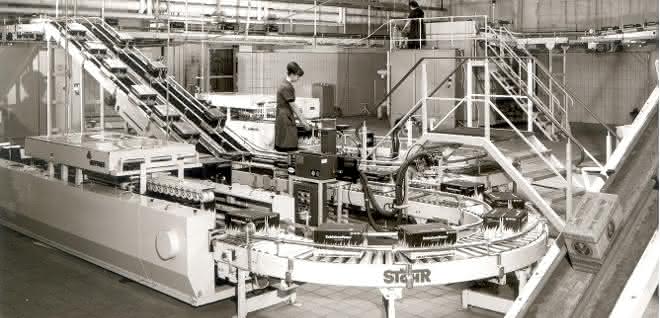
"Dematic can look back on a long tradition. Thanks to our innovative strength, we have had a decisive influence on the history of intralogistics. We continue to set ourselves this standard today," says Rainer Buchmann, CEO Dematic Central Europe. After the first mechanical loom heralded the first phase of the Industrial Revolution in 1784, Mechanische Werkstätten Harkort & Co. was also an early adopter of water and steam-powered production systems. The company developed the first steam-powered crane as early as 1819 and began mass producing overhead cranes in 1840.
Second phase of the Industrial Revolution
The second phase of the Industrial Revolution began in 1870 with the introduction of electricity as a driving force. The internal combustion engine replaced the steam engine and the chemical industry and electrical engineering developed into new sectors. Influenced by the resulting opportunities, another precursor company, Stöhr Elevatorenfabrik, was founded in 1900, specializing in continuous conveyors, elevators and bucket elevators.
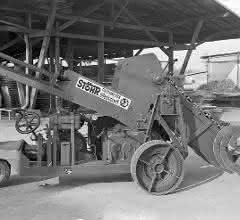
In 1922 - around half a century before the start of the third industrial revolution - the company built its first mobile conveyor belt. A few years later, Stöhr developed the first suspended conveyor technology: an advance that enabled a completely new and more effective use of space in factories.
Paradigm shift in intralogistics
At the end of the 1950s, Stöhr brought about a paradigm shift in intralogistics with the world's first storage and retrieval machine. Three years later, the company built the first fully automated warehouse for Bertelsmann. From then on, up to 15,000 orders could be processed there every day. While the company was renamed Stöhr Förderanlagen Salzer in 1968, it also changed its focus from a pure product provider to a fully-fledged solution provider. The aim was to supply customers with systems for their entire business processes.

The third industrial revolution began in 1970, when the first programmable logic controller (PLC) called Modicon 084 came onto the market. This device made it possible to control and regulate machines and systems digitally for the first time. PLCs are still widely used in automation technology today. Three years later, Mannesmann, which had acquired Stöhr in the meantime, revolutionized the design of distribution centers with the world's first automated high-bay warehouse. In 1990, the company finally became the world market leader in conveyor technology. Five years later, Mannesmann Demag was the world's first full-range supplier in intralogistics.
Industry 4.0
The turn of the millennium marked the start of the fourth phase of the industrial revolution, in which cyber-physical systems take center stage. These ensure decentralized and dynamic control and networking of all components via the Internet, mobile computers and cloud computing. After Dematic was founded as an independent company in 2005, the intralogistics automation specialist turned the market for automated small parts warehouses upside down and invented the Dematic Multishuttle.
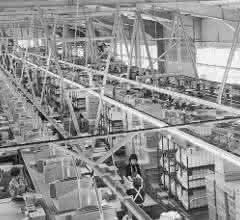
In 2011, the company presented the Rapidstore storage and retrieval machine, the Rapidpick picking station, the Multishuttle Flex and the DC Director warehouse management software. The second generation of the Dematic Multishuttle, launched in 2012, was lighter, faster and even more powerful. Today, Dematic is one of the leading providers of integrated automation technology, software and services for optimizing the supply chain. as


You might also be interested in
ebm-papst is growing again thanks to AI and data centers
ebm-papst returned to a growth trajectory in fiscal year 2025/26. Air Technology, data center applications, and artificial intelligence are driving revenue and investment.
 read more...
SPE on the Verge of a Market Breakthrough
Single Pair Ethernet (SPE) has moved beyond the conceptual phase and is increasingly being implemented in industrial settings. The focus here is not only on higher data rates and simplified cabling, but above all on the issue of system integration...
read more...More than 900 exhibitors already registered
Around six months before the start of the trade fair, more than 900 companies have registered for SPS 2026 in Nuremberg. The trade fair focuses on industrial AI, cyber security and digital transformation.
read more...Virtual PLCs in practice: How vPLCs make production systems more flexible and scalable
The increasing networking of IT and OT is fundamentally changing industrial automation. The IT/OT Integration Summit shows how modern technologies can make production environments more efficient, flexible and future-proof. The event will focus on...
read more...Sales growth in a turbulent market environment
Thanks to innovations and a focus on strategic industrial markets, Sick was able to moderately increase its sales in the 2025 financial year. In a turbulent market environment, the company was able to maintain its position and gain market share with...
read more...Siemens presents new AI agent
Siemens is launching 'Eigen Engineering Agent', an AI for automation technology. The solution is integrated into the TIA Portal, has been tested with over 100 companies and is designed to significantly accelerate engineering processes.
read more...Schaeffler keeps sales almost stable
Schaeffler generated revenue of EUR 23.5 billion in 2025 and increased EBIT before special items to EUR 936 million. At 266 million euros, free cash flow was significantly above the prior year and forecast. Net income remained negative due to high...
read more...Advancing artificial intelligence together
Helukabel is stepping up its activities in the field of artificial intelligence and is now a member of the IPAI. The innovation and collaboration platform for companies, research facilities, institutions and administration has set itself the goal of...
read more...New impetus for ifm sales
Two new positions were filled at ifm at the start of 2026: Markus Wolf becomes Managing Director Sales Germany, Sven Quant takes over the position of Central Managing Director in the Process Sensors division within the ifm Group.
read more...