
Four directions
Cranes lift steel pipes automatically
At Swiss steel pipe manufacturer Jansen, pipes come in bundles from the warehouse into the dip bath and out again. Jansen relies on CXT NEO double-girder bridge cranes with controls from Konecranes to ensure that they do not bend or fall down.
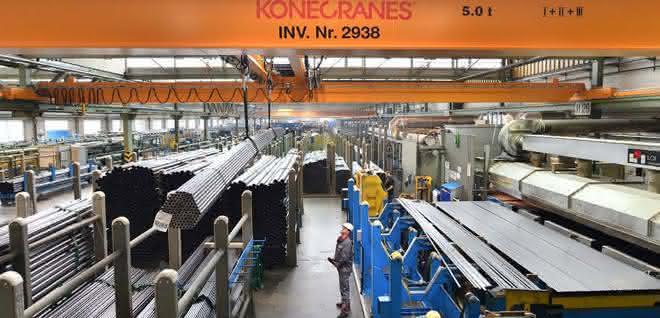
Precision is essential in the manufacture of cars and trucks: The bodywork must fit together perfectly, otherwise the longevity of the vehicle will suffer. Jansen in Oberriet, Switzerland, on the border with Austria, manufactures precision steel tubes for the automotive industry with a high degree of accuracy. In addition to exact dimensions, vehicles in particular require durability in order to withstand tens or even hundreds of thousands of kilometers of driving - on asphalt, gravel roads and in wind and weather.
To make the steel pipes more resistant, they undergo an immersion bath before being finished at Jansen, a long-established company founded in 1923. To get into the bath, the steel pipes, which are bundled together, must first be safely lifted out of the warehouse. They must not be bent or tilted too much in the process. They must then be held at a controlled angle for their protective bath. This requires a very special control system. Konecranes has therefore designed three CXT NEO double-girder bridge cranes with an upper crane and three trolleys specifically for Jansen's requirements.
Pipe bundles in confined spaces
"Because the space in the production hall is very tight, we built the cranes very compactly," explains Andreas Scheerer, team leader of the Modernization department at Konecranes at the Frick site in Switzerland. "They have to be able to transport pipes of different lengths in four directions at the same time." The pipe bundles at Jansen are between 3.5 and 13 meters long. They must not bend during transportation, otherwise the pipes could be permanently damaged. At the same time, the bundles, which can weigh up to five tons, must always remain balanced. Otherwise there is a risk of slipping during transportation - a risk for the employees.
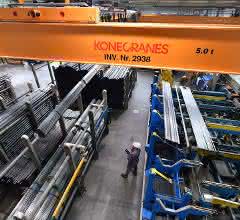
At Jansen, the steel pipes also have to be inclined so that they enter the dip bath safely. "The angle must not be too steep, otherwise the steel tubes will slip," says Rolf Büchel, Head of Production at Jansen. "This is the only way the bundles can be optimally immersed." And after treatment, the pipes must be returned to their original horizontal position - preferably automatically and safely.
Semi-automatic control for three hoists
In order to transport the pipe bundles safely and reliably, all three CXT NEO double-girder overhead traveling cranes have an upper crane with three trolleys. Rolf Büchel: "This means we are prepared for any pipe length. If the bundle is very short, the crane operator can use two of the three trolleys for transportation. If the steel pipes are very long, all three hoists are used."
A control system specially developed by Konecranes for Jansen simplifies the control of the three trolleys. "These are programmed into the crane control system so that the cranes can automatically adjust to the different lengths of their cargo," explains Andreas Scheerer. "When the crane operator selects a pipe length, the trolleys automatically move to the correct positions. That saves an enormous amount of time." The entry angles into the immersion bath are also defined in advance: Crane operators only have to press the command for "tilt", then the right hook moves up and the left hook moves down until the optimum angle of a maximum of 2.5 degrees is reached, depending on the pipe length - the middle hook always remains in the same position.
For such complex actions, the crane must "know" where the trolleys and hooks are in the transport process at all times. The CXT NEO cranes communicate with frequency inverters, absolute encoders, barcode systems and the radio remote control via a fail-safe PLC control with Profinet connection. Andreas Scheerer: "This means the crane always has all the important information." Thanks to Truconnect Remote Service, the maintenance experts at Konecranes also receive all the important data: remote data transmission allows them to see at an early stage when maintenance is required, thereby increasing the availability of the cranes. as


You might also be interested in
ebm-papst is growing again thanks to AI and data centers
ebm-papst returned to a growth trajectory in fiscal year 2025/26. Air Technology, data center applications, and artificial intelligence are driving revenue and investment.
 read more...
SPE on the Verge of a Market Breakthrough
Single Pair Ethernet (SPE) has moved beyond the conceptual phase and is increasingly being implemented in industrial settings. The focus here is not only on higher data rates and simplified cabling, but above all on the issue of system integration...
read more...More than 900 exhibitors already registered
Around six months before the start of the trade fair, more than 900 companies have registered for SPS 2026 in Nuremberg. The trade fair focuses on industrial AI, cyber security and digital transformation.
read more...Virtual PLCs in practice: How vPLCs make production systems more flexible and scalable
The increasing networking of IT and OT is fundamentally changing industrial automation. The IT/OT Integration Summit shows how modern technologies can make production environments more efficient, flexible and future-proof. The event will focus on...
read more...Sales growth in a turbulent market environment
Thanks to innovations and a focus on strategic industrial markets, Sick was able to moderately increase its sales in the 2025 financial year. In a turbulent market environment, the company was able to maintain its position and gain market share with...
read more...Siemens presents new AI agent
Siemens is launching 'Eigen Engineering Agent', an AI for automation technology. The solution is integrated into the TIA Portal, has been tested with over 100 companies and is designed to significantly accelerate engineering processes.
read more...Schaeffler keeps sales almost stable
Schaeffler generated revenue of EUR 23.5 billion in 2025 and increased EBIT before special items to EUR 936 million. At 266 million euros, free cash flow was significantly above the prior year and forecast. Net income remained negative due to high...
read more...Advancing artificial intelligence together
Helukabel is stepping up its activities in the field of artificial intelligence and is now a member of the IPAI. The innovation and collaboration platform for companies, research facilities, institutions and administration has set itself the goal of...
read more...New impetus for ifm sales
Two new positions were filled at ifm at the start of 2026: Markus Wolf becomes Managing Director Sales Germany, Sven Quant takes over the position of Central Managing Director in the Process Sensors division within the ifm Group.
read more...