
Conveyor system
Raw materials for production
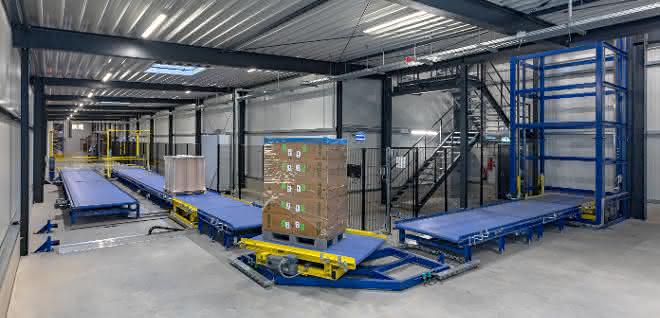
From goods receipt to production at the touch of a button and without manual intervention - this has been a reality at the Löningen-based company Schne-frost since last year. From now on, the raw materials are transported between the newly built incoming goods warehouse and production in a fully automated and efficient manner thanks to an integrated conveyor system from HaRo Anlagen- und Fördertechnik. Transport across a fire department access road using a conveyor bridge is not the only special feature of the new conveyor system at Schne-frost.
Food processing
It took less than half a century for the company to turn a simple foodstuff - the potato - into a superstar. What began in the 1950s as a wholesale business for seed and table potatoes is now an innovative production company for frozen potato and vegetable specialties. From the well-known French fries, croquettes and mashed potatoes to potato dumplings and potato noodles, Schne-frost offers potatoes in all conceivable shapes, sizes and flavors. Since it was founded by Ernst Schnetkamp, an agronomist at the time, the company has grown steadily and today has a factory site covering over 100,000 square meters - equipped with the most modern production technologies in the food industry.
With the same intention and an expansion of its production lines, the company turned to the Sauerland-based conveyor technology manufacturer HaRo in 2019: Schne-frost was looking for a conveyor system that would link the new warehouse with the existing building to connect its new raw materials warehouse to production. The challenge: a fire department bypass between the two buildings could not be impaired for the transportation of the raw materials. A difficulty for which Thorsten Koopmann, Sales Area Manager at intralogistics manufacturer HaRo, developed the right solution concept: two vertical conveyor systems and a section of link conveyors were to cover the distance as well as the height differences between the buildings and meet the requirement for automated transport.
Conveying in two directions
"The customer also wanted to transport the raw materials not only in one direction - from goods receipt to production - but also in the opposite direction." Finally, the unused raw materials are to be transported back to the raw materials warehouse. However, as Thorsten Koopmann emphasizes, the conveyed goods are not just the usual and standardized pallet designs: "We use a wide variety of pallets from all over the world with very individual dimensions, materials and skid or base designs. This is one reason why a trained and experienced eye is also required when selecting the conveyor system. "These pallets cannot be transported using standard roller conveyor or chain conveyor applications," says the area manager, who recommended a link belt conveyor to his customer to avoid tedious re-palletizing. The link belt conveyor enables flexibility in the conveyed goods and eliminates problem areas that could cause the material flow to come to a standstill if the conveyed goods are not suitable for reliable transportation due to their design or possible damage.
Lifting table-link belt combination
But how do the pallets actually get from the incoming goods area to the production area? Thanks to a lift table and link conveyor combination, the goods are fed at floor level, even with a standard lift truck without a high lift, so that no differences between the lift and the link conveyor need to be overcome. Particularly strong and robust modular belts promise maximum durability - even with uneven conveyed goods. An airlock, which is equipped with 2 mechanical access barriers, guarantees maximum safety for employees working there and prevents them from entering the danger zone.
In addition, a contour check ensures that the maximum overhang of 200 millimetres per side is not exceeded and that damage to the conveyor systems and the associated interruptions to the material flow can be completely ruled out. The swivel stations for diverting the conveyed goods also have a special feature: "Because the swivel station's pivot point is positioned off-center, the swivel station rotates flush to the front of the link conveyor without any gaps or distances," says Thorsten Koopmann.
Vertical conveyor
The transfer to the vertical conveyor is fully automated: The goods can be transferred directly from the link conveyor to the freight elevator. The vertical conveyor easily overcomes the height difference from the warehouse to the bridge and then transfers the pallets back to the link conveyor in the bridge. Here too, transportation to the second vertical conveyor is fully automated. The second vertical conveyor is then used to transport the goods back down to the lower level of production. The same process is also possible in the opposite direction. In this way, around 50 pallets per hour are reliably and cost-effectively transported several kilometers per day in three-shift operation.
A concept that completely convinced the Schne-frost Group. Not only does the HaRo Group offer a comprehensive service - from planning to installation and electrical commissioning - from a single source, the expertise of the conveyor technology manufacturer is also available to the customer after successful installation in the form of spare parts orders and regular maintenance. The conveyor system at Schne-frost can also be flexibly expanded or supplemented at any time, as the individual components offer the special option of being built together. This is an option that the food manufacturer is happy to keep open in the future, as the company premises still offer plenty of potential for expansion.


You might also be interested in
Lifting oven grates
Bharat Forge CDP is a supplier of forged chassis and engine components as well as non-automotive systems. Since 2020, the company has been working with Kito-ER2 electric chain hoists to lift furnace grates in the production hall.
 read more...
Mobile and intelligent handling solutions
Scaglia Indeva has been developing and producing industrial manipulators and handling solutions for more than half a century. The company will be presenting its latest products for logistics at LogiMat.
read more...Mink at the Hannover Messe 2023
Transportation on brushes
Technical brushes from Mink are suitable for the gentle transportation of sensitive workpieces. According to the manufacturer, the adaptability of the brushes to different surfaces ensures part quality and avoids rejects.
read more...Partial automation in wood processing
Rescue from the staff shortage
The Schnurr company in Nordrach in the Black Forest has been processing wood for almost 170 years. Today, the company is a sought-after partner when it comes to individual wooden packaging or sawn and planed wood.
read more...Products for better ergonomics
At Intec, Scaglia Indeva will be presenting innovative ergonomic products for intralogistics. The focus is on products for better ergonomics, smoother work processes and protection of employees against overload.
read more...New pallet roller for the warehouse
Conveyor technology specialist Rulmeca is expanding its range of conveyor rollers for pallets and other heavy goods with the XPS series.
read more...Individual energy management
When a Festoon cable carrier system for a crane system with a travel distance of 30 meters was to be replaced, Tsubaki Kabelschlepp designed a complete package consisting of chain and cables, guide channel including substructure and an individual...
read more...Plan and manage maintenance
The health and safety regulations and statutory inspection guidelines for operating equipment in companies are strict and extensive. As a result, it is not easy to keep track of all inspection regulations and periods in day-to-day operations.
read more...Fully automated conveyor system for battery systems
With a fully automated and flexibly expandable conveyor system for truck loading, a manufacturer of battery systems in the electric automotive industry is meeting the increasing demand.
read more...