

Raw material transfer
Belt conveyors instead of trucks - an economical alternative?
Extracted raw materials have to be transported from the quarry to the plant or port - a task that companies often manage with trucks. As an alternative, system providers such as Beumer supply open troughed belt conveyors or closed pipe conveyors. However, whether an investment is worthwhile depends on various factors.
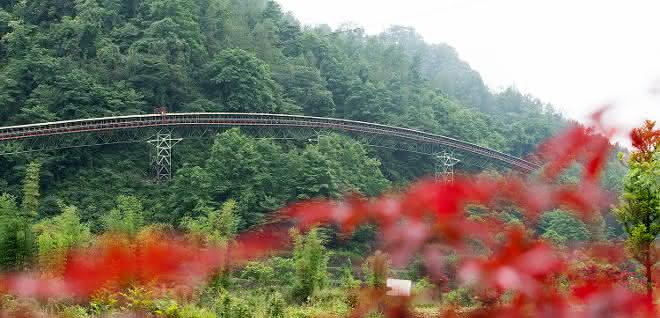
To transport limestone, coal, ores or other raw materials as efficiently as possible from the extraction site to the plant, which is often several kilometers away, and from there on to the port, companies often rely on trucks. However, the roads are not always well developed. And because the route can lead through mountainous terrain and nature reserves, over rivers and unstable ground, the journey usually involves detours. This costs time and therefore money. If the route passes through inhabited areas, this places a particular burden on local residents. The more raw materials that need to be transported, the more trips are required.
It therefore makes sense for companies to take a closer look at alternatives. For example, Beumer offers open troughed belt conveyors and closed pipe conveyors. But is this investment worthwhile? "That depends on the application in question," says Richard Munson. He has been working at Beumer in Kansas City, USA, since 2010 and is responsible for the development and sales of conveyor systems for the energy, cement and mining industries as well as for port terminals. "Companies should carry out an economic assessment in advance," he advises.
An economic valuation is worthwhile
There are various ways to do this - for example, the net present value method, a form of profitability calculation. "Put simply, all future earnings are discounted to the present day and the initial investment is also taken into account," explains Munson. In the calculation, this method works with a discount rate that reflects the best available alternative investment. The user receives a net present value, or NPV for short. If this is positive, the company makes a profit on the investment.
"Another option is cash flow analysis. This quantifies the surplus that results when I subtract the expenses from the income," explains Munson. From the annual difference in total operating costs, the user can see whether the investment in a conveyor system is worthwhile. Various variables are required for a precise evaluation of both transport options - for example, the transport costs per tonne, the volume of material to be moved within a defined period, but also the respective investment or the tax depreciation schedule. "If the user compares the conveyor system with the truck in a time diagram, he obtains the break-even point that separates the profit zone from the loss zone," explains the Beumer expert.
Cost comparison
Depending on the topography, length and power requirements, conventional conveyor systems cost on average between 1,000 and 3,000 euros per meter. Added to this are the costs for construction and delivery as well as for mechanical and electrical installation. In addition, complex construction work is often required. The initial investment in a conveyor system is therefore quite high. "However, the operating costs are significantly lower than when using trucks," reports Munson. "This is because the costs for vehicles include labor, vehicle depreciation, maintenance, repairs, fuel and road maintenance. In addition, there are often other burdens that are often difficult to identify."
The estimated cost of operating a conventional conveyor system is around 20 cents per ton of material to be transported, and just under three euros for a truck. "The biggest variable for the vehicles is the number of round trips per hour," says Munson. "For short and direct routes, of course, this looks better than for long routes where the driver only reaches the destination via detours."
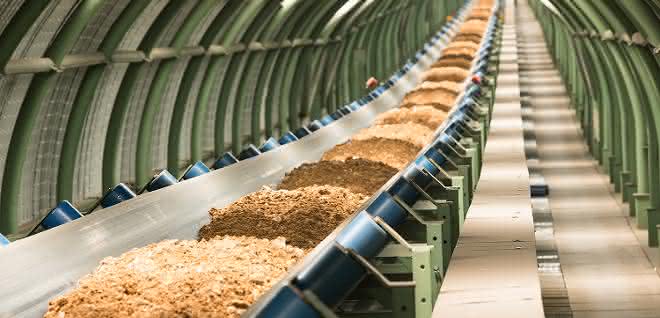
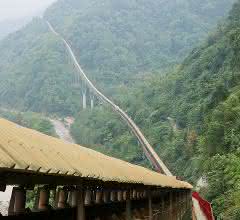
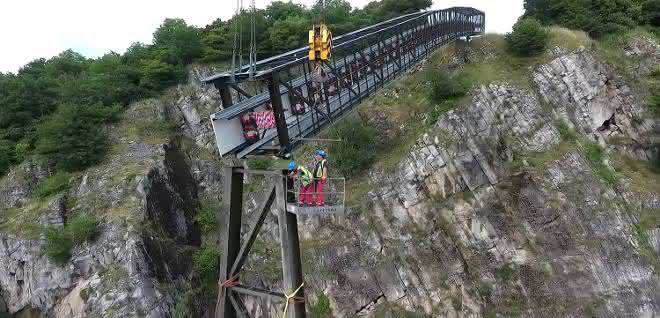
Troughed belt conveyors and the closed pipe conveyors lead directly to the destination. They can also be adapted to the respective terrain structure. A key feature of the technology is that it enables horizontal and vertical curves. Depending on the properties of the material to be conveyed, inclines of up to 15 degrees can be implemented, with lengths of more than twelve kilometers depending on the topography. Precisely because of this ability to negotiate curves, significantly fewer or no transfer towers are required. This saves the user costs, and the system also transports the goods over challenging inclines and declines, rivers or road crossings. The Beumer experts use their own calculation programs to determine the static and dynamic belt tensile forces as early as the system planning stage. This is the prerequisite for the safe design of the curves.
In the case of trucks, there are other cost factors that cannot be outlined as simply as the number of journeys - for example, control measures against dust and for rain runoff. These variables are completely eliminated with the closed pipe conveyors. "If around 1,000,000 tons of bulk material are moved per year, the potential gross difference in the cost of the mass to be moved by truck and conveyor system is 2.8 million euros," Manson calculates. Quite a high amount, in his opinion. The conveyor system will have paid for itself in just a few years.
Ecological and economical
The electric drives and low-energy belts have a positive effect on the operating costs of the belt conveyor systems. Compared to truck drives, these also protect the environment. They are therefore a preferred option, particularly in times of climate change and rising greenhouse gas emissions. The motors used in the systems are usually designed to be controllable. This allows the loads to be optimally distributed across the drive units under different operating conditions. If the belt conveyor system is running downhill, the system operates in generator mode. The electrical energy generated from this is fed back into the public grid via a regenerative unit. This allows operators to further reduce the operating costs of the entire system.
"Depending on the project, belt conveyor systems require up to 90 percent less primary energy than comparable truck transports," says the sales manager, referring specifically to a project-related comparison at the Chinese cement manufacturer Sichuan Yadong Cement. According to this comparison, trucks powered by diesel fuel consume a specific primary energy of 11.4 kilowatt hours per tonne of transported material - the belt conveyor system, which was built later, only consumes 1.44 kilowatt hours. If, as in this case, 7.5 million tons of raw material are transported per year, the user saves a total of 74 million kilowatt hours annually with the belt conveyor. This corresponds to the energy consumption of more than 20,000 single-family homes. The savings in diesel fuel alone reduce the company's operating costs by more than 5.5 million euros per year.
So is it worth investing in a belt conveyor system? "It all depends," says Manson. "Ultimately, the operator has to look at the total cost per tonne over time when evaluating both transport options." The fact is that the operating costs of a belt conveyor are significantly lower than those of a truck. The decisive factor is how much material is transported during the project period - then it can quickly pay for itself. But the Beumer conveyor systems are more environmentally friendly right from the start. as


You might also be interested in
E-scooter with customizable damping
The startup Scuddy has significantly improved the flexibility, performance, customizability and ergonomics of its second-generation foldable e-scooter of the same name - thanks in part to damping technology from ACE.
 read more...
Hurdles on the road to success
Welding is one of the most complicated processes in the manufacturing process, and it is becoming increasingly difficult to find suitable personnel. Can this problem be solved by automating processes? Can or should the robot colleague replace the...
read more...New plug-and-play solutions for the warehouse
Exotec announces a new Skypath conveyor system, the optimized Skypicker picking robot and Deepsky, another proprietary storage software. All three products can be seamlessly integrated into the manufacturer's Skypod system.
read more...Production automation
At Motek, Weiss will be presenting solutions for the linear and rotary movement of workpieces that can be easily integrated into the overall system of hardware and software.
read more...Solutions for surface hardening
Many industrially used components require a combination of a tough core and a hard surface layer so that they can better withstand the stresses of use. Hardening is achieved by rapidly heating the surface and then cooling it quickly.
read more...Wheel bearings and wheel bearing sets
Low-friction rolling behavior
Hecht Kugellager offers a wide range of bearing technology for use in the automotive industry, commercial vehicles and mobile machinery.
read more...Simulation in product development
The Munich-based start-up Spyra significantly shortens the development time of its production by using Solidworks simulation solutions.
read more...Doubling production capacity by 2026
Nabtesco is investing in a third production site, doubling its production capacity to two million precision gearboxes per year by 2026.
read more...Counterbalance trucks with lithium-ion technology
Clark has relaunched the GEX and GTX series.
read more...