

Automatic stackers
Safer than forklift trucks?
Accidents with and caused by pedestrian-controlled forklifts in the workplace often result in serious injuries, sometimes even fatalities. The causes are often restricted visibility due to the load, carelessness or moments of surprise. Automatic forklift trucks are a safer alternative in such cases.
Fortunately, the number of serious accidents involving machinery has fallen significantly in recent years. Unfortunately, this does not apply to accidents involving forklift trucks. In 2016, the German Social Accident Insurance (DGUV) registered a total of 33,868 accidents involving industrial trucks in German factories. These included wheelbarrows, sack trucks and hand trucks as well as roll containers and hand pallet trucks. Forklift trucks and automated guided vehicles (AGVs) were also included in this category. In 2016, 12,674 accidents with and caused by people-operated forklift trucks in the workplace were reported here. What is worrying is that not only were a significantly higher number of accidents reported with manned forklift trucks compared to AGVs, but in some cases people were even killed. In comparison, the accident rate with AGVs that resulted in fatal injuries is zero.
To a considerable extent, the drivers themselves are injured, for example in collisions with other vehicles or structural installations or due to the truck tipping over. According to another study, 44 percent of cases involve bystanders who are hit, crushed or even run over. This happens approximately equally when driving forwards or backwards and when turning.
Forklift truck drivers are severely restricted in their field of vision and often work under high time pressure. Bystanders are often unaware of this restricted visibility and suddenly enter or cross the forklift's traffic area without paying attention. The forklift trucks sometimes drive through the factory at high speed. If you don't fasten your seatbelt, you are putting your life at risk, just like in a car. "The forklift truck tips over because the driver drives too fast into a bend, for example, because he accelerates too much when reversing or hits a road boundary," explains Marcus Gaub, Industrial Trucks Officer at the Retail and Logistics Division (FBHL).
The Berufsgenossenschaft für Fahrzeughaltungen (BGF, source: DGUV Information 208-004) has summarized the most common causes of accidents involving forklift trucks: Hitting people, overturning the forklift truck, incorrect load pick-up, driving and operating errors, incorrect loading and unloading of vehicles, assembly and repair work as well as unauthorized passengers and unauthorized use.
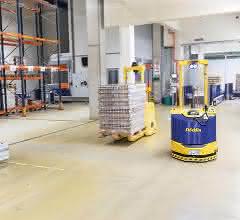
Are driverless transportation systems a solution? Looking at the accident statistics alone, the answer has to be "yes". Automated forklift trucks move through warehouses at a fixed maximum speed of usually no more than around 1.6 meters per second (which is roughly the walking speed of a human). Automatic forklift trucks are equipped with safety laser scanners that detect people and obstacles well in advance. The vehicles then react immediately and reduce their speed. They also move along defined routes so that they do not change direction unexpectedly. Experience has shown that the slower and anticipatory driving of the automated forklift truck results in a greater sense of safety among the workers.
However, the slow speed does not mean that the transport robot is inferior in performance to pallet trucks driven by people. The vehicle works continuously and does not need any breaks, even the charging times are quite short thanks to modern battery technology. Fleets of driverless vehicles are easily scalable, so if the vehicles in the fleet are not sufficient, another one can easily be added. The investment in a driverless pallet truck is manageable and pays for itself in a short time.
Of course, personal safety is always the first and highest priority when using AGVs and potential hazards should be considered as part of a holistic material flow concept right from the planning stage.
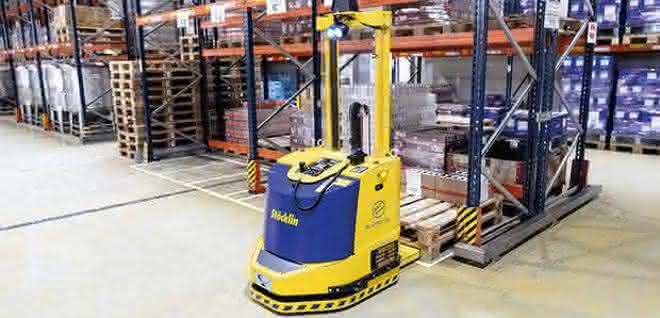
InSystems Automation implements the transport robots individually in the customer's production environment and creates a specification to eliminate potential risks in advance. In cooperation with Stöcklin Logistik and Bluebotics, Insystems offers the Proant 576 for pallets up to a maximum load of 1,200 kilograms. The driverless pallet truck picks up pallets fully automatically and navigates fully automatically along virtual lines to its destination based on an environment contour that has been taught in once.
The vehicle has various safety systems: two safety laser scanners at the rear and two safety laser scanners at the front of the vehicle continuously monitor the driving area. Two light scanners on the forks ensure that the load is picked up safely. This means that pallets can only be set down when the deposit area is clear. Additional laser scanners on both sides of the vehicle check the route for possible obstacles. The Proant adapts its speed to its surroundings and always comes to a safe stop. This is ensured by the speed-dependent warning and protective fields defined in the safety laser scanners, which cause the vehicle to reduce or stop its speed. as


You might also be interested in
New Trade Show for the Turned Parts Industry
The Association of the German Turned Parts Industry has given a positive assessment of the first Make-to-Order (MTO) Days: With 184 exhibitors and approximately 1,400 trade visitors, the inaugural event proved to be a successful platform for...
 read more...
In-house exhibition Bielefeld 2026
How DMG Mori thinks about the factory of the future
DMG Mori will be showcasing turning and milling expertise, automation solutions and additive manufacturing along the Machining Transformation (MX) at the Bielefeld 2026 in-house exhibition.
read more...Association of the German Turned Parts...
Turned parts industry looks cautiously to the future
Rising order intake, new members, cautious optimism: the members of the Association of the German Turned Parts Industry are confident. At the spring conference in Leipzig, around 150 participants discussed current market developments, strategic...
read more...World premieres at the EMO 2025
From September 22 to 26, 2025, Grob will be presenting several innovations at EMO Hannover. The focus of the trade fair appearance will be on the latest 4- and 5-axis universal machining centers and the associated automation solutions.
read more...Efficient complete machining
Index-Werke will be bringing the Index G220 turn-mill center and the Traub TNA400 universal lathe to Intec.
read more...Digitization of process chains
CAM system Hypermill in practice
At EMO 2023, Open Mind will focus on turning, milling and the importance of CAM software and MES in networked production environments.
read more...High-speed spindle in handbag format
Modules for milling and turning
At Weiss, the focus is on the new 1.5 kilogram micro-mill spindle, which rotates at up to 60,000 revolutions per minute.
read more...Handling and workpiece clamping
Networked production starts with the component
Schunk is coming to Hanover with a 360-degree portfolio covering all aspects of machine tools. The focus will be on more sustainable production, connectivity and e-mobility.
read more...Stroll through the city
DMG Mori is inviting visitors to take a stroll through the city at EMO: In a specially constructed DMG Mori City, the machine tool manufacturer is concentrating on its focus topic of Machining Transformation (MX).
read more...