

AGV in use
Knoll Maschinenbau optimizes internal transport tasks
Manufacturing companies are constantly confronted with market changes and increasing customer requirements. Digitalization in the wake of Industry 4.0, corona-related material shortages, shorter delivery times and customer audits are just some of the challenges they have to face.
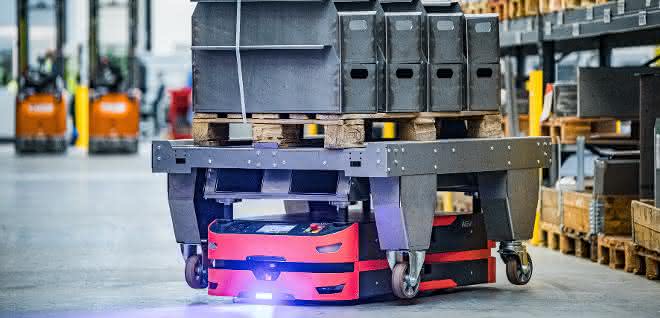
One component of the coping strategy is the automation of internal processes in order to make production progress more effective and faster. The management of Knoll Maschinenbau therefore decided to identify frequently used internal logistics transports and to automate them with the help of automated guided vehicles from Safelog.
"We decided to introduce the automated guided vehicle system in two stages," reports Christian Spohn, Head of Automation at Knoll Maschinenbau GmbH. "The first stage involved implementing the system in the areas of sheet metal, chain and strip production as well as assembly and connecting the small parts warehouse and dispatch to these production areas." In a second step, further production areas will be developed with AGVs. Two AGV L1 devices and one AGV M3 device from Safelog GmbH were used to implement the first phase of the project.
It's all about transporting sheet metal
In sheet metal production, the AGV M3 is used to manage six stations as part of a fixed-cycle circuit. The Knoll and Safelog project team defined five stopping positions in different production areas as well as the sheet metal warehouse as the start and end point of each round. The mobile transport robot transports a trolley with five storage compartments. These are each permanently assigned to a station. "We have defined a fixed standing time for each station. During this time, the workers can unload the material intended for them and store semi-finished products that have already been processed on the trolley," says Spohn, explaining the process. "Collection and delivery therefore take place in a single, precisely timed process step." Once all stations have been completed, the AGV M3 takes the trolley to the unloading station at the sheet metal warehouse. The time spent at the warehouse is used to recharge the batteries. If there are delays in the planned process, the waiting time at the warehouse can also be shortened in order to start the next interval on time. "The cycle times at the individual stopping positions are monitored using the SAP control software from our partner FLEXUS AG," explains Maximilian Kalk, Project Manager at Safelog GmbH. "As soon as the system detects a delay, the AGV alerts the worker with acoustic signals." In this way, a binding process sequence was established and the time specifications for the duration of a round trip were adhered to.
Heavy haulage on call
While strict cycle times had to be adhered to in sheet metal production, the two AGV L1s were to be available on call to take over any transportation tasks that arose. At the heart of the project are two stations with charging stations, where the automated guided vehicles wait for orders. The hinged belts and chains weighing up to 1,000 kg are loaded onto application-specific heavy-duty trolleys. Once an order is complete, the worker requests collection via the SAP user interface on his PC. The AGV drives under the trolley and docks at four connection points for transportation using lifting columns as soon as the infrared over-trolley detection signals that the correct position has been reached. Possible destinations include the warehouse, production and the shipping department. "The biggest challenge in this part of the project was the accuracy with which the trolleys had to be positioned at the loading and unloading stations," explains Kalk. "To ensure a secure stand at the loading position, the trolley rollers had to be threaded into a guide rail with millimetre precision."
At the central warehouse, the second transshipment station, the trolleys are loaded with components for system assembly in eight buffer spaces. Once a delivery is complete, the warehouse worker generates a transport order in SAP by scanning the QR code of the storage location and specifying the destination. "Each destination is assigned a fixed ID, which must be entered by the warehouse employee when the order is generated," says Spohn, explaining the system. "The fitters arrange for a fully unloaded trolley to be collected in the same way."
Virtual lane guidance enables flexible route planning
The length of the route network used by the AGVs at Knoll Maschinenbau is more than 2.5 kilometers. Route guidance is largely based on contour navigation, as there is little change in the prominent landmarks required for navigation during operation. Only in some places with strongly varying contours, such as in the dispatch warehouse, is the virtual track guidance secured by triangular reflectors. These are attached to the hall floor with magnets so that they can be easily dismantled and reassembled for large internal transports. The AGVs also use RFID tags to locate themselves in the warehouse.
"Thanks to the contour navigation, all transports with the AGV L1 devices can be carried out in a route- and time-optimized manner," reports Spohn. "If the shortest route is not possible, the control software reports this to the AGV and it automatically selects a different route to reach its destination as efficiently as possible." The automated guided vehicles have a total of 2,500 route variants at their disposal. "As some driving maneuvers require a high degree of accuracy, we have opted for hybrid navigation consisting of a magnetic track and a virtual track," says Kalk, explaining a special feature. "This has major advantages, as the interaction between the two systems improves process reliability immensely."
Control via SAP transport control system
An intelligent transport control system (TLS) was used to distribute tasks and control the AGVs in order to combine transport orders and avoid empty runs. The SAP experts at FLEXUS AG integrated not only the mobile transport robots, but also all other industrial trucks and tugger trains into the system. The transport orders created by the workers are distributed to all available suitable vehicles via a transport order pool. The assignment is based on the current position of the resource and flexibly definable parameters such as weight, loading area or pallet type of the transported goods. "The FLEXUS transport control system tracks all road users involved and records status reports from our AGVs, such as battery charge status or the status of a transport order," reports Kalk. Using the collected data, device-specific status or error messages can be sent or visualized by the software.
"The AGV project with Safelog is a complete success," confirms Spohn. "Encouraged by the positive experiences from the first automation phase, we have decided to manage further production areas with the help of automated guided vehicles. We also see Safelog's AGV as the perfect addition to our product portfolio in the field of automation technology. This allows us to offer solution concepts from a single source and at eye level from user to user."


You might also be interested in
Lifting oven grates
Bharat Forge CDP is a supplier of forged chassis and engine components as well as non-automotive systems. Since 2020, the company has been working with Kito-ER2 electric chain hoists to lift furnace grates in the production hall.
 read more...
Mobile and intelligent handling solutions
Scaglia Indeva has been developing and producing industrial manipulators and handling solutions for more than half a century. The company will be presenting its latest products for logistics at LogiMat.
read more...Mink at the Hannover Messe 2023
Transportation on brushes
Technical brushes from Mink are suitable for the gentle transportation of sensitive workpieces. According to the manufacturer, the adaptability of the brushes to different surfaces ensures part quality and avoids rejects.
read more...Partial automation in wood processing
Rescue from the staff shortage
The Schnurr company in Nordrach in the Black Forest has been processing wood for almost 170 years. Today, the company is a sought-after partner when it comes to individual wooden packaging or sawn and planed wood.
read more...Products for better ergonomics
At Intec, Scaglia Indeva will be presenting innovative ergonomic products for intralogistics. The focus is on products for better ergonomics, smoother work processes and protection of employees against overload.
read more...New pallet roller for the warehouse
Conveyor technology specialist Rulmeca is expanding its range of conveyor rollers for pallets and other heavy goods with the XPS series.
read more...Individual energy management
When a Festoon cable carrier system for a crane system with a travel distance of 30 meters was to be replaced, Tsubaki Kabelschlepp designed a complete package consisting of chain and cables, guide channel including substructure and an individual...
read more...Plan and manage maintenance
The health and safety regulations and statutory inspection guidelines for operating equipment in companies are strict and extensive. As a result, it is not easy to keep track of all inspection regulations and periods in day-to-day operations.
read more...Fully automated conveyor system for battery systems
With a fully automated and flexibly expandable conveyor system for truck loading, a manufacturer of battery systems in the electric automotive industry is meeting the increasing demand.
read more...