
Transport vehicles
AGV for machine interlinking
dpm Daum + Partner Maschinenbau has developed an automated guided vehicle for Liebherr Verzahntechnik that enables continuous machine interlinking in automated metalworking.
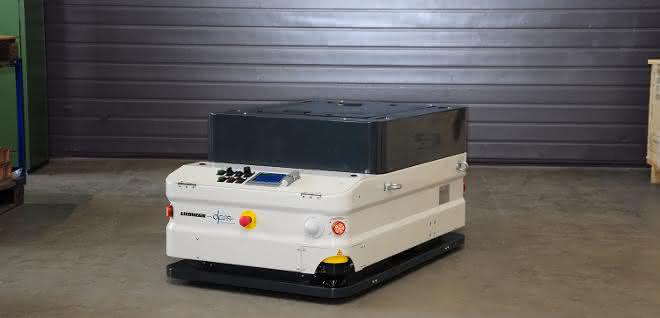
How can a complete interlinking be achieved in automated metalworking, which also includes the loading and unloading stations? Liebherr Verzahntechnik's "Automation Systems" division provides the answer to this question: with a customized automated guided vehicle system (AGV). Such a system has been developed by dpm.
A lithium battery, which is charged fully automatically via ground contacts, provides the energy supply for the automated guided vehicle (AGV). A camera is used for lane guidance and a Siemens PLC is used for control. The vehicles can send error messages and commands to a control system via WLAN. Stopping points are determined using DMC markers, transponders or virtual tags.
The AGV is line-mobile. This means that it can drive straight ahead and backwards as well as turn around its central axis, for example to enter confined access areas of production systems. Two diagonally installed personal protection scanners detect possible obstacles around the vehicle, which can emit warning signals via flashing lights or a signal tone during operation.
The new AGV for integrated and fully automated production is available in two versions: with and without an eccentric lifting device of 100 millimetres. The compact dimensions of 1,060 x 840 x 500 millimetres create the conditions for a wide range of applications. The drive power is 800 watts and the maximum payload is 700 kilograms. The AGV travels at a speed of up to 90 meters per minute with a positioning accuracy of plus/minus five millimeters.
The AGV is combined here with the "bin picking" system developed by Liebherr, in which a robot reaches into a transport box. This means that the parts to be processed can be provided in a bin (on the AGV) without being sorted. The robot, which is controlled by 3D vision systems, picks the parts according to the production cycle and feeds them to the first station. Removal from the production system and storage on the AGV - for example in baskets or blisters - for onward transportation to other production areas is also carried out according to this principle.
From Liebherr Automationssysteme's point of view, the use of AGVs creates the conditions for the design of innovative production systems that can be flexibly adapted to new requirements in terms of production capacity and sequence. According to Liebherr, this opens up new possibilities for networking machines and systems. as


You might also be interested in
ebm-papst is growing again thanks to AI and data centers
ebm-papst returned to a growth trajectory in fiscal year 2025/26. Air Technology, data center applications, and artificial intelligence are driving revenue and investment.
 read more...
SPE on the Verge of a Market Breakthrough
Single Pair Ethernet (SPE) has moved beyond the conceptual phase and is increasingly being implemented in industrial settings. The focus here is not only on higher data rates and simplified cabling, but above all on the issue of system integration...
read more...More than 900 exhibitors already registered
Around six months before the start of the trade fair, more than 900 companies have registered for SPS 2026 in Nuremberg. The trade fair focuses on industrial AI, cyber security and digital transformation.
read more...Virtual PLCs in practice: How vPLCs make production systems more flexible and scalable
The increasing networking of IT and OT is fundamentally changing industrial automation. The IT/OT Integration Summit shows how modern technologies can make production environments more efficient, flexible and future-proof. The event will focus on...
read more...Sales growth in a turbulent market environment
Thanks to innovations and a focus on strategic industrial markets, Sick was able to moderately increase its sales in the 2025 financial year. In a turbulent market environment, the company was able to maintain its position and gain market share with...
read more...Siemens presents new AI agent
Siemens is launching 'Eigen Engineering Agent', an AI for automation technology. The solution is integrated into the TIA Portal, has been tested with over 100 companies and is designed to significantly accelerate engineering processes.
read more...Schaeffler keeps sales almost stable
Schaeffler generated revenue of EUR 23.5 billion in 2025 and increased EBIT before special items to EUR 936 million. At 266 million euros, free cash flow was significantly above the prior year and forecast. Net income remained negative due to high...
read more...Advancing artificial intelligence together
Helukabel is stepping up its activities in the field of artificial intelligence and is now a member of the IPAI. The innovation and collaboration platform for companies, research facilities, institutions and administration has set itself the goal of...
read more...New impetus for ifm sales
Two new positions were filled at ifm at the start of 2026: Markus Wolf becomes Managing Director Sales Germany, Sven Quant takes over the position of Central Managing Director in the Process Sensors division within the ifm Group.
read more...