
Transport robots at Bierbaum
A new robot for the bed linen fleet
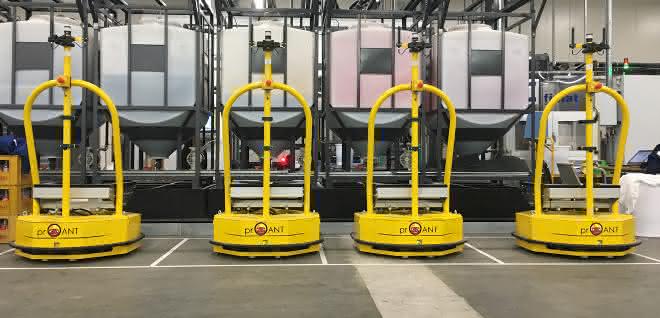
Bed linen manufacturer Bierbaum is expanding its robot fleet at its Borken site to include five transport robots from Insystems' Proant 490 platform. The new Proant can be flexibly integrated into the existing process automation.
The German textile company Bierbaum, headquartered in Borken, employs 750 people and generated an annual turnover of 112.5 million euros in 2016. Bierbaum's two main areas of production are technical nonwovens and, above all, bed linen. The latter is sold under brands such as Bierbaum Wohnen, Irisette, Strenesse and numerous private labels.
In order to make production more efficient and relieve its own employees of non-value-adding activities, Bierbaum has been using four autonomously navigating transport robots for a year now to transport open paint drums, which were previously moved by many employees using a hand truck. The company has now purchased another transport robot from the Proant 490 platform from Insystem Automation. The transport robot can be easily integrated into the existing fleet. The new vehicle is registered with the fleet manager and immediately taken into account in order management. This technology also allows the fleet to be scaled as required at a later date.
Flexible integration into process automation
Jan-Frederic Bierbaum, Managing Director of the group of companies: "Due to the growing demand for our products, our internal transport orders have also increased. By expanding the transport robot fleet, we can respond to this development in a sensible way and also create a backup solution should one of the vehicles need maintenance or repairs." He adds: "New automation technologies and a seamless wireless communication infrastructure can make a decisive contribution to producing where the demand is in future."
At Bierbaum, the transport robots move independently between the ink kitchen and the four printing presses at an average speed of one meter per second through the hall and search for the optimal route to their destination. Open plastic buckets with different dimensions and weights of up to kilograms are transported.
The vehicles are designed to be safe for people thanks to a built-in Sick safety laser scanner, which constantly scans its surroundings in the direction of travel and uses speed-dependent warning and protective fields to slow down or swerve the vehicle when obstacles are encountered. The vehicles communicate with each other and with the fleet management and order management system via a protected WLAN network. Thanks to modern, high-current, cycle-resistant battery technology (LiFeYPO4 cells), the transport robots can also be charged quickly. as


You might also be interested in
Predictive maintenance in retrofit
Predictive maintenance pays off. This is because early detection of impending failures means that systems can be serviced in a targeted manner before production downtime occurs. But how complex is it to integrate such a maintenance concept into an...
 read more...
Maintenance instead of replacement
The circular economy starts with the machinery
Sustainability in industry starts with machines, says our guest author from Deguma: How maintenance, modernization and the 5R strategy save resources, energy and CO₂.
read more...3D printing for unplanned requirements
The material fails and the machine suddenly stops? Then you need to take the right measures to be able to resume production quickly. Material failure in the form of faulty components or material wear in the frame are a risk for any production.
read more...High demands in terms of safety, application and robustness
Demanding work in the electrical trade and energy supply as well as smooth processes in production require innovative and customized measurement technology that scores points for safety, ease of use and resilience.
read more...Car meets e-bike: riding with lubrication-free polymer bearings
Studies show that the proportion of pedestrian and bicycle traffic is increasing in urban areas. With the JetBike, JetBike GmbH from Braunschweig presents a mixture of e-bike and car and relies on lubrication-free polymer bearings from Igus.
read more...Hydraulic hub for more efficient servicing
Bosch Rexroth presents a digital toolbox for service and maintenance. With a comprehensive range of digital services, the Hydraulic Hub simplifies and accelerates the service and maintenance of hydraulic products and increases machine availability.
read more...Arnold Umformtechnik expands after-sales...
Faster help with VR glasses
Arnold Umformtechnik is expanding the after-sales service for its machines to include digital remote services. The focus is on data security, simple operation and clear processes.
read more...147,000 euros per hour: high costs for German companies due to unplanned downtime
According to the "Value of Reliability" study, 67% of industrial companies in Germany experience unplanned downtime at least once a month. This costs the German economy 147,000 euros per hour. Nevertheless, reactive maintenance concepts are not...
read more...Maintenance starts with a maintenance planner
Legal requirements stipulate that machines and systems must be serviced regularly. The maintenance work serves to ensure occupational safety and economic efficiency.
read more...