
Maintenance
The future of inspecting technical systems
The inspection of technical systems is an important maintenance task. It ensures the operational suitability and functionality of the system. In this way, unplanned downtime and even accidents can be avoided, resulting in monetary losses and, above all, damage to life and limb.
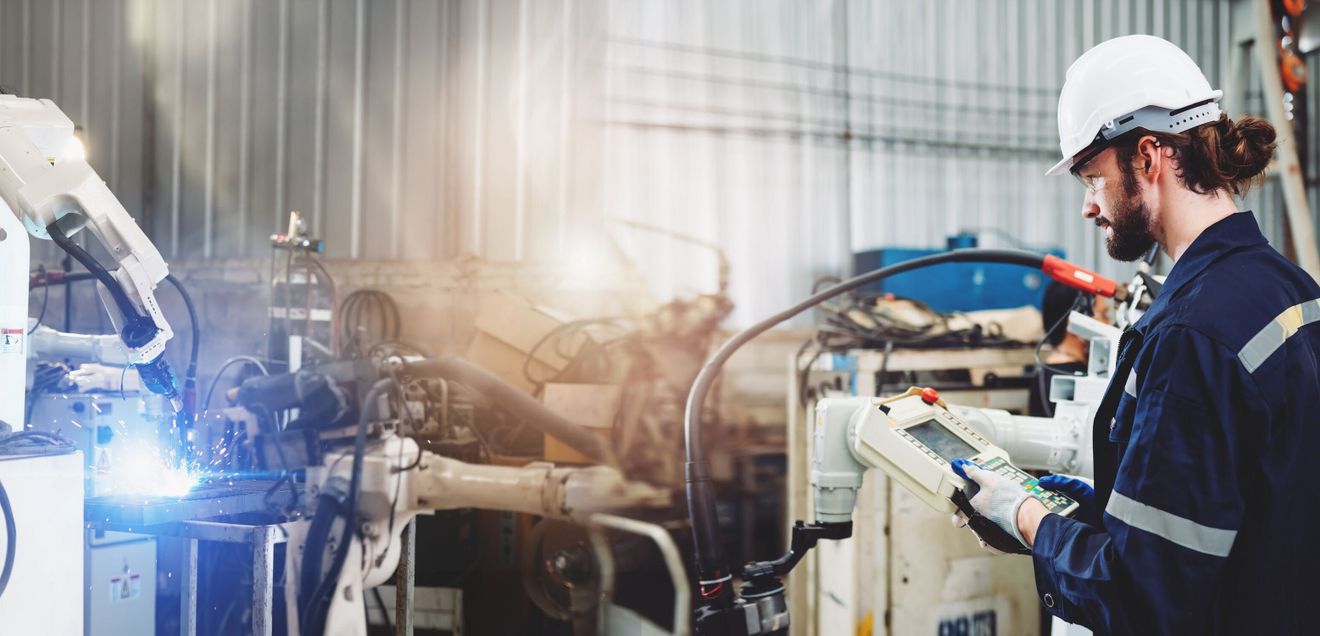
In order to derive maximum benefit from the inspection, it is important to provide specialists with the best possible support and thus deploy them efficiently. Through consistent digitalization, it is also possible to relieve them and have parts of the tasks carried out automatically or even by artificial intelligence. The result is a digitized, guided inspection.
What does inspection mean today?
During an inspection, the current condition of a technical system is determined, documented and assessed. However, an efficient cost-benefit ratio can only be achieved if the "how" is planned and defined from the outset. When planning an inspection, it must therefore first be clarified what benefits are to be achieved and what expenses are to be expected. As a rule, an inspection is intended to achieve operational approval for the system and ensure its functionality for a future period. On the one hand, it must be checked whether the components of the system are fundamentally suitable to fulfill their intended purpose. For example, installed components are identified by their part number. Then it is checked whether the actual use of the components corresponds to their specification, and also whether the previous load on a component was already so heavy that it can no longer safely fulfill its purpose and must be replaced. It is important not to forget digital components. Software can also be incorrectly designed or outdated; processors and microchips are subject to similar aging processes as analog components.
The benefits of a secure system are offset by various costs: Firstly, the specialist who carries out the inspection must be paid. Costs are incurred for the procurement and installation of spare parts and upgraded components. Last but not least, the system is usually not available for normal operation for the duration of the inspection. The realization that "duration" and "correct execution" are the two main cost drivers for the inspection is trivial: If the specialist needs longer for the inspection, it costs more money and the loss of production increases. If the inspection is not carried out correctly, it will not be approved for operation, the inspection will have to be repeated and additional costs and production losses will be incurred.
It is therefore all the more surprising that in industrial practice, little use is still made of the possibilities for supporting and optimizing inspections. When an inspection is due, the specialist receives a corresponding order, a clipboard, a pen and a printed checklist to work through. Based on the known information, the specialist assembles tools and spare parts and gets to work. To the best of their knowledge and belief, they go through the items on the checklist, note values, replace parts, check software versions and finally reassemble everything. Finally, she hands over the checklist and reports that the job has been completed. Upstream and downstream processes are often supported digitally: ERP systems digitally map schedules to remind employees of upcoming inspections and assign them digitally to a specialist. The fact that the inspection was carried out and by whom, as well as a digitized version of the checklist, are also stored in the ERP system.
More is possible - the future of inspection
The following five steps can be taken to better support specialists during inspections and make greater use of the opportunities offered by digitalization:
1. support through algorithms
Algorithms are basically simple step-by-step instructions for processing tasks. In contrast to checklists, the user is taken by the hand and guided through the task instead of simply acknowledging it. At first glance, it may seem time-consuming to create these instructions, but the benefits far outweigh the effort involved. The tasks can be completed more quickly and, above all, with repeatable quality. Supplementary checklists for required tools, spare parts and comparative values for measurements and part numbers can be stored. If these algorithms are generated with software support, a generic basic algorithm can be created and derivatives with varying degrees of detail can be derived from it. For example, a very detailed derivative can be generated to support trainees and a less detailed one for specialists with many years of experience.
2. digital provision of the algorithms
The logical second step is to make these algorithms available on digital end devices. The user can then navigate from step to step or algorithm to algorithm on their smartphone. Once again, it is worth creating the algorithms in a structured and software-supported manner. This means they are machine-readable and can be exported as a content package and imported into a structure app. The algorithms are always available on the smartphone and do not need to be printed out. The results and metadata are also directly available in digital form. A direct feedback channel is also created: If an algorithm is ambiguous or incorrect, the user can report this via the structure app.
3. integration into ERP systems
This step should be carried out in parallel with step 2. If a specialist is then assigned an inspection job, they can switch from the job to the corresponding algorithm and work can begin. Once the inspection is complete, the results and metadata can be stored in the ERP system and saved permanently. The larger the treasure trove of data collected in this way, the more evaluations can be carried out. This allows additional optimization potential to be exploited.
4. transfer of tasks to AI
If the data pool is large enough, individual inspection tasks can be automated or even processed using methods from the field of artificial intelligence. It is conceivable, for example, to partially automate the installation inspection: Instead of checking the specification of a component themselves, the specialist takes a photo of the part number. The suitability of the component is automatically checked using image recognition and catalog matching. Furthermore, results and metadata could be evaluated, for example, to predict which spare parts are frequently replaced during a particular inspection. On this basis, the checklist for spare parts to be taken along for inspection can be improved. The possibilities here are varied and depend on the individual case. However, it should always be borne in mind that automation and artificial intelligence are generally themselves technical systems that should themselves be subject to regular inspection.
5. use of augmented and virtual reality
Strictly speaking, this last step is a special type of step 2, as devices for using augmented and virtual reality are essentially digital end devices. If inspection algorithms are displayed to the specialist as augmented reality using data glasses, they can navigate through the steps and algorithms using voice or gesture control. The advantage of this type of control is that the end device itself does not need to be touched. This type of control is also possible when wearing gloves. Further support for the specialist is provided when locations on the system that play an important role in the respective inspection step are highlighted. For example, the smart glasses can highlight in color a cover that needs to be removed.
Finally, the possibility of setting up a virtual reality environment to test the inspection algorithms should be mentioned here. Such an environment can also be designed in such a way that trainees can train virtually. As this requires a virtual model of the actual system, the effort involved is correspondingly high. However, companies that already have virtual models of their systems produced for presentation and demonstration purposes should not ignore this next step.
The inspection of technical systems is too important to only support upstream and downstream processes. If the specialist carrying out the inspection is supported individually, this can save a lot of money and even save lives. Advancing digitalization is creating more and more opportunities here. They just need to be used.
Johannes Diedrich, Head of Industrial Projects at Synostik


You might also be interested in
Predictive maintenance in retrofit
Predictive maintenance pays off. This is because early detection of impending failures means that systems can be serviced in a targeted manner before production downtime occurs. But how complex is it to integrate such a maintenance concept into an...
 read more...
Maintenance instead of replacement
The circular economy starts with the machinery
Sustainability in industry starts with machines, says our guest author from Deguma: How maintenance, modernization and the 5R strategy save resources, energy and CO₂.
read more...3D printing for unplanned requirements
The material fails and the machine suddenly stops? Then you need to take the right measures to be able to resume production quickly. Material failure in the form of faulty components or material wear in the frame are a risk for any production.
read more...High demands in terms of safety, application and robustness
Demanding work in the electrical trade and energy supply as well as smooth processes in production require innovative and customized measurement technology that scores points for safety, ease of use and resilience.
read more...Car meets e-bike: riding with lubrication-free polymer bearings
Studies show that the proportion of pedestrian and bicycle traffic is increasing in urban areas. With the JetBike, JetBike GmbH from Braunschweig presents a mixture of e-bike and car and relies on lubrication-free polymer bearings from Igus.
read more...Hydraulic hub for more efficient servicing
Bosch Rexroth presents a digital toolbox for service and maintenance. With a comprehensive range of digital services, the Hydraulic Hub simplifies and accelerates the service and maintenance of hydraulic products and increases machine availability.
read more...Arnold Umformtechnik expands after-sales...
Faster help with VR glasses
Arnold Umformtechnik is expanding the after-sales service for its machines to include digital remote services. The focus is on data security, simple operation and clear processes.
read more...147,000 euros per hour: high costs for German companies due to unplanned downtime
According to the "Value of Reliability" study, 67% of industrial companies in Germany experience unplanned downtime at least once a month. This costs the German economy 147,000 euros per hour. Nevertheless, reactive maintenance concepts are not...
read more...Maintenance starts with a maintenance planner
Legal requirements stipulate that machines and systems must be serviced regularly. The maintenance work serves to ensure occupational safety and economic efficiency.
read more...