
Industrial design
Support service technicians through product design
Complex technology, time pressure and round-the-clock operations: service technicians in industrial plants do not have an easy job. This makes it all the more important that the components used can be handled and operated as easily as possible. Providers who only focus on the technical data of the products are of little help here. Instead, professional design management is needed to ensure that maintenance staff can concentrate optimally on their work. By Markus Weinländer

A user-friendly design of devices such as controllers or network components requires a cross-functional team with experience in design, use and production and requires a step-by-step development process. At Siemens, a detailed briefing forms the basis: What does the customer's application look like? What are the most important features of the new device? The design team then develops the initial design proposals, which can be assessed using digital models or prototypes from the 3D printer - including with customers and users, whose feedback is particularly important.
Special design for special requirements

One example of a particularly service-friendly device is the Scalance XP200 switch family. Suitable for industrial use and designed with a high IP65 protection rating, these switches can also be installed outside a control cabinet, for example on conveyor lines. As space is at a premium here and the switch must not protrude too far into the room, a housing concept was developed that is only a few centimetres deep. Angled connectors are used to ensure that the cabling is as flat as possible. However, the connections were offset in two rows to simplify the installation of the cables (Fig. 1). Another aid for quick diagnosis is the offset control panel: this means that the LED displays can be read easily even when fully "wired". The arrangement in three visual levels (Fig. 2) in turn helps to quickly assign the information and provides visual clarity, making installation and operation easy to learn.
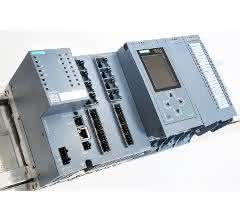
However, service specialists must be able to handle a wide range of devices. For Siemens, the consistency of the design is therefore of great importance, but without ignoring specific requirements. As similar as possible, as different as necessary is the motto. To implement this, so-called "stage sets" are created at the start of development, which show the new product in the environment of proven components (Figure 3). Here, the Scalance XM400 switches are closely based on the design of the Simatic S7-1500 controller family, from the labeling of the operating elements to the design of the top-hat rail mounting - after all, the same tool should be able to be used. One major difference, however, is the arrangement of the Ethernet sockets. While these are elegantly concealed under the display on the S7-1500 CPU, they have been designed without a cover on the Scalance XM400. The reason: while the mains plug on the CPU is usually only disconnected when a device is replaced, maintenance workers often have to connect new devices to the switch or connect to their laptop for diagnostic purposes - a cover would be very disruptive here, even if the design were more uniform and the control cabinet tidier. But practicality comes first!
Software in focus

However, the operation of devices today has shifted strongly to the software, through which almost all functions are accessible. Device design must therefore also take this user interface into account in order to make operation easy to learn and yet productive. The principles of visual structure, simplification and the avoidance of decorative elements, orientation towards specific work processes and consistency are important guiding principles in the design. Here, for example, attention is paid to consistent labeling and arrangement of the menu items. One successful example is the Simatic RF600 RFID reader, where a team of experts from design, marketing, technical customer support and development analyzed the individual operating steps involved in setting up an RFID reading station in detail and developed an innovative user interface (Fig. 4). The result: with Simatic RF600, users can now put a reading point into operation in just a few minutes.
Design makes for better products
The examples show how modern product design for industrial components not only leads to an attractive design, but also brings tangible benefits for users. The prerequisite is that the design process is interlinked with product management, development and construction at an early stage, as is the case at Siemens. The success of this intensive cooperation is reflected in satisfied customers and also in the annual awards of the Industrie Forum Design (iF) or the Red Dot Awards: Siemens has been regularly represented on the winners' podium with its industrial products for many years.
The author: Markus Weinländer is Head of Product Management Simatec Net at the Siemens Process Industries and Drives Division.


You might also be interested in
Housing and inserts for plenty of power
Lapp presented the expansion of its Epic Power series at SPS 2023: four new M23 circular connector inserts and three new M23 housings. The special feature: all housings can be combined with any of the four inserts.
 read more...
News and product updates from Smartgas
Portable gas analyzers for outdoor use
Smartgas is starting the second half of the year with a series of updates to existing products and a number of new products. Portable analyzers expand the range of applications, while new accessories such as protective housings and heating modules...
read more...Everything accurate in switch cabinet construction
To ensure smooth work processes, tools for processing enclosures and housings must function flawlessly and reliably. Häwa rounds off its punching range with the Multi-Press 500.
read more...Shafts and conversion parts
The Rodriguez range includes ball bushings including matching housings, shaft brackets, crossbars and supports.
read more...Cooling and temperature control units
Hygienic packaging sells safely
In few industries are the requirements for hygiene in the production process as strict as in the food sector - the health of consumers has top priority. This results in enormous challenges for all machines and components involved, especially in...
read more...Simple tool change in seconds
With the CMS, Schunk is launching a user-friendly, manual change system for quick component replacement. In addition to its simple and convenient operation, the CMS also stands out with its extensive range of optional modules and complementary end...
read more...Motion controller for small drives
Medium power range covered
Faulhaber has another housing-less and compact motion controller in its range, which is particularly suitable for integration in device construction and medical technology applications.
read more...Welding solutions in the name of resource efficiency
At the Welding & Cutting trade fair in Essen (September 11-15), Fronius will be focusing on the major drivers in welding technology. Quality requirements are increasing in all industries, but the required welding specialists are scarce. In...
read more...Safe solutions for cable installations
From thick power cables to thin sensor lines, cables and lines must be routed safely through systems and machines. A challenge that should not be underestimated, explains Jörg Sokat, Head of Product Management at Pflitsch.
read more...