

Digital service
Plant engineering of the future
A new, digital service guides technicians through production in a targeted manner and enables efficient and time-saving maintenance.
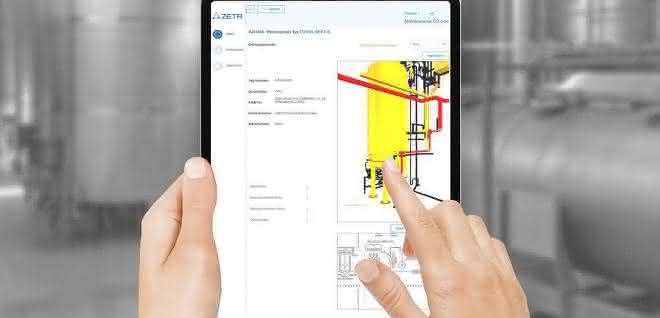
Plant engineering is complex and particularly demanding in the biotech and pharmaceutical sectors, such as vaccine production. This is because production in this area must meet strict standards and always deliver consistently high quality. Production processes must always be strictly monitored, data regularly evaluated and machines maintained. The Zeta Group specializes in the design, construction, automation, digitalization and qualification of customer-specific biopharmaceutical systems for aseptic process solutions. In addition to plant engineering, Zeta also offers the planning of HVAC, cleanroom and building technology.
A weak point for many customers is inefficient maintenance processes due to a lack of system knowledge and incorrect information sources. In order to develop a solution for this, Zeta decided to work with Bitrock Digital Partners on a digital twin that significantly increases the efficiency of the maintenance process. The Munich-based company works with its customers to develop innovative business models that create significant revenue potential and thus pave the way for the future.
Maintenance 4.0 - from tool to business model
The development of pharmaceutical products involves numerous planning steps. The volume of digital planning data increases as the project progresses. With its "Smart Engineering Services", Zeta provides the digital twin of the process plant. The company has many years of experience in managing large-scale pharmaceutical projects and has developed a comprehensive digitalization strategy that generates added value for customers, plant operators and project suppliers. A central component is a digital maintenance tool, the "Smart Maintenance Navigator" (SMN), which enables maintenance processes to be clearly displayed on mobile devices such as tablets, smartphones or wearables.
New technologies, processes and organizational structures allow previously unknown weak points and forms of wear and tear to be identified. These can only be countered with a maintenance system that has features such as networking, decentralization and intelligence from the outset and therefore has a direct influence on the success factors of time, costs and quality of a production system. Initially, the SMN was primarily available for internal use by Zeta employees. However, it quickly became clear that there was also a need for improved maintenance on the customer side.
The SMN makes the maintenance-relevant data of the digital twin available to users in the context of their work tasks. The system ensures an efficient and digitalized maintenance process and supports companies in achieving consistent product quality and minimal downtimes. Zeta drew on the expertise of Bitrock Digital Partners to fine-tune the tool and develop a business model based on it.
The new service guides maintenance technicians through the plant in a clear and targeted manner so that maintenance work can be carried out efficiently. The maintenance environment is identified in the 2D and 3D model, the equipment is highlighted and the work steps are described. Data on spare parts or tools required for assembly activities is read from the digitally stored manuals on the mobile device. In contrast to paper documents or PC-based systems, the Smart Maintenance Navigator can be used flexibly, runs on the mobile device carried and is always up to date with the current status of the system.
In a study conducted by the Fraunhofer Institute for Production Systems and Design Technology IPK and the IT consultancy MSG, 85% of the companies surveyed stated that they had already developed concepts for the digital twin. However, only 54% have an end-to-end strategy for this. This is why Zeta has set itself the goal of developing a business model and product concept for the SMN - together with Bitrock. Martin Mayer, Head of Business Development at Zeta, says: "With Bitrock Digital Partners, we have managed to quickly and efficiently identify new digital revenue channels with significant added value based on our internal assets and expertise."
To develop a digital business model, Bitrock first held internal discussions with Zeta to understand the system life cycle and potential areas of application for the SMN. In addition, the market was analyzed and then customers were segmented. Another important part was customer meetings with various contacts to determine the needs of different product versions and business models.
Identify new digital sales channels
Various key statements were derived from these discussions and the market analysis. The central finding: the market and demand for a digital maintenance tool on the part of Zeta customers is there. The prerequisite for the success of a digital maintenance tool is the combination of a user-oriented software solution with maintenance-relevant data. Every production plant is different and therefore has its own specific requirements. Based on the different customer needs and requirements of the plants, three different product versions with different price models were developed. During the interviews, it also became clear that one of the biggest challenges for customers appears to be technical ERP integration. In addition to different product versions, Bitrock also created a business case for the next 5 years.
The project was successfully completed after four months. The next steps are to bring the various product versions to market maturity and towards full integration. This requires a pilot phase to specify the respective requirements, including adaptation of the SMN, the development of the market entry strategy and further development of the operating model as well as the definition of user contracts. The Smart Maintenance Navigator is a use of the digital twin that greatly simplifies maintenance in plant engineering and thus offers great added value for the industry.


You might also be interested in
Predictive maintenance in retrofit
Predictive maintenance pays off. This is because early detection of impending failures means that systems can be serviced in a targeted manner before production downtime occurs. But how complex is it to integrate such a maintenance concept into an...
 read more...
Maintenance instead of replacement
The circular economy starts with the machinery
Sustainability in industry starts with machines, says our guest author from Deguma: How maintenance, modernization and the 5R strategy save resources, energy and CO₂.
read more...3D printing for unplanned requirements
The material fails and the machine suddenly stops? Then you need to take the right measures to be able to resume production quickly. Material failure in the form of faulty components or material wear in the frame are a risk for any production.
read more...High demands in terms of safety, application and robustness
Demanding work in the electrical trade and energy supply as well as smooth processes in production require innovative and customized measurement technology that scores points for safety, ease of use and resilience.
read more...Car meets e-bike: riding with lubrication-free polymer bearings
Studies show that the proportion of pedestrian and bicycle traffic is increasing in urban areas. With the JetBike, JetBike GmbH from Braunschweig presents a mixture of e-bike and car and relies on lubrication-free polymer bearings from Igus.
read more...Hydraulic hub for more efficient servicing
Bosch Rexroth presents a digital toolbox for service and maintenance. With a comprehensive range of digital services, the Hydraulic Hub simplifies and accelerates the service and maintenance of hydraulic products and increases machine availability.
read more...Arnold Umformtechnik expands after-sales...
Faster help with VR glasses
Arnold Umformtechnik is expanding the after-sales service for its machines to include digital remote services. The focus is on data security, simple operation and clear processes.
read more...147,000 euros per hour: high costs for German companies due to unplanned downtime
According to the "Value of Reliability" study, 67% of industrial companies in Germany experience unplanned downtime at least once a month. This costs the German economy 147,000 euros per hour. Nevertheless, reactive maintenance concepts are not...
read more...Maintenance starts with a maintenance planner
Legal requirements stipulate that machines and systems must be serviced regularly. The maintenance work serves to ensure occupational safety and economic efficiency.
read more...