

Occupational safety
Plan and manage maintenance
The health and safety regulations and statutory inspection guidelines for operating equipment in companies are strict and extensive. As a result, it is not easy to keep track of all inspection regulations and periods in day-to-day operations. Software tools that enable efficient management of all items subject to inspection can help.
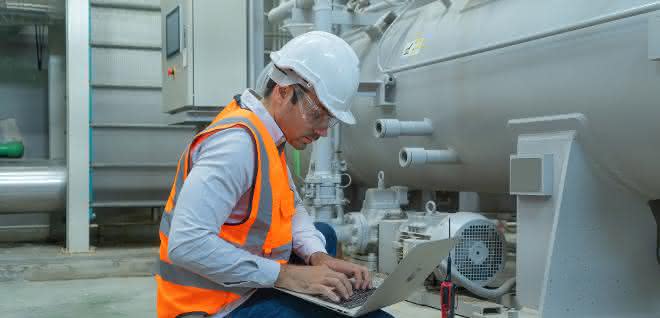
Companies face numerous challenges when it comes to maintaining their equipment, but if they miss inspection deadlines, fines can be imposed. If an accident occurs, in the worst case no insurance company will be liable. Only if all equipment is fully inspected at the correct intervals is the company on the safe side legally. In the event of damage, he must therefore be able to prove that the work equipment is in perfect condition by means of test reports. Legally compliant documentation, for which specific regulations apply, is therefore a further challenge in maintenance management.
Digital tools provide a solution to this problem: With the right software, inspections of all operating equipment can be planned, carried out and documented in a structured manner. This ensures that legal requirements are met and guarantees that equipment is functional or can be repaired or replaced quickly. Regular maintenance also reduces downtime and lowers maintenance costs.
What all needs to be checked?
The occupational health and safety regulations cover almost all equipment. This includes not only machines and tools, but also pressure vessels, emergency vehicles, doors and windows as well as ladders and steps.
Ladders, shelving, electrical appliances: The inspection of ladders is regulated by the German Ordinance on Industrial Safety and Health (BetrSichV), while the inspection of shelving is governed by BGR 234 and DIN EN 15635. The accident prevention regulation of the employers' liability insurance associations (DGUV Regulation 3) requires electrical systems and appliances to be inspected at regular intervals. The regulations of the Association for Electrical, Electronic & Information Technologies (VDE) also apply - they apply to all appliances with plugs, from coffee machines to printers, from cable drums to drills.
Doors, gates and windows also need to be maintained - in an emergency, a defective fire door can endanger lives. With the maintenance planner, the inspection of the large number of locking devices can be carried out quickly, reliably and with a high degree of automation. The test protocol is comprehensive: The standards DIN EN 12453 "Doors - Safety in use of power operated doors - Requirements" and DIN EN 16005 "Power operated doors - Safety in use - Requirements and test methods" specify exactly what is to be measured. All components must interact faultlessly. Among other things, the mechanics and stability of the components and fastenings, the ease of movement of moving parts or, if present, the drive and control as well as safety devices are tested. As doors and gates are exposed to the weather, the protocol also includes checking for wear, corrosion or other damage. Springs, chains, shafts and cables are also checked for tension, lubrication and cleanliness.
Forklift trucks: Six regulations of the German Social Accident Insurance (DGUV) specify tests for forklift trucks. The safe provision and use of forklift trucks and industrial trucks must be checked once a year; the hydraulic hose lines must be checked at least once a year. Integrated chargers must be checked every four years and the pressure of liquid gas tanks every ten years. According to the Technical Rules for Hazardous Substances (TRGS), diesel forklifts must have their exhaust emissions measured once a year or every 1,500 operating hours. Forklifts with an official license plate must undergo a general inspection every two years in accordance with the Road Traffic Licensing Regulations. A European Parliament directive also stipulates a whole-body vibration measurement for forklift trucks with ride-on capability.
The German Ordinance on Industrial Safety and Health (BetrSichV) prescribes periodic inspections and their documentation - type of inspection, scope and results - for machines and systems. Inspections are mandatory if work equipment is exposed to influences that cause damage and thus lead to hazards for employees.
Testing electrical machines in accordance with DIN VDE 0113-1 (EN 60204-1) requires a qualified electrician who is authorized in accordance with the Technical Rules for Operational Safety (TRBS 1203), a component of DGUV Regulation 3. For example, production systems, printing machines, CNC milling machines or robot systems are tested. Such a machine inspection consists of many individual steps and is defined by the product standard of the machine. If this is missing, DIN VDE 0113-1 prescribes the following steps, among others: Checking the conformity of the system and its technical documentation, checking the automatic switch-off and the voltage and function test.
One software that supports maintenance management in all industries and companies is the maintenance planner from Hoppe Management Consultants. All test objects are recorded with the relevant data. With just a few clicks, maintenance deadlines and regulations can be checked and documents can be created, archived and maintained. Key maintenance figures are displayed graphically and can be imported and exported in various formats. Last but not least, the reminder function in the integrated calendar ensures that no inspection date is missed.


You might also be interested in
Helu makes its first trade fair appearance under a new brand name
Helu Kabel will be presenting itself as Helu for the first time at Hannover Messe 2026, showcasing system solutions, Heluchain cables and new industrial luminaires.
 read more...
Strategic realignment with brand relaunch
In future, Helukabel will trade as Helu
The Helukabel Group is parting with part of its name: in future, the company will only operate under the Helu brand. With this step, the specialist for electrical connection technology is underlining its strategic development from a classic cable...
read more...Modular plant construction for corrugated board
Insight into the production of corrugators at BHS Corrugated: Automated, modular and equipped with Helukabel components.
read more...Best quality for the steel
Conditions in the steel industry are harsh and inhospitable. The machines used must be able to withstand the demanding environmental conditions in order to deliver the best quality at all times.
read more...If the standard cable is not sufficient
Lapp offers cables for countless applications - but not for all of them. From time to time, the developers have to modify a standard cable or develop a special cable.
read more...Slight decline in sales, strong investments
The Lapp Group has not been spared from the weakening global economy. However, the company only recorded a slight loss in the past 2024 financial year.
read more...Electrical connection technology
Cables and wires for industrial automation
Heukabel offers system solutions for cable routing from a single source. The subsidiary EKD Systems specializes in tailor-made cable drag chains made of steel, stainless steel and plastic, which are used in moving machines and systems as well as in...
read more...Lapp relies on Ultramid from BASF
Mobile charging of electric vehicles
The automotive industry is currently undergoing the biggest transformation in its history. The boom in battery electric vehicles in particular is presenting the industry with major challenges. Lapp, as a supplier of cables and connection...
read more...Cable handling application
At this year's Motek, ArtiMinds Robotics is showcasing a robot-based automation solution for the sensor-assisted assembly of flexible cables in connector housings.
read more...